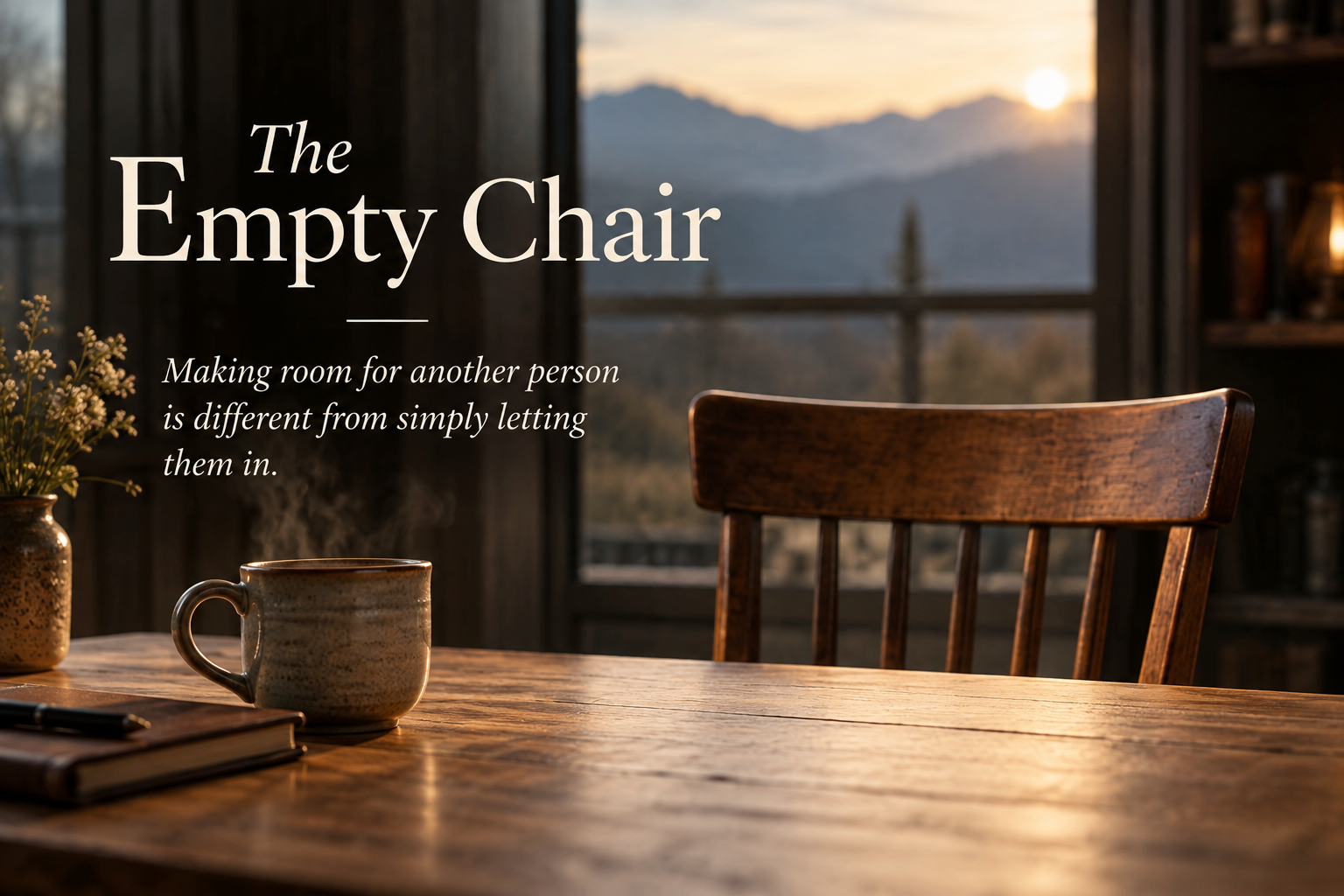

Making room for another person is different from simply letting them in.
There is an empty chair across from me. Nothing particularly remarkable about it. It is wooden, built for the simple business of holding a person, and at the moment it is doing nothing at all. The tea beside me is still warm, although I have reached the age when I seem to spend a good portion of every morning reheating cups I was certain I had only just poured. Beyond the window, the mountains are doing what mountains do best, which is remaining entirely unimpressed by whatever I happen to think is important today. The dog has found a place nearby and settled into the serious work of sleeping. And there is this chair. I have spent much of my life around chairs, though I don’t suppose I thought much about them when I was younger. There are thirteen of them around the table at the séance, each occupied for a little while by someone who has come looking for something they may not be able to name. There have been folding chairs backstage, uncomfortable chairs in dressing rooms, hotel chairs designed by people who apparently never intended anyone to sit in them, chairs pulled together in theatre bars after midnight, chairs in kitchens belonging to people I barely knew when I arrived and knew considerably better when I left. I remember remarkably few of the chairs themselves. I remember the people. A hand resting on the edge of the table. Someone leaning forward before telling me something they had clearly not planned to say. Someone laughing hard enough to put their head down. Someone sitting quietly after everyone else had gone. It is strange how an ordinary piece of furniture can become inhabited by memory. A chair can remain empty for years and still somehow belong to someone.
After the last séance at the Stanley, there is a particular kind of quiet in the room. The audience leaves, the door closes, and the theatre seems to exhale. For a while the room still carries evidence that people were there. A chair is slightly crooked. Something has been left on the table. The smell of extinguished candles hangs in the air. Thirteen people have just spent an hour together in a room built around uncertainty, story, suggestion, memory, and the possibility that the world might contain a little more than we can account for. Then they disappear back into the hotel and I am left with thirteen empty chairs. I sometimes straighten them almost without thinking. It is part of putting the room back together. But every so often I notice one before I move it, pulled a few inches farther from the table than the others, and I find myself thinking about the person who occupied it. Not because anything extraordinary happened. Usually nothing extraordinary happened at all. They simply sat there for a while. They listened. They watched. Perhaps we exchanged a few words afterward. Then they went on with their life and I went on with mine. Performance is full of these brief encounters, people passing through one another’s lives with surprising intimacy and almost no duration. For an hour I may know the sound of someone’s laugh, the way they respond when frightened, whether they reach for the person beside them in the dark. Then the lights come up and they become strangers again. I used to think the work was mostly about what happened while the chairs were occupied. I am less certain of that now. Sometimes I think the empty chair afterward is part of the work too, because it reminds me that everyone who enters a room brings an entire life with them, and I have been allowed to see only the smallest corner of it.
I have always been comfortable inviting people in. It is part of what I do. A performer spends a lifetime saying, in one form or another, come closer. Sit down. Listen to this. Let me show you something. Storytellers become particularly practiced at it because stories are invitations by their nature. Once upon a time is simply an old-fashioned way of pulling out a chair. But somewhere along the way I began to understand that inviting someone into a room and making room for them are not remotely the same thing. I can ask you to sit across from me and still make the entire encounter about myself. I can ask you a question while quietly preparing my answer to it. I can listen to your story only long enough to discover which of my stories it reminds me of, then take the conversation back as soon as you pause for breath. I can be charming and attentive and generous and still never really surrender an inch of territory. I know this because I have done it. Probably more often than I would care to admit. There is a particular arrogance available to people who make their living with words. We become accustomed to filling silence. Silence feels like an empty space that somebody ought to do something about, and we happen to have brought a very large supply of words. Onstage, that instinct can be useful. Across a table, it can become a kind of theft. A person pauses because they are searching for the thing they actually mean, and I rescue them from the pause before they can find it. I fill the space, perhaps even beautifully, and never discover what might have happened if I had simply remained quiet for another five seconds.
I don’t think I understood this very well when I was younger. I thought hospitality meant opening the door. I thought generosity meant offering something. Food, a drink, a story, a laugh, advice, reassurance, entertainment, whatever seemed appropriate to the occasion. There is nothing wrong with any of that, of course. A warm room is a gift. So is a good story. So is laughter when the night has grown heavy. But age has made me suspicious of generosity that never requires me to give anything up. Real hospitality, I think, costs a little territory. If you are truly going to sit across from me, I may have to surrender my certainty about you. I may have to let your experience complicate something I have spent years believing. I may have to hear an account of an event I remember differently. I may have to allow you to be angry without immediately defending myself, sad without trying to repair you, joyful about something I don’t understand, or frightened by something I find easy. I may even have to accept that the version of yourself I have been carrying around in my head is no longer accurate. We do this to people without meaning to. We decide who they are and then keep them there. Family members are especially vulnerable to it. Old friends too. We remember the person who sat in the chair ten years ago and fail to notice that someone else has arrived. Perhaps one of the quieter responsibilities of loving another person is periodically emptying the chair of the person we remember, so the person who exists now has somewhere to sit.
Thousands of conversations have passed through my life, and when I try to remember the important ones I am struck by how little brilliance had to do with them. I remember funny things people said, certainly, and occasionally a sentence has stayed with me for decades. But the conversations that changed something in me were rarely performances of intelligence. More often, someone simply stayed. We sat in a theatre bar after everyone sensible had gone to bed. We leaned against a wall backstage while another act was working on the other side of the curtain. We sat in a car after arriving somewhere and didn’t get out because the conversation had not finished with us yet. We stood in a hotel corridor where one of us had said goodnight twenty minutes earlier and neither had quite managed to leave. There were kitchen tables with glasses and cups and the remains of food between us, the debris that accumulates when nobody is watching the clock. Somewhere in those hours, strangers became acquaintances, acquaintances became friends, and friends occasionally became people who knew things about me I had not known how to tell anyone. I don’t remember anyone announcing that a meaningful conversation was about to begin. Nobody lowered the lights. Nobody provided an agenda. Usually one person simply risked saying something slightly more true than the conversation required, and the other person did not run from it. That may be one of the smallest and most consequential choices we make with one another. Someone hands us a fragile thing in the form of a sentence, and for a moment we get to decide whether we are going to hold it or immediately hand them something of our own.
There are people I wish I had listened to longer. I don’t say that dramatically. I suspect anyone who has lived for six decades accumulates a small company of them. Some are gone entirely. Others are simply gone from my life, which can be its own peculiar form of haunting. There were conversations I hurried because I believed there would be another one. Questions I didn’t ask because I thought I already understood the answer. People whose familiar stories I half listened to because I had heard them before, never considering that one day I would give almost anything to hear the voice telling them again. This is one of the cruelties hidden inside ordinary life. We almost never know when something is happening for the last time. The final cup of tea does not announce itself. The last long drive together looks exactly like all the others. Nobody places a small card on the table informing us that this is our final opportunity to ask the question we have been postponing. Life simply continues until, in one direction or another, it doesn’t. I don’t think this means we should clutch at everyone or turn every conversation into an excavation of the soul. That would be exhausting, and probably unbearable. Most conversations should be allowed to remain wonderfully ordinary. We should talk about the weather and complain about parking and tell stories we have told too many times. But perhaps we can be there while we are there. Perhaps that is enough. Not every chair needs to become sacred. It only needs to be occupied by the person actually sitting in it, rather than by our assumptions, our impatience, our need to be interesting, or our certainty that we already know what they are going to say.
The tea has gone cold now. Of course it has. The mountains haven’t moved, at least not enough for me to notice, and the dog has shifted position without apparently interrupting his sleep. The chair across from me remains empty. I find myself looking at it differently than I did when I began writing this. Not sadly, exactly. An empty chair can certainly carry grief, but it can also carry possibility. Someone might sit there tomorrow. Someone I know well might sit there and tell me something I don’t know. Someone I have known for years might arrive as a person I have never quite met because I have been too busy remembering who they used to be. A stranger might sit down and remain a stranger, which is perfectly all right too. Invitation, I am beginning to think, is not contained in the words come sit with me. Those words merely open the door. The invitation begins after the person arrives, when I resist the temptation to decide too quickly who has come through it. It continues when the conversation wanders somewhere I had not intended to go, when a silence appears and I allow it to remain empty, when the person across from me reaches for the words and I don’t reach for them first. So I will leave the chair where it is for now, slightly away from the table. There is enough room to sit down.


