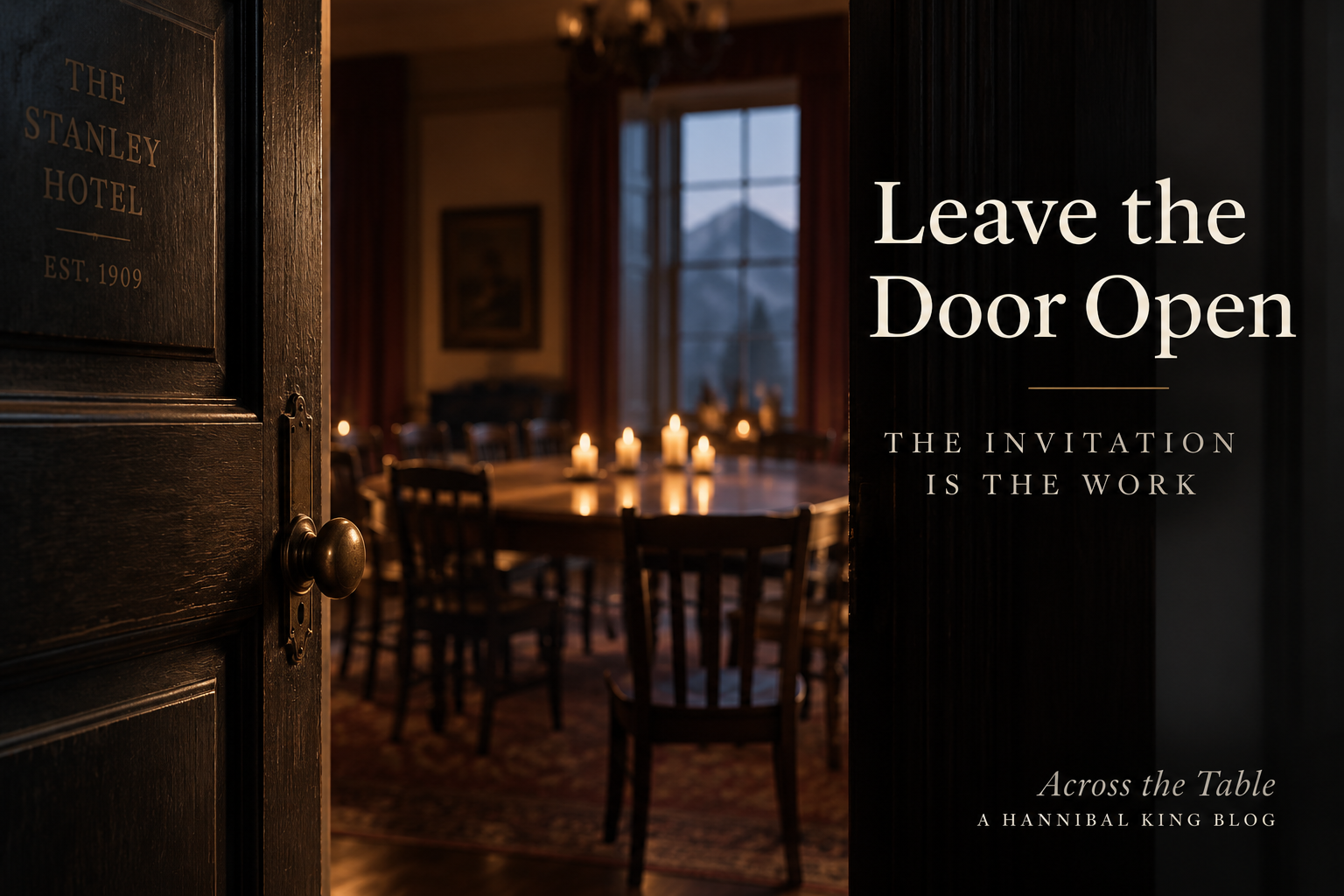

There are a great many doors at the Stanley Hotel, which is perhaps an obvious thing to say about a hotel, but old doors have a different presence than new ones. They have weight. They stick when the weather changes. They close with conviction. Some of them seem to have been painted often enough that their edges carry a small history of colors, one administration covering another, one decade politely concealing the previous one. Late at night, after the guests have mostly found their rooms and the public spaces have begun surrendering themselves to silence, a doorway can become strangely noticeable. Light falls through it into a darker corridor. Voices arrive through it before the people do. Somewhere beyond it a television is playing, an elevator announces itself, somebody laughs, somebody says goodnight. Then the hallway becomes quiet again. I have spent enough of my life in hotels and theatres to know this particular kind of quiet. It is not the absence of people. It is the evidence that people were here a few minutes ago.
The room where I perform 13 has its own version of that silence. Before the evening begins, there are thirteen chairs waiting around the table. Later there will be thirteen people in them, thirteen histories I know almost nothing about, thirteen different reasons for having come downstairs and surrendered a portion of their evening to a stranger who intends to tell them stories in the dark. Afterward, the chairs will be empty again. Somewhere in between those two emptinesses, something will have happened. I hesitate to define it too precisely because I have learned that the people who sit around a table rarely experience the same evening. One person will remember a laugh. Another will remember a moment of uneasiness. Someone may be moved by something I considered almost incidental. Someone else may spend half the show trying to work out how something was accomplished. This is one of the privileges and irritations of being a performer. We make the thing, but we do not get to decide what the thing becomes once it belongs to somebody else.
I think I understood that less when I was younger. I wanted to make certain people understood. There is a young man’s earnestness in that, and perhaps a young performer’s insecurity too. If I had made something I cared about, I wanted you to care about it for the correct reasons. If I told a story and you took something from it that I had not intended, some part of me wanted to sit you down afterward and explain the story to you properly. God help the audience member who encountered a younger artist armed with intention. I had themes. I had reasons. I had thoughts about what the evening meant. I had, I am certain, more certainty than the situation required. Age has not necessarily made me wiser, but it has made me more suspicious of explanations, particularly my own. These days, when someone tells me that a story meant something to them that I had never considered, I am more inclined to believe them.
Perhaps that is one reason I have been thinking about invitation.
A performer lives by invitation, although we do not usually call it that. We advertise. We promote. We sell tickets. We write descriptions and make posters and tell people that something wonderful is going to happen at seven o’clock, and then again at nine, and, because apparently we have made questionable choices about sleep, again at eleven. There is commerce involved, and I do not find anything shameful about that. Artists have always needed supper. The landlord remains remarkably unmoved by artistic purity. I would very much like the thirteen chairs in my room to contain thirteen paying people every time I walk through the door. I have no desire to romanticize an empty theatre. An empty theatre is beautiful for approximately three minutes. After that, it is an empty theatre.
But somewhere in the years of trying to fill rooms, I think I began to notice the difference between asking someone to come inside and trying to make them come inside. It is a small difference until it isn’t. Persuasion carries a certain tension in its shoulders. It needs something from the other person. It begins with an invitation, perhaps, but then it leans forward. It explains. It reassures. It makes another argument. It notices hesitation and immediately begins working on it. I know that posture because I have occupied it, not merely as a performer trying to sell a ticket, but as a man trying to be understood. I have explained myself to people I loved with the determined optimism of someone who believed that one more paragraph would surely settle the matter. There must be a point, I apparently believed, at which the sheer excellence of my explanation would cause another human being to surrender and say, “Ah. Of course. You are entirely correct. I see everything now.”
Life has been disappointingly unwilling to provide many of those moments.
What it has provided instead are tables.
That sounds suspiciously like symbolism, but I mean actual tables. I have spent an extraordinary portion of my life sitting across from people. Tables in restaurants after shows, tables backstage, kitchen tables, bar tables, folding tables in rooms that were never intended to be theatres, tables where business was discussed and tables where business was forgotten, tables where someone began telling a story only after everyone else had gone home. I have learned more at those tables when I stopped trying to steer the conversation than when I knew exactly where I wanted it to go. Sometimes a person needs twenty minutes of talking about nothing before they arrive at the thing they actually came to say. Sometimes they never arrive there at all. Sometimes the most intimate thing another person will give you is not a confession or a secret but simply the comfort of sitting beside you without having to provide anything interesting.
There is an empty chair on the other side of every invitation. I am beginning to think that the empty chair matters more than I once understood. It is not merely a place waiting to be filled. It is evidence that the person who prepared the room has made space for someone who is not himself. That is a different act from assembling an audience. It requires imagining another person’s presence before they arrive, while knowing almost nothing about what they will bring with them. The chair might eventually hold a stranger, a friend, a skeptic, someone grieving, someone celebrating, someone tired, someone who almost did not come. Around the séance table, I cannot know those things when the evening begins. I cannot know what happened in the car before they walked into the hotel, what conversation they had at dinner, whom they miss, what frightens them, or what private memory some accidental sentence of mine might disturb. All I know is that they have come through the door and taken the chair that was waiting for them.
There is humility in that arrangement that I am still learning. The person across the table is not raw material for my story. They are not there merely to complete the experience I designed. They have an entire life extending backward from that chair and another extending forward from it, most of which will never include me. For an hour our lives overlap. That is all. I can make the room ready for that overlap. I can take the work seriously. I can pay attention. I can try not to waste their time. I can offer mystery without demanding belief and intimacy without pretending we know one another better than we do. Then, at the end, I have to let them leave with whatever belongs to them.
I wonder whether this is what changes when persuasion loosens its grip. The question stops being, “How do I get you to come closer?” and becomes something gentler and considerably more frightening: “Can I make a place in which you are free to come closer if you choose?” There is no guarantee in that question. Someone may look through the doorway and keep walking. Someone may sit at the table and remain guarded. Someone we love may never tell us the thing we have been waiting to hear. Someone we hope will understand us may continue, with impressive determination, not to understand us at all. Leaving a door open is not the same thing as knowing who will walk through it.
Perhaps that is why real invitation feels vulnerable. There is no trick hidden inside it. You cannot invite someone freely while secretly requiring a particular answer. The moment the answer becomes compulsory, the invitation has become something else. I know this intellectually, but I am not always particularly good at it. I still want people to come. I want the room full. I want the conversation to continue. I want the people I care for to pull their chairs a little closer. I want to be understood. At sixty-one, I have not floated above these ordinary appetites into some serene state of detachment, and I hope I never do. Wanting people near us is part of being alive. The difficulty, perhaps, is wanting them near without grabbing hold of their sleeve.
Tonight, or tomorrow night, or on some night soon enough, there will again be thirteen chairs waiting in a darkened room at the Stanley Hotel. People will arrive through a doorway carrying lives I cannot see. They will sit down. For a little while we will make something together that did not exist before they entered and will never exist in quite the same way again. Then they will stand, gather their things, perhaps linger in the corridor, perhaps disappear immediately toward the elevator, and the chairs will become empty once more. I will remain on my side of the table for a little while longer.
I don’t think my work is to persuade them that the room mattered.
Maybe my work is to have made room for them in the first place.
And when the next person comes down the corridor, the door will still be there.


