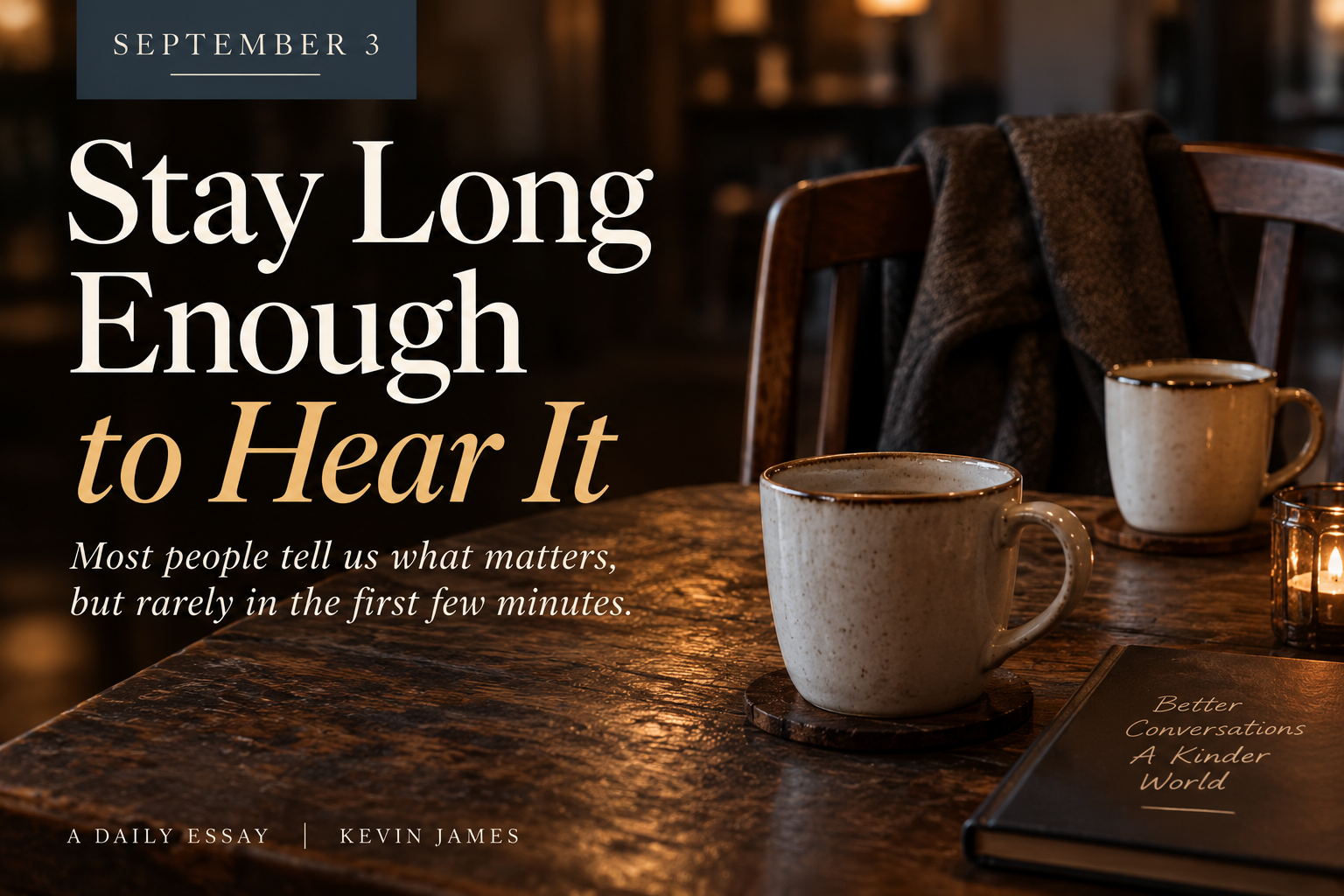

Most people tell us what matters, but rarely in the first few minutes.
Years ago, after a show, I found myself sitting across a table from someone who seemed reluctant to leave. I wish I could tell you I remember precisely where we were, or what show I had just finished, or even who else had been in the room, but memory is peculiar about these things. It saves what it wants. What I remember is the table, the remains of whatever we had been drinking, and a coat hanging over the back of the chair across from me. I remember that we had already had the conversation. You know the one. The proper conversation. The show had been good. The audience had been generous. Travel was discussed, and weather, and some mutual acquaintance whose name has long since escaped me. All the ordinary scaffolding we erect around two people who do not yet know whether they are going to tell each other the truth. There came a point when the conversation seemed finished, and I remember thinking that I should probably get up. There were things to put away. There was always a drive somewhere, or another room waiting, or the familiar little responsibilities that become convenient when silence begins to feel uncomfortable. But neither of us moved. The coat remained on the chair. Whatever was in my cup continued cooling. And for a few moments there was nothing between us but the small sounds a room makes when two people have run out of things they know how to say.
I have spent most of my adult life in rooms where silence means something. A theatre teaches you that fairly quickly if you are willing to be taught. An audience is talking to you from the moment you walk onto the stage, although very little of what they say involves words. They settle differently when they trust you. They lean forward when something matters. They shift in their seats when you have stayed somewhere too long, and there is a particular kind of stillness that comes over a room when everyone has forgotten, briefly, that they are supposed to be an audience. I have learned to love that stillness. I suspect I spent the first part of my career being frightened of it. Young performers tend to believe empty space must be filled. We rush the pause, explain the mystery, step on the laugh, and begin the next sentence before the last one has had time to find its way into the room. Experience teaches something almost opposite. Sometimes the strongest thing you can do on a stage is nothing. Stand there. Trust what has already happened. Let thirteen people around a séance table have their own thoughts before you give them another one of yours. It has taken me considerably longer to understand that conversations ask the same thing of us. People are speaking before they speak, and sometimes they are saying the most important thing in the moment when they appear to have stopped talking altogether.
The person across from me that night eventually began again, but not with anything dramatic. There was no confession worthy of a screenplay, no sudden revelation that rearranged the furniture of either of our lives. As I remember it, the conversation simply became less polished. That is the phrase I keep coming back to. Less polished. The sentences became a little less certain. There were longer spaces between them. A joke appeared where a straightforward answer might have been expected, and I knew enough, even then, to understand that jokes are sometimes little doors disguised as exits. We laugh because laughter gives us somewhere to go when the room has become too honest. I know this territory rather well. I have made a living standing in front of people, and I can be charming when charm is useful. I can tell a story when the air gets heavy. I can make a room laugh, redirect attention, rescue an awkward moment, and carry a conversation safely back toward shore. These are useful abilities for a performer. They are not always useful abilities for a friend. That evening, for reasons I cannot claim as wisdom, I did not rescue anything. I did not offer a story of my own to prove that I understood. I did not say, “Here is what you should do.” I did not reach across the table with some tidy sentence intended to make everything better. I stayed where I was. And because I stayed, the other person stayed too.
There is a kind of listening we learn because we want to become better communicators. We learn to maintain eye contact, ask questions, reflect things back, notice body language, and wait until the other person finishes before speaking. All of that is useful, I suppose, but I have become less interested in listening as a technique. Technique can become another performance, and performers are particularly good at making attention look convincing. What interests me now is something quieter, something I might call the generosity of sustained attention. It is the willingness to remain with another person after the obvious material has been exhausted. It means not demanding that they know exactly what they mean. It means allowing them to contradict something they said ten minutes earlier without immediately pointing out the contradiction. It means giving them enough room to revise themselves while they are sitting in front of you. We forget how rarely people are given that privilege. The world asks us constantly to declare ourselves. What do you think? What do you believe? What side are you on? What is your answer? We are expected to arrive everywhere already formed, carrying opinions polished enough for immediate presentation. But most of the things that matter deeply to us are not nearly so obedient. Grief changes shape halfway through a sentence. Love can sound remarkably like anger when it has been frightened. Regret sometimes arrives dressed as nostalgia. Loneliness has a habit of telling jokes. If we insist that people speak only in finished sentences, we may never hear what they are actually trying to say.
At sixty-one, I can look backward and see conversations I hurried because I thought I understood them. That is not an especially comfortable admission. There were people I loved whose sentences I completed because I had known them long enough to believe I knew where they were going. There were strangers whose stories reminded me of stories I had heard before, so I quietly placed them into categories while they were still speaking. There were people who came to me with something difficult and received advice when what they may have wanted was company. I suspect I have mistaken usefulness for kindness more often than I know. There is a tremendous temptation, particularly as we get older and accumulate experience, to believe that experience has given us answers. Perhaps it has given us a few. More often, I think, it has given us better questions and, if we are fortunate, a little more patience with the time it takes another person to discover their own. I wish I had understood this earlier. I wish I could return to certain tables, certain backstage corridors, certain cars parked outside theatres long after everyone else had gone home. I would interrupt less. I would worry less about saying the right thing. I would not be so eager to demonstrate that I understood. Understanding is sometimes an oddly selfish ambition. It puts the emphasis on what I can comprehend rather than on what you are trying to tell me. There are moments when the better gift is simply to say, by remaining there, You do not have to make this easier for me.
Maybe that is why the table has become such an important object in my life. I spend so much time around them. There is the séance table at the Stanley, surrounded by thirteen chairs and all the strange expectations people bring into that room. There is the table at home, where tea gets cold because conversation has wandered somewhere unexpected. There are restaurant tables, dressing-room tables, folding tables backstage, hotel tables cluttered with the evidence of temporary lives. And there is this imaginary table I keep returning to when I write, with you on one side and me on the other. A table establishes a peculiar equality. Neither of us is standing at a lectern. Neither of us is addressing the other from a stage. We have both been given a chair. But having a chair does not guarantee that we have been given room. That requires something more difficult. It requires me to stop occupying every silence. It requires me to resist turning your experience into an opportunity for one of my stories. It requires me to believe there may be something in you that has not yet found its sentence, and that my job is not to drag it into daylight but to make the room safe enough that it might eventually come out on its own. I think that may be one of the deepest forms of hospitality we can offer another human being. Not merely, “Come in.” Not merely, “Sit down.” But, “Take the time you need. I am not going anywhere yet.”
I do not remember the final words of that old conversation. Perhaps that is appropriate. What has remained with me is not a sentence but the fact that neither of us stood up when we might have. The coat stayed draped over the chair. The drink went cold. The room grew quieter, and eventually something in the conversation softened because there was no longer any pressure for it to become anything. I think about that now when someone lingers after a show, when a friend pauses halfway through a thought, when someone says, “Anyway,” and looks away, as though they have decided not to finish what they started. I am trying to become less eager to help them finish. Sometimes I ask another question. Sometimes I do not. Sometimes the most generous thing I know how to offer is a little more time and the assurance, given without words, that silence has not frightened me away. We spend so much of our lives believing that love, friendship, hospitality, even storytelling, are demonstrated by what we provide. The right words. The right answer. The useful advice. The story that makes sense of things. Perhaps sometimes they are demonstrated by what we withhold. The interruption. The solution. The clever reply. The hand reaching too quickly for the coat. The tea can go cold. Whatever needs doing can wait another few minutes. The person across from us is still there. So, for a little while longer, we stay too.


