
Editing Is Structural Mercy
Commitment is a decision, not a mood.
That simple fact sits underneath almost every meaningful piece of work I have ever made. It sits underneath the residency, the books, the essays, the long nights at a table with strangers who slowly become participants in something deeper than entertainment. Commitment shows up not as inspiration, but as structure.
And nowhere does that structure reveal itself more clearly than in editing.
Most people imagine editing as subtraction. Cutting lines. Trimming stories. Reducing a script until it fits a time limit. That is certainly part of it. But the deeper truth is more interesting than that.
Editing is structural mercy.
When we edit our work, we are not punishing it. We are protecting it.
A story with too many ideas collapses under its own enthusiasm. A talk with five themes leaves an audience holding none of them. A performance that refuses to let go of its clever moments slowly suffocates the parts that actually matter.
I have watched performers fall in love with their material the way gardeners fall in love with weeds. Everything feels alive. Everything seems worth keeping.
But growth alone does not create a garden.
Structure does.
Over the years I have learned something simple about audiences. They are generous, but they are not infinitely patient. They are willing to walk with you, but they need a path. When that path disappears, even the most thoughtful room begins to drift.
Editing lays the stones.
It says, gently but firmly, this is the way through.
When I am preparing a piece for the stage, I often remove things I enjoy. Good lines disappear. Clever references vanish. Entire stories sometimes fall away. Not because they are bad, but because they interrupt the deeper movement of the work.
This is where mercy comes in.
A performance that tries to say everything ends up saying very little. Editing gives the audience room to breathe. It allows the central idea to stand upright instead of being crowded by its cousins.
It is the difference between a cluttered room and a well set table.
For public creatives, speakers, storytellers, and performers, this discipline matters more than most people realize. Our job is not simply to express ourselves. Our job is to carry meaning across the distance between two human beings.
That requires care.
Editing is care.
It asks difficult questions.
Does this moment serve the audience?
Does this line deepen the story?
Does this section move the work forward, or is it simply something I enjoyed writing?
These questions are not cruel. They are acts of respect.
Respect for the audience’s time.
Respect for the integrity of the piece.
Respect for the craft itself.
In my own work, I often think of editing as a form of hospitality. When someone sits down across from you, whether at a kitchen table or in a theater seat, they are offering something precious. Their attention.
Attention is a gift.
Editing ensures we do not waste it.
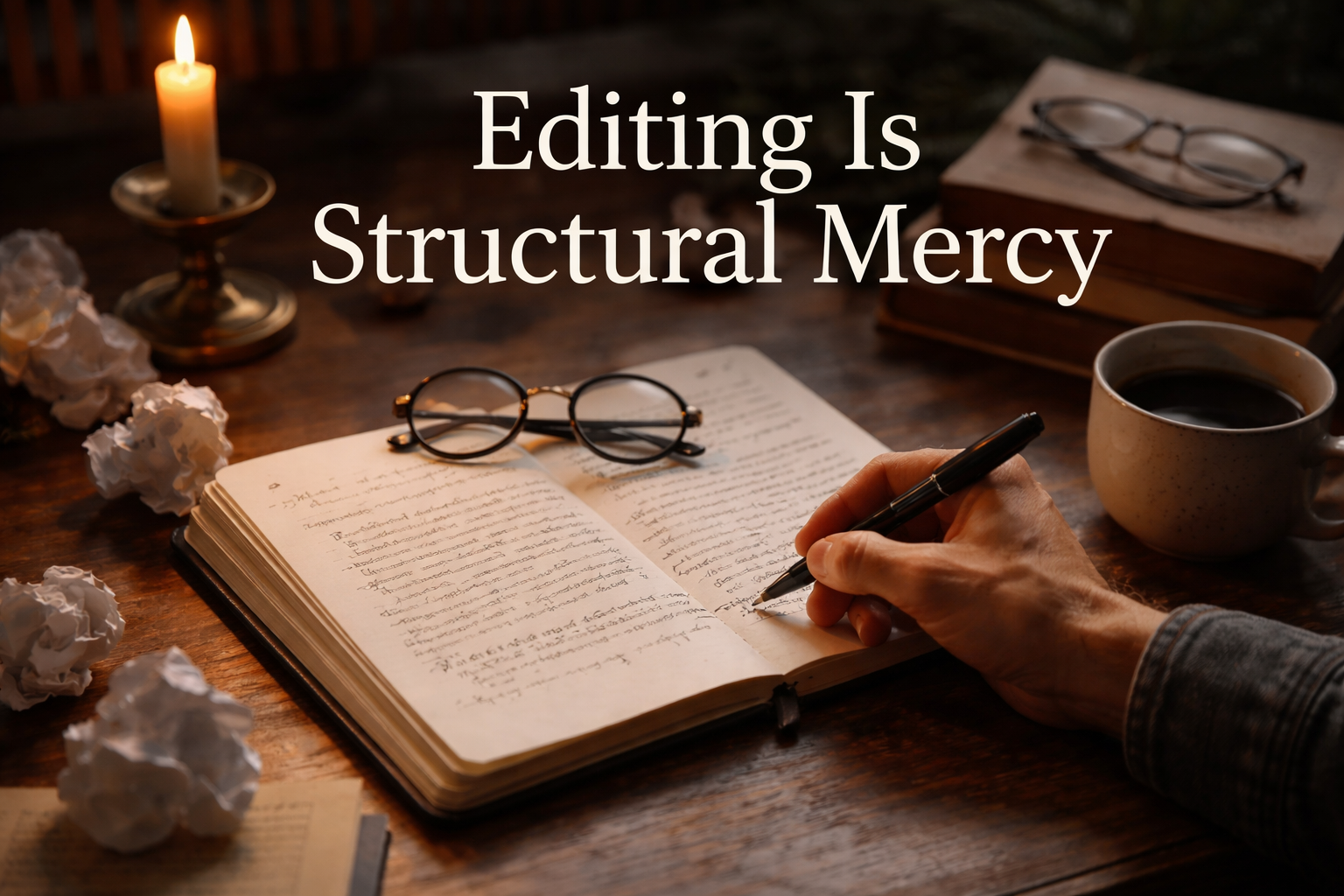
This kind of discipline rarely feels dramatic. There are no fireworks involved. Mostly it looks like quiet hours. Reading aloud. Crossing out paragraphs. Rearranging pieces until the rhythm of the work finally settles into place.
It is patient work. Sometimes even a little boring.
But depth almost always hides inside the boring parts.
The longer you stay with the process, the more clearly the shape of the work begins to emerge. The unnecessary pieces fall away. What remains becomes stronger, clearer, kinder to the audience.
The story begins to breathe.
Commitment shows itself here. Not in bursts of enthusiasm, but in the willingness to return to the work again and again until it becomes what it was meant to be.
Editing is not the enemy of creativity.
It is the structure that allows creativity to be understood.
And for those of us who care about meaningful work, that structure is not a limitation. It is a form of mercy, both for the audience and for ourselves.
If you are doing this work seriously, you will eventually discover that the craft deepens every time you return to the table. The process gets quieter. The choices get sharper. The work becomes more generous.
That is where the real practice begins.
And if you are walking that path, you are in good company. Pull up a chair. There is always more to learn here.