
What You Do Without Applause
Detaching from validation
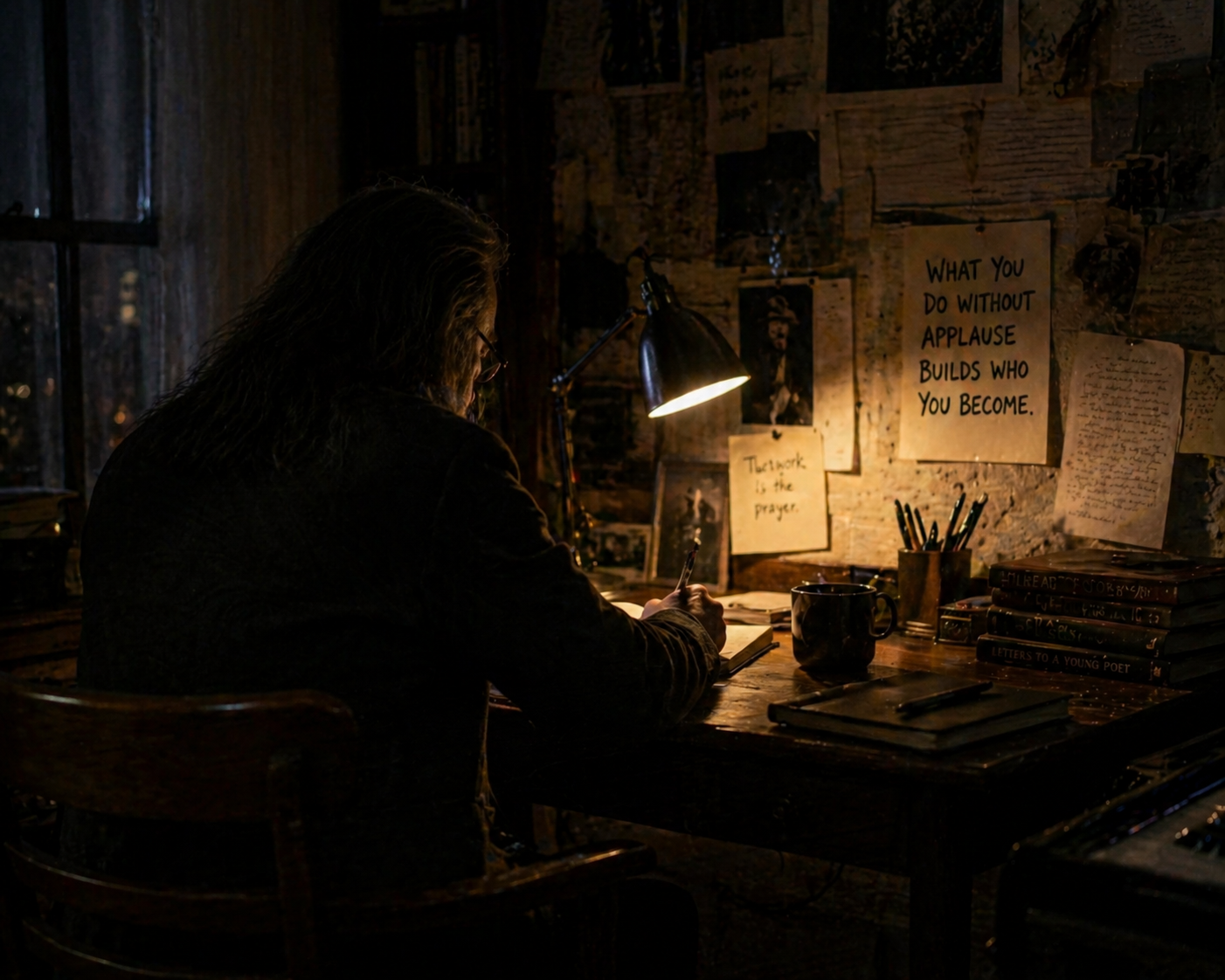
There is a version of your work that exists entirely without witnesses.
No audience leaning forward. No comments section flickering to life. No quiet nod from the back row that tells you, yes, that landed. Just the work itself, in its plain clothes, asking to be done again. And again. And again.
This is the part most people quietly negotiate away.
Public creatives, speakers, performers, we are trained, often unconsciously, to tether our sense of progress to response. Laughter, silence, applause, metrics. We learn to read a room, then we learn to need the room. It’s a subtle shift, but a costly one. Because the room is not always there. And even when it is, it is not always honest.
The deeper work, the kind that actually shapes identity, happens in conditions that offer very little feedback. You rehearse a story in an empty space and it feels flat. You write a paragraph that no one will read today, maybe not ever. You record something and watch it back in silence, without the buffer of reaction. It can feel like shouting into a well and waiting for an echo that never comes.
This is where most people drift.
Not because they lack talent, but because they lack a relationship with the work that is independent of being seen. They mistake the absence of applause for the absence of value. And so they adjust. They perform less. They post less. They practice less. Or they chase faster forms of validation, louder rooms, quicker returns.
But if you stay, something quieter begins to form.
You start to notice the work itself differently. Without the pressure of response, your attention sharpens. You hear the rhythm of your own voice, not the version that gets a reaction, but the one that feels true in your body. You make choices that are not immediately rewarded, but are structurally sound. You begin to trust repetitions that would look unimpressive from the outside.
This is not glamorous work. It is, in many ways, invisible.
But identity is built in invisible places.
The person who does the work consistently is not the one who is most celebrated. It is the one who has learned to return without being called back. To sit down without being invited. To refine something that no one is currently asking for. There is a kind of self-respect that grows here, not loud, not performative, but steady.
It changes how you show up when the audience does return.
Because now, you are not asking the room to complete something in you. You are offering something that is already complete in its structure, if not in its final form. The applause, if it comes, lands differently. It is appreciated, but it is not required. It becomes information, not identity.
This detachment is often misunderstood as indifference. It is not that.
It is care, directed inward first. A refusal to outsource your sense of progress to people who, however generous, cannot see the full arc of your work. It is a commitment to the long shape of things, rather than the immediate response.
Practically, this might look unremarkable.
You keep your rehearsal schedule even when there is no show on the calendar. You write when the post will not go live for weeks. You refine material that has already “worked,” because you know it can hold more weight. You allow pieces to exist before they are ready to be seen, and sometimes, before they are seen at all.
You build a body of work that does not rely on being witnessed to be real.
Over time, this becomes a kind of quiet leverage. Not in the strategic sense, but in the personal one. You are less easily shaken. Less dependent on the temperature of a room. More able to stay with something long enough for it to deepen.
And depth, as you’ve likely noticed, does not announce itself loudly.
It accumulates.
If you are in a season where the response is thin, or inconsistent, or absent altogether, consider the possibility that this is not a failure of your work, but an invitation into a different relationship with it. One where you are not constantly asking, did they like it, but something steadier, did I do the work well.
That question, answered honestly over time, will shape you into someone who can carry weight on stage, on the page, across the table.
And when the room fills again, as it tends to do, you will meet it as someone who was already working.
If that’s a direction you’re walking, you don’t have to do it alone. There are ways to structure this kind of practice so it holds, even when the applause fades. We can keep building that, quietly, together.