
One of the quiet lies of modern creative culture is that freedom produces depth.
It doesn’t.
Freedom produces possibility. Possibility produces exploration. Exploration is necessary. But depth, the kind that changes the way a person stands in a room and speaks to other human beings, comes from something much less glamorous.
It comes from containers.
A container is simply a boundary that allows attention to accumulate.
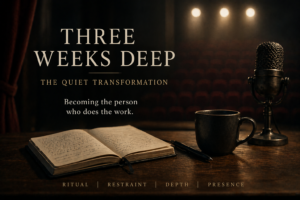
When I say container, I’m not speaking metaphorically. I mean something very concrete. A book is a container. A rehearsal schedule is a container. A course, a residency, a mentorship, even a weekly practice session at the same table, at the same hour, is a container.
Without one, intention evaporates.
I have watched this for decades in rooms full of talented people. Speakers with brilliant ideas. Performers with natural charisma. Storytellers with powerful experiences to share.
The talent is rarely the problem.
The problem is diffusion.
They are thinking about a hundred directions at once. They are collecting inspiration. They are experimenting endlessly. They are “figuring it out.”
Which is another way of saying they are floating.
Floating feels creative. Floating feels expansive. Floating feels like freedom.
But floating rarely leads anywhere.
Depth, on the other hand, requires walls.
Not prison walls. Garden walls.
Something that says, “Inside this space, we work.”
When I began performing regularly, the container was the show itself. A certain time. A certain room. A table. A set of chairs. People sitting across from me expecting something meaningful to happen.
That structure changed everything.
Suddenly the question wasn’t, “What do I feel like creating today?”
The question became, “What belongs in this room?”
That shift is enormous.
A container forces clarity.
It asks different questions.
What is essential?
What survives repetition?
What actually serves the people sitting in front of me?
The same is true of books. When I write essays or long-form work, the book becomes the container. It gathers scattered thoughts and asks them to live together. Some ideas belong. Others quietly fall away.
This is not limitation. It is refinement.
Courses and residencies function the same way.
When people commit to a defined arc of work, something changes in the nervous system. The wandering stops. The experimenting narrows into practice. The vague desire to “get better” becomes daily, visible effort.
Depth begins to accumulate.
The truth is that most people do not lack motivation.
They lack structure strong enough to hold their attention.
A container does that.
It protects the work from mood.
Mood is a poor project manager.
Mood is enthusiastic on Monday, tired on Wednesday, distracted by Friday, and completely convinced that a new idea will solve everything by Sunday.
Containers ignore mood.
They simply say, “We are doing this now.”
The paradox is that real creative freedom often appears only after the container is in place. Once the boundaries exist, the mind relaxes. The work has somewhere to go. Effort begins to stack instead of scatter.
Over time something even more interesting happens.
Identity forms.
You stop being someone who occasionally thinks about speaking, storytelling, performing, writing, or teaching.
You become someone who practices.
And practice, given enough time, becomes presence.
Presence is what audiences feel long before they remember a single sentence you said.
If you are someone who wants to show up more meaningfully in front of others, this may be the most practical advice I can offer.
Stop waiting for the perfect idea.
Build the container.
Choose a structure that holds your attention long enough for depth to appear. A course. A body of writing. A rehearsal discipline. A residency of your own design. A mentorship that asks more of you than casual interest ever will.
Depth does not arrive through inspiration.
It arrives through commitment inside a shape that can hold it.
And if you ever find yourself looking for such a container, there are a few places where we quietly build them together.
You would be welcome at the table.