
Every Artist Needs a Personal Rulebook
The non negotiables you keep
Most artists spend a great deal of time looking for inspiration.
Fewer spend time deciding their rules.
That may sound like a small distinction, but in practice it changes everything. Inspiration is a weather pattern. Rules are architecture. One comes and goes, the other holds the roof up when the wind starts to move.
If you plan to stand in front of other people and offer them something meaningful, whether that is a story, a talk, a song, a trick, or an idea, you will eventually discover this simple truth.
Mood is unreliable.
Commitment is a decision.
And decisions tend to require structure.
Over time most working artists develop what I like to think of as a personal rulebook. Not something printed and framed on the wall. Something quieter than that. Something internal. A set of non negotiables that guide the work whether you feel particularly brilliant that day or not.
The audience will never see this rulebook.
But they will feel its presence.
A personal rulebook does not begin as philosophy. It usually begins as pain. You discover it after doing things the wrong way long enough to recognize what the right way must be.
For example, one rule might be simple.
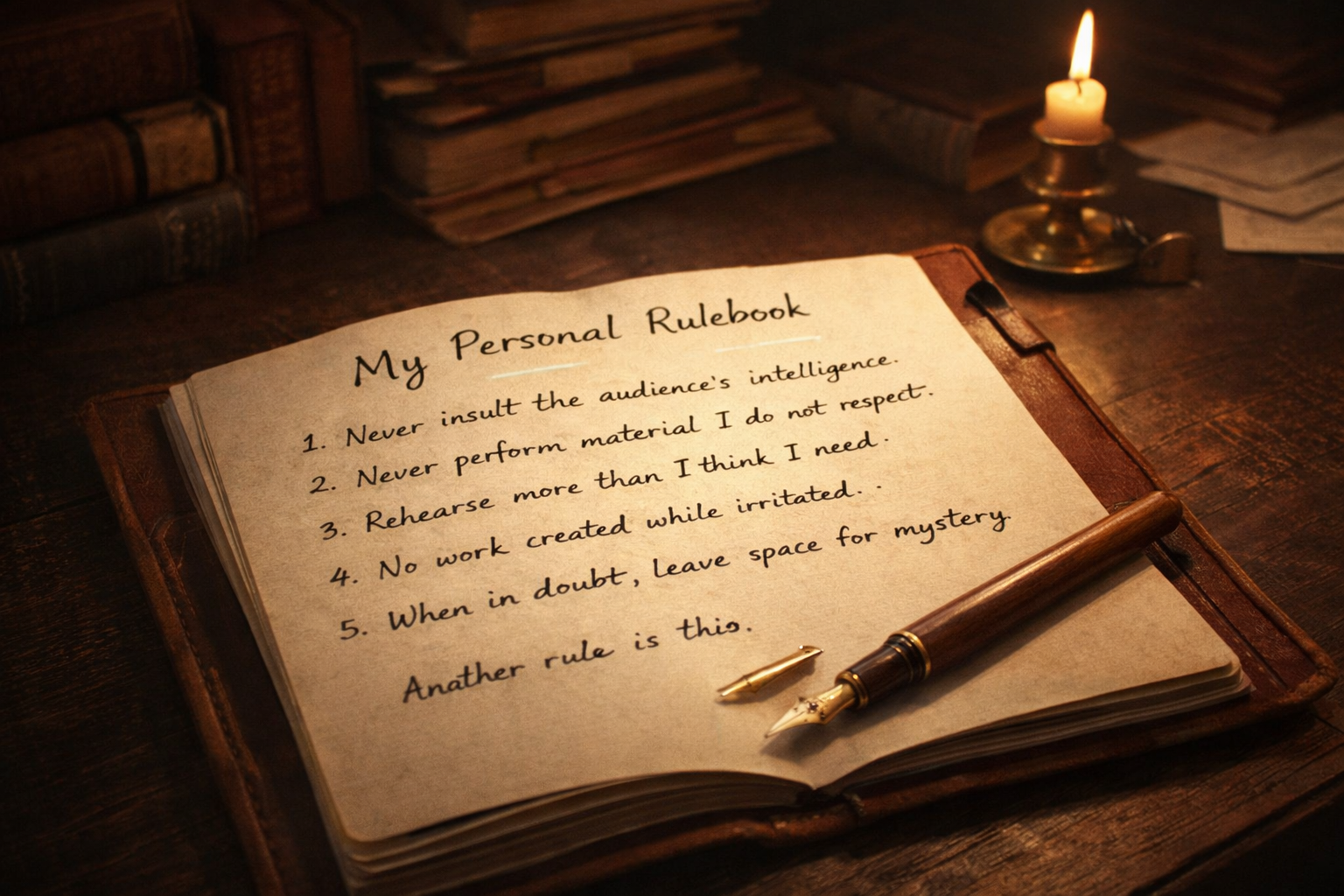
Never insult the audience’s intelligence.
Another might be equally simple.
Never perform material you do not respect.
These sound obvious when spoken aloud, but they are violated constantly. The temptation to take shortcuts is always present. The pressure to fill time, chase attention, or imitate whatever seems popular in the moment is very real.
Rules protect you from that drift.
They are the quiet guardrails that keep the work honest.
Another rule many performers eventually adopt is this one.
Rehearse more than you think you need.
Not because perfection is the goal. Perfection is a myth anyway. Rehearsal is not about flawlessness. It is about familiarity. It allows the work to settle into the body so that when you stand in front of people you are free to be present rather than anxious.
Presence is the real currency of performance.
And presence requires preparation.
Some rulebooks include boundaries about time and attention. For instance, you might decide that you do not publish work that was created in a rush of irritation. Or that you do not respond publicly to every criticism that wanders across the internet. Or that you do not sacrifice sleep and sanity for the sake of appearing productive.
These are not productivity hacks.
They are sanity policies.
A good rulebook protects the artist as much as it protects the audience.
It also protects the long game.
One of my own rules is rather simple. I do not release something into the world until it has been edited with care. Editing is not punishment. It is mercy. Mercy for the audience who must receive the work, and mercy for the artist who will have to live with it later.
Another rule is this.
Leave a little space for mystery.
Not everything needs explanation. Not every silence needs to be filled. The audience does not come to be overwhelmed with noise. They come to encounter something that feels considered.
A rulebook helps maintain that consideration.
The interesting thing about personal rules is that they rarely restrict creativity. In fact the opposite happens. When the boundaries are clear, the imagination relaxes. It knows the container is strong enough to hold whatever might arrive.
Structure invites depth.
Without it, everything drifts toward the surface.
If you are a speaker, a storyteller, a performer, or anyone who hopes to show up in front of others with a measure of honesty, it may be worth taking a quiet afternoon to consider your own rulebook.
Not a long list.
Just a few lines you are unwilling to break.
The non negotiables you keep when the room is full, and especially when it is not.
Those small decisions accumulate over time. They shape the work. They shape the voice. Eventually they shape the kind of artist people trust.
And trust, in this line of work, is the rarest thing we have.
If these ideas resonate with you, then we are likely traveling in the same direction. There is plenty of room at the table for people who care about doing the work with a little more intention.