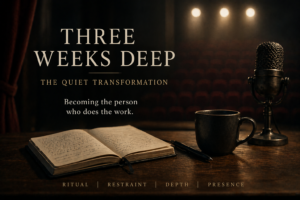

There is a romantic idea that commitment arrives as a feeling.
A rush of certainty. A burst of motivation. A moment when the clouds part and a trumpet sounds somewhere behind the mountains.
If you wait for that moment, you will wait a very long time.
Commitment is not a mood. It is not enthusiasm. It is not the high you feel after watching someone else succeed and deciding that this is finally your year.
Commitment is a practice.
Anyone who has spent real time on a stage knows this. The audience sees the moment under the lights, the story landing in silence, the laugh arriving exactly where it should. They see the polished moment. What they do not see is the quiet accumulation of decisions that made that moment possible.
The early rehearsals when the material is clumsy.
The notebook full of half thoughts.
The nights when the room is thin and the applause polite.
Commitment lives there.
It is not glamorous. It is not loud. It is simply the decision to return.
Again tomorrow.
Again next week.
Again next year.
For public creatives, this matters more than talent. Talent is lovely. Talent opens doors. But talent without structure dissolves into drift. I have seen brilliant performers vanish into distraction simply because they treated their work like a feeling instead of a practice.
A practice has rhythm.
You sit down at the table whether you feel inspired or not.
You rehearse whether the idea feels brilliant or unfinished.
You write even when the sentences arrive slowly.
The work itself becomes the structure that carries you forward.
One of the quiet gifts of a practice is that it removes the drama from the process. You stop asking whether you feel like doing the work. You simply ask what today’s small step looks like.
A page.
A rehearsal.
A thoughtful post that speaks honestly to the people you serve.
Over time, these small steps accumulate into something that outsiders call authority. From the inside, it feels much simpler. You just kept showing up.
In my own life, much of what people now see as “a body of work” began as ordinary ritual. A notebook on the table. A quiet hour in the morning. A promise to keep refining the craft of speaking to a room, whether that room held twenty people or two hundred.
Practice builds the voice.
It also deepens the relationship with the audience. People sense when someone has devoted real time to the work. Not polished marketing. Not clever performance. Real time.
Depth recognizes depth.
That is why commitment cannot be seasonal. It cannot appear when the algorithm is favorable and disappear when attention wanders elsewhere. The people who matter, the thoughtful listeners and readers and audiences, are looking for something steadier than that.
They are looking for someone who has chosen the long road.
If you are one of those people, someone who wants their voice to carry weight when they stand in front of others, then your real task is simple.
Build a practice.
Protect the quiet hours.
Return to the page.
Refine the craft of speaking, writing, and presence.
Over time, the work begins to reveal things you cannot force. Clarity. Confidence. A voice that sounds unmistakably like your own.
And eventually, you realize something surprising.
Commitment was never the difficult part. The difficult part was believing that small, steady devotion could carry you further than bursts of excitement ever could.
It can.
If you feel called toward that kind of depth, there are places where we explore it together. Essays, books, conversations across the table. Not quick inspiration. Real practice.
The door is open when you are ready to sit down and continue the work.