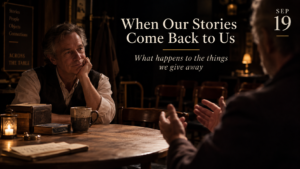
Most days begin in a quiet room. Sometimes it is a hotel room with curtains that never quite close. Sometimes it is my little workspace tucked into the corner of a home far from the places where my children and grandchildren sleep. No matter the shape of the room, there is always the table, the soft hum of early thoughts, and the gentle pulse of a life lived mostly in my own company. There was a time when working alone felt like a compromise. Now it feels like a home, a practice, and a gift I chose without quite realizing it. I work alone, and I love it, because somewhere along the way I learned that solitude is not an absence. It is an invitation.
People imagine that a performer spends life swimming in noise. In the wings, backstage, or under the lights, that is true. My nights are filled with breath and heartbeat, with the subtle grip of a tarot card and the shimmer of a story settling into a listener. But the making of that world, the crafting of the next show or the next essay or the next whispered moment of magic, happens in stillness. It is the space between applause where I learn what the work is trying to become.
Working alone, I hear things I miss in a crowd. The scrape of a chair across old wood, the sound a pen makes before it touches a page, the rustle of a memory returning at its own pace. These small sounds are the punctuation of my days. They remind me that solitude is not silent. It speaks in careful tones. If I pay attention, it tells me what to write next, what to practice, what to protect.
There is a different rhythm to collaboration. I value it, I hunger for it at times, but collaboration asks me to negotiate tempo. When I work alone, I get to listen to the natural cadence of my mind. I can speed up when inspiration strikes without pulling anyone along behind me. I can slow down when something hurts without feeling like I am holding someone else back. I can stop entirely, then start again with a single breath. I can follow curiosity into strange corners without needing to explain why. Solitude allows the work to grow in honest lines without apology.
The truth is that most of my life as an artist has been shaped by long stretches of solitude. Travel teaches you to be your own companion. So does reinvention. So does grief. When you move far from your family, when the phone grows quiet, when the rooms feel larger than your ability to fill them, you learn to shape meaning with what you have left. You learn that solitude is a teacher. It shows you who you are when applause fades, when no one is watching, when you cannot perform your way through the ache. It teaches you to sit with yourself long enough that a kind of peace rises from the floorboards.
This is not a romantic solitude. It is not the lonely poet in a candlelit attic, nor the wandering mystic searching for enlightenment. My solitude is practical and workmanlike. I sit at a table, I shuffle cards, I rewrite paragraphs, I test the same effect again and again until it hums. I linger over sentences. I listen for the line that feels true. I spend hours building what will one day take only moments to perform. The magic is simple over a table. The making of it is not. There is sweat in solitude. There is labor. But there is also the thrill of discovery, because no one is there to pull the curtain early or redirect you. You can chase the work until the work chases you back.
Loving solitude does not mean I don’t miss the people I love. That ache is constant and soft. My children and grandchildren live far from me. The distance is measured in miles, but it is also measured in holidays missed, in stories heard secondhand, in the way a voice catches when you say goodbye too quickly. Love, stretched across geography, becomes a quiet room of its own. I carry them with me into my work. Their laughter settles beside my notebooks. Their absence sharpens my gratitude for every small conversation, every reunion, every picture that arrives on my phone when I least expect it. My solitude is shaped by love. It does not exclude it.
Working alone has taught me a particular kind of honesty. There is no one to impress in these early hours, no one to reassure me that the draft is good or the idea is clever. I must face the work without distraction. I must commit to the uncomfortable truth that sometimes I will fail. Sometimes the words will not come, sometimes the sleight will not land, sometimes the emotion will not translate. Solitude teaches resilience because there is nobody to carry you through the doubtful moments except your own will. And once you accept that, you become free. You stop waiting for permission. You stop fearing stillness. You begin to recognize that the work is forged in those moments when you are both creator and companion.
People often ask if it gets lonely. The answer is more complicated than yes or no. Some days the silence is heavy and I long for conversation. Other days the silence is generous, giving me room to breathe and build. Loneliness, I have learned, is not the same as solitude. Loneliness is an ache for connection. Solitude is the soil where connection grows. When I have spent enough time alone, when I have shaped the work with care, when I have tended my inner garden, I bring the results back to the world, back to the audience who sits across the table. And in that moment, the solitude becomes a gift I can offer. Every story, every turn of the card, every shared breath is stronger because I spent time listening to the quiet first.
I love working alone because it keeps me honest. It keeps me curious. It keeps me connected to the parts of myself that only speak when the world is soft around the edges. It anchors me in the craft rather than the applause. It gives me a place to return to when the noise grows too loud. It reminds me that there is a sacredness in simple things, in the way a cup of coffee warms the hands, in the scratch of ink on paper, in the steady presence of a table waiting for the next idea.
In the end, working alone is not isolation. It is communion with possibility. It is where I meet myself without pretense. It is where the next chapter begins. And though I miss my family with a tenderness that never quite lifts, though the road is long and the nights are quiet, I know this life fits me. I know the work is better for it. I know that in these calm hours, I become the storyteller I was always meant to be.
I work alone, and I love it. Not because it is easy, but because it is true.