I have never trusted ideas that live only in the head.
Ideas are too light there. Too clever. They float away at the first sign of resistance.
If something matters to me, it has to pass through my hands.
My hands have always known more than I could explain. They learned early. Before I had language for intention or will, my hands were already practicing attention. They stacked, folded, shuffled, lifted, steadied. They learned the weight of objects and the weight of moments. They learned when to press and when to wait.
I did not inherit strength in the dramatic sense. No thunderclap talent. No single moment where destiny pointed and said, “There, that one.” What I inherited was endurance. A quiet permission to stay with a thing longer than most people are willing to. To repeat a motion until it stopped being a motion and became a truth.
When I was younger, I thought strength lived in certainty. In force. In the confidence to say, “This is how it is.”
Now I know better.
Real strength lives in the hands because hands cannot lie.
They tremble when the heart trembles.
They hesitate when the moment is wrong.
They remember what the mind tries to forget.
A magician learns this quickly. You can memorize technique, but your hands will betray you if your attention wanders. The hands know when you are rushing. They know when you are showing off. They know when you are trying to impress instead of connect. Every false intention shows up as tension. Every honest one relaxes the grip.
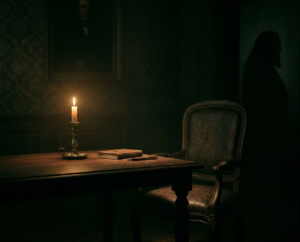
I have spent thousands of hours at tables. Kitchen tables. Séance tables. Small round tables in dim rooms where people lean forward without realizing they are doing it. Tables are honest places. They bring people close enough that pretense becomes exhausting.
At those tables, my hands became my voice.
They learned how to invite without demanding.
How to offer without grabbing.
How to hold silence as carefully as an object.
There is a difference between control and care. Control tightens. Care listens. Control wants an outcome. Care wants presence. The hands know the difference instinctively. Try to control a moment and your fingers stiffen. Try to care for it and they soften, ready to adjust.
This is why I believe so deeply in the physical practice of art. Writing with a pen. Shuffling real cards. Turning real pages. There is friction involved. Resistance. The slight ache that comes from staying with something long enough for it to matter. Friction teaches patience. It teaches humility. It teaches respect.
My hands have failed me plenty of times. They have dropped things. Revealed secrets too early. Shaken when I wanted them still. But those failures were instruction, not betrayal. Each mistake taught my hands how not to rush the next moment. How to breathe before acting. How to wait half a second longer than comfort suggests.
That half second is everything.
It is the space where connection decides whether it will happen or not.
It is the pause where a story takes root instead of skimming past.
It is the breath that turns a trick into a moment.
People often talk about presence as if it were mystical. Something bestowed. Something you either have or do not. I disagree. Presence is trained. It is rehearsed through the body. Through the hands returning to the work again and again, even when no one is watching.
Especially when no one is watching.
The strength of my hands is not brute force. It is reliability. They show up when my confidence does not. They remember what to do when my mind panics. They know the sequence, the rhythm, the feel of things going right because they have practiced going wrong safely.
That is what discipline really is. Not rigidity, but forgiveness built into repetition. The willingness to try again with curiosity instead of punishment.
I have watched people soften when my hands slow down. When I stop proving and start listening. When the gesture becomes smaller instead of bigger. It turns out people do not want to be dazzled as much as they want to be held in attention. They want to feel that nothing is being forced. That nothing is being taken.
Hands can take. Hands can also give without expectation. The difference is intention, and intention always leaks into movement.
There are days my hands feel older than I am. Scarred by repetition. Stiff in the morning. Marked by the quiet accumulation of years. I welcome that now. Those marks are not decline. They are evidence. Proof that I stayed. That I chose craft over shortcuts. That I trusted slow growth over sudden applause.
When I think about legacy, it is not fame that comes to mind. It is transmission. What my hands can pass to another pair across a table. Not instructions, but permission. Permission to slow down. Permission to practice. Permission to trust that attention compounds.
I have held the hands of people as they cried. I have placed objects into open palms and watched skepticism turn into wonder. I have rested my hands flat on a table and felt a room settle without a word spoken. That is strength. Not dominance, but steadiness. Not volume, but gravity.
The world rewards speed right now. Efficiency. Optimization. Hands are told to move faster, automate, disappear behind glass and swipe gestures. But the body resists being erased. The hands remember what it means to be needed.
My hands have built my life quietly. One repetition at a time. One table at a time. One shared moment that did not ask to be recorded or proven. Only felt.
If there is wisdom here, it is simple.
Trust what you practice.
Let your hands teach you what your head cannot.
Stay long enough for care to replace control.
The strength of my hands is not that they can make something happen.
It is that they know when not to.
And in a world that is always reaching, that restraint might be the strongest thing I have ever learned.