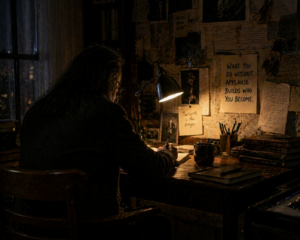

Structure Shapes the Artist
There is a quiet myth that floats around creative work. It suggests that art appears when the mood strikes. Inspiration descends like weather. The artist waits, alert and hopeful, until the lightning arrives.
It is a pleasant story. It is also a dangerous one.
Because the truth is far less romantic and far more useful.
Artists are not shaped by mood.
Artists are shaped by structure.
For most of my life I have worked in environments where waiting for inspiration would be professionally irresponsible. A theatre fills with people at eight o’clock whether I feel poetic or not. A séance table gathers its guests whether the spirits of creativity are cooperative or not. The lights rise. The room grows quiet. And you step forward.
This reality teaches something quickly.
Commitment must exist before feeling.
Structure is what allows that commitment to become visible in the world.
Many creatives resist this idea at first. Structure sounds restrictive. It sounds mechanical. It feels like the enemy of spontaneity.
But in practice the opposite is true.
Structure protects the work from the chaos of the artist’s internal weather.
Without structure, creativity becomes a negotiation with your own moods. One day you feel brilliant. The next day you feel uncertain. The third day you feel tired and the work quietly disappears.
Years pass this way. Many talented people drift here.
Structure interrupts that drift.
A simple system does something powerful. It turns creativity from a personality trait into a practice.
You write on certain days.
You rehearse at certain hours.
You publish on a rhythm that the audience can trust.
It becomes less about how you feel and more about who you have decided to be.
That decision matters.
When I began working residencies, performing night after night in the same room, I discovered something surprising. The repetition did not dull the work. It refined it. The container created pressure. And pressure shaped the material.
Lines became cleaner.
Moments became sharper.
Silence began to carry more meaning.
The structure did not flatten the artist. It carved the artist.
You see the same principle across serious creative lives. Writers who keep office hours. Musicians who practice scales long after they no longer need them. Speakers who rewrite a story a dozen times before stepping onto a stage.
The discipline is not punishment. It is protection.
Structure keeps the artist from becoming scattered.
There is another benefit that arrives quietly.
Structure reveals your voice.
Many people spend years trying to discover their voice. They take courses, read books, watch endless videos about creativity. All of this searching can become another form of delay.
Voice does not appear through searching.
Voice appears through repetition.
When you return to the work again and again, certain instincts begin to surface. Certain themes keep appearing in your stories. Certain rhythms feel natural in your speech. Over time, the work begins to recognize itself.
Structure creates the conditions for that recognition.
For public creatives, speakers, performers, storytellers, this matters even more. You are not only shaping private expression. You are shaping experiences for other people. An audience deserves the steadiness of someone who has done the work.
They feel it immediately.
A structured artist carries a different kind of presence. Not louder. Not flashier. Just grounded.
Calm authority tends to come from repetition.
Which brings us back to commitment.
Commitment is not a surge of motivation. It is a decision about how you will arrange your days. It is a quiet agreement you make with yourself before the applause, before the audience, before the mood arrives.
The decision often looks ordinary from the outside.
A writing hour each morning.
A rehearsal every afternoon.
A weekly reflection that forces you to notice what is improving and what is not.
But over time these small containers shape something larger.
They shape the artist.
And if you are someone who feels called to deeper work, to work that carries weight and meaning for other people, then structure will become one of your most loyal allies.
It does not make the work smaller.
It gives the work somewhere to live.
If these ideas resonate with you, then perhaps we are already sitting at the same table, exploring how structure can support the kind of creative life that lasts.