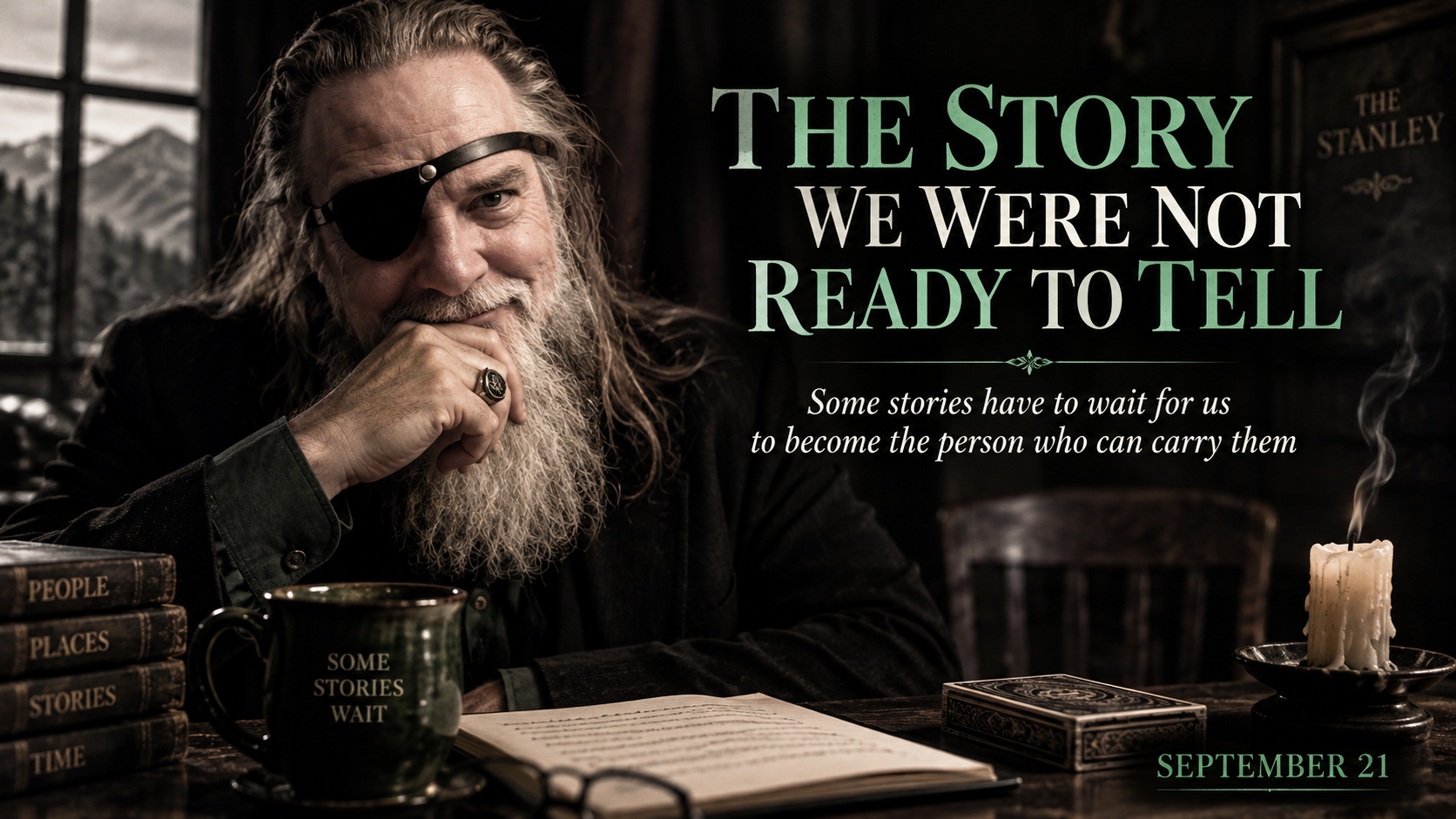

Some stories have to wait for us to become the person who can carry them
There is a story I have been carrying for a very long time that I have never told you. I have come close. More than once, actually. I have opened a blank page and written the first few sentences. I have found myself thinking about it while driving through the mountains, when the road is familiar enough that the hands seem capable of steering without much assistance from the mind. It has appeared while I was preparing for a performance, while shuffling cards, while sitting alone after everyone else had gone. Once or twice I have even heard the beginning of it forming in my mouth, that peculiar moment storytellers recognize when an experience begins arranging itself into language. And every time, somewhere before the story has properly begun, I have stopped. There is nothing scandalous about it. No terrible secret waits at the center. If I told you the facts, you might wonder why I had waited so long. The facts are ordinary enough. But something in me has always answered the same way whenever the story presents itself: not yet.
For most of my life I thought one of the great problems of being a storyteller was finding stories. Young performers worry about this. Young writers do too. We look at the blank page or the empty stage and wonder where all the material is supposed to come from. Eventually, if you stay alive and pay even moderate attention, that problem solves itself. Life becomes embarrassingly generous with material. People arrive. People leave. We fall in love. We disappoint one another. Someone says something at a kitchen table that remains with us for thirty years. A parent grows older. A friendship disappears so gradually that we cannot remember the last time we called it a friendship. We succeed at something we were certain would make us happy and discover that happiness apparently had other plans. We fail at something that seemed catastrophic and later realize it quietly redirected our entire life. By sixty-one, the difficulty is no longer finding stories. They are everywhere. The difficulty is deciding which ones belong in the light.
I think I once believed that remembering something clearly meant I understood it. I know better now. Memory and understanding are not the same faculty, and they do not operate according to the same clock. Memory can be astonishingly immediate. I can remember the architecture of certain rooms from decades ago. I remember where people sat, what the light looked like through a window, the weather outside, a particular expression on someone’s face. I can sometimes remember a sentence almost word for word. The mind is peculiar about what it keeps. It will discard an entire year and preserve the sound of a spoon touching the side of a teacup. But understanding is slower. Sometimes much slower. There are things that happened to me when I was twenty-five that I did not begin to understand until I was fifty. There are probably things happening to me now that some future version of myself, should I be lucky enough to meet him, will look back upon with considerably more clarity than I possess today.
That may be one of the quieter gifts of growing older. We become capable of revisiting the scenes of our own lives without requiring them to mean exactly what we once needed them to mean. The younger man who lived some of my stories was standing much too close to them to see their shape. He needed heroes. He needed villains. He needed causes and consequences arranged neatly enough that he could understand where to place the blame and where to collect the credit. Most of all, he wanted to be understood. I have some affection for him now. He was doing the best he could with the tools available to him. But I would not necessarily trust him to tell all of my stories. He had a habit of confusing certainty with clarity.
After a performance at the Stanley, there is a moment I have come to love. The audience has gone. The room begins returning to its ordinary state. Whatever mysteries existed there a few minutes earlier have apparently packed their bags and left with everyone else. I put the cards back into their case. I straighten the table. The candle is extinguished, leaving that thin curl of smoke that seems to linger much longer than it should. There is a peculiar silence after people have spent an hour listening to you. It is different from the silence before they arrive. The room has been used. Something has passed through it. Sometimes I sit there for another minute before leaving, surrounded by the evidence of stories I chose to tell, and I become aware of the ones I didn’t.
That distinction has become increasingly important to me. A storyteller is defined partly by what he tells, but perhaps also by what he chooses not to tell. There is a dangerous idea lurking around our culture that authenticity requires disclosure. If something happened to us, particularly if it was painful or meaningful, we are encouraged to excavate it, package it, and offer it publicly as evidence that we are being real. I understand the impulse. I have built much of my life around telling true stories. But I no longer believe that everything true must therefore be told. Some experiences deserve privacy. Some require distance. Some belong partly to people who never agreed to become characters in our narratives. A story may belong to my life without belonging entirely to me.
That becomes complicated when we write about other people. Memory is wonderfully unreliable in precisely the places where we most want it to be authoritative. I remember what you said. You remember what I said. We both remember the room. We disagree about why either of us was there. Somewhere between those recollections is an event that actually occurred, but neither of us possesses it completely. This does not mean that truth is meaningless or that harm should be excused because everyone has a perspective. Some things happened. Some wounds are real. Some actions cannot be made harmless by changing the camera angle. But maturity has made me suspicious of stories that require another human being to become smaller so that I can become larger.
There are stories I could have told at thirty that would have made excellent performances. I would have known exactly where the audience should laugh, exactly where they should become angry on my behalf, exactly which details to emphasize so that by the end there would be very little doubt about who had behaved badly and who had survived nobly. I might even have told the truth. That is the uncomfortable part. Every fact could have been accurate and the story could still have been dishonest.
At forty, I might have told the same story differently. Perhaps it would have become a story about survival. About becoming stronger. About leaving something behind and discovering who I was without it. That version might also have been true. We often pass through a period when our wounds become evidence of our resilience, and there is nothing wrong with that. Sometimes we need that story. Sometimes we need to know that what happened did not finish us. But even survival can become a kind of argument if we are not careful. It can quietly require someone else to remain the monster so that we may remain the hero who escaped.
At sixty-one, I find myself less interested in heroes and monsters. Human beings have become considerably more inconvenient than that.
Time has not made every old injury harmless. It has not transformed every betrayal into a misunderstanding or every regret into wisdom. There are things I wish had happened differently. There are things I wish I had done differently. There are people who hurt me, and people I hurt while being absolutely convinced that I was the injured party. Age has not made the past prettier. It has simply given it more dimensions. I can sometimes see now that two people can love one another and still be incapable of giving each other what they need. Two people can be sincere and still misunderstand each other completely. Someone can wound us without waking that morning intending to become the villain in our story. And, perhaps most difficult of all, we can be wounded and still bear responsibility for some part of what happened next.
This is where waiting has changed certain stories for me. Time has removed some of the prosecution from them. I no longer feel quite the same need to present evidence. I do not need to call witnesses. I am less interested in persuading the jury. Some of the sharp edges have worn down, not because they were imaginary, but because I no longer need to hold them tightly enough to cut myself.
Perhaps that is what I have been waiting for with this particular story.
I still will not tell it to you today.
I can feel the temptation, even writing that sentence. There is a theatrical instinct in me that knows withholding something creates curiosity. I could tease the edges of it, give you just enough detail to make you lean forward. But that would defeat the point. The story is not important because you do not know it. It is important because I am beginning to understand why I have not told it.
For years, I think I wanted something from the listener.
I wanted agreement. I wanted someone to hear the story and say, Yes, you were right. Perhaps I wanted sympathy. Perhaps I wanted vindication. Perhaps I wanted another human being to look backward through time and stand beside the younger version of me, reassuring him that he had understood everything correctly. There is nothing shameful about wanting those things. We all want witnesses to our lives. But wanting a witness and telling a story are not always the same act.
Lately I have begun asking myself a different question before telling certain personal stories: What do I need from the person hearing this?
It is an uncomfortable question because the answer is not always flattering. Sometimes I want admiration. Sometimes forgiveness. Sometimes I want you to dislike someone you have never met. Sometimes I want to explain myself so thoroughly that there will be no room left for your judgment. And occasionally I discover that I am telling the story because I have finally reached the point where I need nothing from you at all.
Perhaps that is when a story becomes ready.
Can I tell it without asking you to take my side? Can I allow another person to remain fully human inside my version of events? Can I resist editing away the details that complicate my innocence? Can I admit where memory has become uncertain? Can I leave parts unresolved because life itself never resolved them? Can I tell you what happened without insisting that you arrive at the same conclusion I did?
Those questions feel more important to me now than whether the story is entertaining.
Tonight the room is quiet again. Everything has been returned to its place. The cards are inside their case. The chairs are empty. The candle has gone dark, although the faint smell of smoke remains in the air. Somewhere beyond these walls the Stanley continues with its nightly business, doors closing, footsteps moving through hallways, strangers carrying their own untold stories back to their rooms.
I sit at the table for another minute.
The old story arrives again.
This time I do not push it away. I do not open a notebook either. I simply let it sit across from me, as though it were another person who has been waiting patiently for an invitation. I recognize more of it now. I recognize the younger man inside it. I recognize the other people too, and they look different from this distance. Less like characters. More like human beings.
Maybe that is what all these years have been for.
Some stories do not need better sentences. They do not need stronger endings or more dramatic beginnings. They need us to live long enough to stop asking them to prove what we once needed them to prove.
The story is still there.
I haven’t told it.
But I think, perhaps, I am finally becoming someone who could.