
There comes a moment when protecting the story becomes less important than giving it away
I have a few stories that have traveled with me for so long that I sometimes forget I have never actually told them. I have thought about them. I have rehearsed pieces of them while driving through the mountains, usually when the road is empty enough that the mind can wander without being asked to explain itself. I have encountered them late at night after a performance, when the room at the Stanley has emptied and I am putting things back where they belong. They have appeared while I have been sitting at a table with a cup of tea growing cold beside me, looking out toward mountains that have become familiar enough that I occasionally forget how extraordinary they are. The stories arrive without ceremony. A face. A sentence. A room I haven’t stood in for thirty years. Sometimes I follow the memory for a while, allowing one detail to lead to another. Then, somewhere along the way, I reach the place where I have always stopped. Not because the story is too painful to remember. Not because there is some terrible secret hidden inside it. I simply haven’t known how to tell it without also trying to explain myself.
That distinction has become clearer to me as I have grown older. There are stories we tell because something happened, and there are stories we tell because we are still trying to establish what that something meant. The second kind can masquerade quite convincingly as storytelling. We arrange the facts carefully. We remember precisely what someone said. We explain the circumstances. We provide just enough history for the listener to understand why we behaved as we did. We may even believe we are being extraordinarily honest because we include our mistakes and embarrassments. But underneath all of it there can be a quiet argument taking place. We are building a case. We want the listener to reach a particular verdict about who we were and what happened to us. We want them to understand why we stayed, why we left, why we said the thing we said, why we didn’t say the thing we should have said. We want them to know that we were trying. That we had reasons. That there were circumstances they couldn’t possibly understand unless we explained them properly. We say we are telling the story, but some part of us is still standing before the jury.
I know that because I have done it. There are memories I have carried for decades in which I was always quietly preparing my defense. I could tell you exactly what happened, but I would also want to tell you what happened before that. And once I had explained that, I would probably need to take you a little further back because otherwise you might misunderstand the first explanation. Before long, we would be twenty years earlier and I would be giving you a guided tour through my own history, pointing out the exhibits that proved I had been reasonable. Perhaps you know this impulse. It is remarkably human. We don’t merely want to be remembered accurately. We want to be understood sympathetically. We want the people listening to recognize that the person we were then was doing the best he could with what he knew. Perhaps he was. Perhaps he wasn’t. At sixty-one, I am increasingly suspicious of any story in which I understand everybody’s motives perfectly, particularly my own.
Something has changed in a few of those stories recently. The facts haven’t changed. The people haven’t changed. I haven’t discovered a forgotten letter or received some late confession that rearranged everything. The ending remains exactly where it has always been. What has changed is that when certain memories visit now, I notice that I am no longer rehearsing the defense. I can remember something foolish I did without immediately explaining why it wasn’t quite as foolish as it sounds. I can remember someone hurting me without needing to turn that person into a villain. I can look at an old failure without secretly hoping you will rename it courage. There is an unfamiliar spaciousness around some of these memories now. They have stopped demanding a verdict. And I wonder whether this is one of the ways we know that a story we have carried for years is finally ready to be told.
Age does peculiar things to autobiography. At sixty-one, I am not simply a thirty-year-old man with thirty-one additional years of material. I am, in certain important ways, a different witness. The young man who experienced some of these events saw them from inside the weather. He knew who had betrayed whom. He knew what mattered. He knew which opportunities had been lost and which victories proved something important about him. He had a wonderfully efficient cast of heroes and villains, with himself occupying whichever role seemed most useful at the time. I don’t mean that dismissively. He was trying to understand his life while simultaneously living it. That’s difficult work. Most of us construct meaning from whatever materials happen to be lying nearby. We call something a disaster because it hurts. We call something a triumph because people applaud. We call someone cruel because they leave us. We call someone wonderful because they stay. Then life continues, as it stubbornly does, and occasionally reveals that our original interpretation was embarrassingly incomplete.
Some of the things I once considered failures were doors, although I couldn’t see the hinges at the time. Some victories I carried proudly for years have become strangely small. There are people I blamed for things who, from this distance, look less like villains and more like frightened human beings trying to survive their own stories. There are people I admired whose generosity looks more complicated now. And there are small kindnesses, gestures I barely noticed when they happened, that have grown enormous with time. Someone made a phone call. Someone gave me another chance. Someone sat beside me when there was nothing useful to say. Someone believed me before I had earned that belief. Those moments did not announce themselves as important. There was no music beneath them. Nobody leaned forward and said, “Remember this. It will matter later.” They simply happened, and decades later I find them glowing quietly among the louder events I once thought defined my life.
Perhaps that is why some stories need so much time. It isn’t always that we lack courage. Sometimes we lack perspective. We are standing too close to the painting. We can see individual brushstrokes and swear that we understand the picture. Time doesn’t necessarily reveal the truth in some perfect, objective sense. Memory is far too unreliable for that. But time can loosen our allegiance to the version we once needed. That may be enough. I no longer need every story from my life to explain how I became who I am. Some things happened and I still don’t know exactly what they meant. Some relationships ended without providing the tidy final conversation that would have made a satisfying third act. Some questions were never answered. Some apologies never came. Some of mine arrived too late. There are doors that closed and never reopened. I used to think a story required resolution before it could be told. Now I suspect that what it requires is something much more difficult: the willingness to leave certain things unresolved.
That willingness changes the relationship between storyteller and audience. If I tell you a story while still needing you to agree with me, I haven’t really given you the story. I have handed you an assignment. I need you to admire someone, forgive someone, condemn someone, perhaps forgive me. I may never say so directly, but the architecture will do the work. Storytellers know how to make an audience feel things. We know where to place information. We know which details make a person sympathetic and which make them suspicious. We know how much can be accomplished by withholding one sentence until the right moment. Those are useful skills onstage, but they carry a responsibility. A story from my own life can become an extraordinarily persuasive little machine if I build it carefully enough. I can almost always make myself look better. The more interesting question is whether I still need to.
Maybe maturity in storytelling begins somewhere around there. Not with perfect objectivity, because I don’t believe such a thing exists when we are telling our own lives, but with less insistence. I can tell you what I remember. I can tell you what I thought then. I can tell you what I think now. I can even admit that those three things don’t always agree. What I cannot do is climb inside your head afterward and arrange the furniture. Once I have given you the story, you get to meet it without my supervision. You may find meaning in a detail I considered incidental. You may sympathize with the person I spent years blaming. You may hear sadness where I intended humor. You may think I was wrong. You may carry away something I didn’t know I had put into the story at all.
There was a time when that possibility frightened me more than it does now. Perhaps performers spend so many years learning to control an audience that surrender becomes one of the last techniques we acquire. We rehearse because we care about what happens in the room. We choose words carefully. We learn timing. We understand that a fraction of a second can change laughter into silence. There is craft in all of that, and I love the craft. But the deepest moments I have experienced across a table have rarely felt like control. They have felt like release. Something passes from one person to another, and for a moment neither of us entirely owns what is happening. A story becomes a third presence in the room. It sits between us. We both recognize something in it, although perhaps not the same thing.
That may be what I was protecting all those years. Not the memory itself, but my ownership of its meaning.
There are stories I still cannot tell. I don’t think that is cowardice. Some involve people whose lives are not mine to expose. Some remain too tangled with promises, loyalties, and consequences. Others may simply need more time. I have become less interested in forcing them. A storyteller doesn’t have to empty every drawer. Privacy is not dishonesty. Silence can be an act of stewardship. But there are other stories I once kept locked away that no longer seem to require protection. When I look at them now, I don’t feel the old urge to explain every corner. I don’t need you to decide who was right. I don’t even need the younger version of myself to come out looking particularly good. I find that I have become unexpectedly fond of that fellow, with all his certainty and fear and ambition and astonishing ability to misunderstand what was happening while it was happening. I don’t need to defend him anymore. I can simply recognize him.
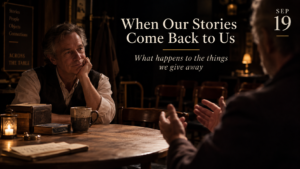
Tonight, after the room has emptied and the last chair has been pushed back into place, I imagine sitting at the table for another few minutes. The candle is out. The work of the evening is finished. Across from me is an empty chair, the sort of chair that has appeared again and again in my thoughts this month. An invitation. A place deliberately left open for another human being.
Between us sits a story I have carried for years.
For most of its life, I treated it like something fragile. I kept it close. Occasionally I opened it privately and examined its contents, making certain everything was still where I remembered leaving it. I protected it from misunderstanding. I protected myself from what someone else might see in it. Perhaps, if I am truthful, I protected my preferred version of myself.
But it doesn’t feel fragile anymore.
It feels finished enough.
So I imagine placing my hand on it and sliding it slowly across the table toward that empty chair. Whoever eventually sits there may understand it differently than I do. They may notice things I missed. They may disagree with conclusions I carried for half a lifetime. They may recognize themselves somewhere inside it and take a piece of it with them when they leave.
That is no longer something I need to prevent.
Because perhaps a story becomes ours in one way while we are living it, and ours in another while we are protecting it. But there comes a moment when keeping it is no longer the most faithful thing we can do.
We give it away.
Not because it no longer matters.
Because it finally matters enough.