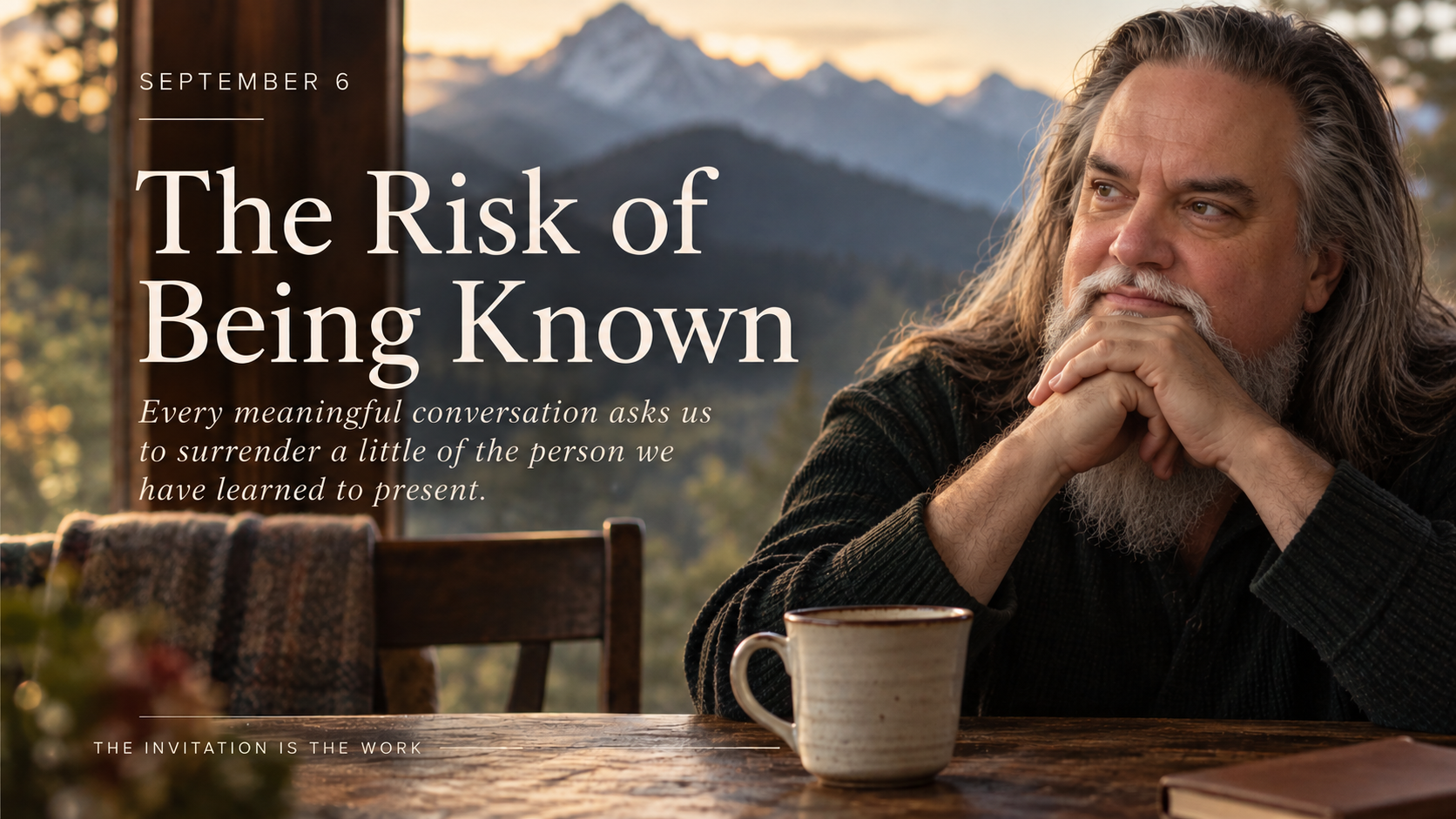

Every meaningful conversation asks us to surrender a little of the person we have learned to present.
I don’t remember what we had been talking about before she asked me if I was all right. That is the peculiar thing about certain conversations. You forget the twenty minutes that preceded the important moment and remember, with unreasonable clarity, the cup in your hand, the sound of the room, the expression on someone’s face when they stopped participating in the conversation you thought you were having. There was tea between us, and I remember reaching for mine even though I didn’t particularly want it. I think I needed something for my hands to do. I have always been good with my hands. Give me a deck of cards, a prop, something that belongs on a stage, and my hands know exactly where to go. Even sitting across a table, they seem to understand that they have responsibilities. Pick up the cup. Straighten something that doesn’t need straightening. Fold them. Unfold them. Gesture at precisely the right moment. But this time there was nowhere useful for them to go. She looked at me for a little longer than people usually do and asked, very simply, “Are you all right?” I had an answer. Of course I had an answer. I have had that answer ready for most of my adult life. But something in the way she asked made it clear that she wasn’t interested in it.
I don’t mean that I had been pretending. That word is too simple, and perhaps a little unfair. I was all right, at least by most reasonable definitions. My life was intact. There was work waiting for me. There were people I loved and people who loved me. There were mountains outside and a dog who believed, with touching certainty, that my presence in a room was reason enough for contentment. I had things to be grateful for, and I knew it. But gratitude and sadness are not opposites. Neither are success and loneliness, confidence and fear, love and uncertainty. We have a habit of arranging our emotions as though only one of them is allowed in the room at a time. If I am grateful, surely I cannot also be lonely. If I am fortunate, surely I have surrendered my right to sadness. If I know how blessed my life has been, perhaps admitting that something hurts would sound ungrateful. So we become editors. We remove the sentences that seem to contradict the story. We smooth the transitions. We make ourselves coherent. And when someone asks how we are, we hand them the version that makes the most sense.
A performer becomes especially good at this, although I suspect most people learn some version of it. I have spent much of my life learning how to control what other people see. That sounds sinister when written plainly, but it is simply part of the craft. A performer understands where to stand, when to speak, how long to allow a silence to live before breaking it. We learn that a glance can direct attention more effectively than a pointing finger. We learn that the smallest gesture can tell an audience where to look and, just as importantly, where not to look. Storytelling has its own version of this. I can tell you something deeply personal and still decide precisely how deeply you are permitted to enter it. I can tell you about grief after I have found the language for grief. I can tell you about failure once I know what the failure meant. I can describe an old wound beautifully after enough time has passed for me to understand its shape. None of that makes the story false. Quite the opposite. Craft is often how we make truth communicable. But there is a considerable difference between telling someone the story of a wound and allowing them to be present while it still hurts.
Perhaps that is the difference between being visible and being known. I have been visible for most of my adult life. I have stood under lights while strangers watched closely. I have told stories to rooms full of people, sat for photographs, written essays, made videos, answered questions after performances, shaken hands in hallways and hotel lobbies, and occasionally had someone tell me that they feel as though they know me because they have followed my work for years. I understand what they mean, and there is something generous in it. They do know something about me. The person onstage is not an invention. The man writing these words is not a character I put on in the morning and remove at night. But neither is he the whole territory. Visibility can be surprisingly selective. You can show thousands of people enormous portions of your life while keeping a few small rooms locked. Sometimes the things we protect most carefully are not terrible secrets at all. They are simply unfinished things. Questions without answers. Grief we have not yet made useful. Fear without a lesson attached to it. Hope we are almost embarrassed to admit because saying what we want gives the world an opportunity to disappoint us.
Being known asks something different because it happens before the editing. It is one thing for me to tell you, years later, about a difficult season and what I learned from it. It is another thing entirely to sit across from you while I am still inside that season and say, “I don’t know.” Those may be three of the most intimate words in the language. I don’t know what happens next. I don’t know whether I made the right choice. I don’t know why I miss this person. I don’t know why something that should make me happy has left me strangely empty. I don’t know why I am afraid. There is no arc yet, no elegant ending, no useful metaphor. The storyteller has arrived without a story. For someone who has spent a lifetime finding language, there is something almost indecent about being witnessed before the language comes.
This does not mean everyone deserves that access. I have become more convinced of that as I have grown older, not less. Vulnerability has acquired a peculiar reputation in our time, as though disclosure itself were evidence of courage and privacy something we ought to overcome. I don’t believe that. There are things in us that deserve protection. There are stories that are ours alone. There are people who have not earned the right to enter certain rooms, and there are relationships that become healthier when a door remains closed. Restraint can be wisdom. Privacy can be an act of stewardship. I have no desire to become transparent to the world, and I am suspicious of the suggestion that complete openness is somehow the highest form of authenticity. A house made entirely of windows would be a miserable place to live.
The more interesting question arrives when the person sitting across from us has earned the right to know. When they have proven themselves careful with our contradictions. When they do not rush to repair us or convert our uncertainty into advice. When they can hear something difficult without immediately making it about themselves. What happens then, when every reasonable condition for honesty has been met, and we still reach instinctively for the polished answer? I wonder how many of us have become so practiced at protecting ourselves that we continue guarding doors long after the danger has gone. The protections that helped us survive one season can become habits in another. The performer learns to manage the room because managing the room is his job. Then one evening he discovers that he is still managing the room when there is only one other person in it.
Age has made me notice this more. At sixty-one, I have spent a considerable amount of time constructing the man I am. I don’t say that cynically. Much of him was built deliberately and honestly. We all make ourselves to some degree. We decide what matters, what standards we will keep, what work we will do, what promises we intend to honor. Over time those decisions accumulate into something recognizable as character. I like much of the man I have become. I don’t want to dismantle him in pursuit of some supposedly purer self hiding underneath. But I am beginning to understand the relief of occasionally setting him down. Of not needing to be the storyteller for an hour. Of not needing to know what something means. Of allowing somebody trustworthy to meet the man who sometimes misses people more than he knows how to say, who has regrets he cannot turn into lessons, who can be frightened by the speed with which the years disappear, who can stand comfortably before a room full of strangers and occasionally feel utterly uncertain sitting across from one person he loves.
Maybe that is one of the things intimacy offers us, not exposure, but rest. A place where the machinery can stop. A place where we are not required to be articulate about our own lives. I think about all the people I have met after performances who lingered because there was something they wanted to say. Often they begin with the show. It gives us somewhere safe to start. Then, sometimes, their voice changes. They stop telling the prepared version. They look down at their hands. They say something that has nothing to do with what happened onstage, except perhaps that something onstage gave them permission to speak. I have always considered it a privilege when someone trusts me with that moment. What I am learning, perhaps rather late, is that trust occasionally asks for reciprocity. Not equivalence. Not an exchange of secrets. Simply the willingness to be there as another unfinished human being.
The tea had gone cold by the time our conversation ended. I remember that because I picked up the cup again and took a drink without thinking, then made a face at it. She laughed. I laughed too. There had been no revelation worthy of writing down. I had not confessed some enormous hidden truth. She had not solved anything for me, and I had not suddenly understood myself. I had simply failed, for once, to give the polished answer. We sat there a little longer. The room was quiet. Nothing had been repaired. Tomorrow would still arrive carrying whatever tomorrow intended to carry. But for a little while, neither of us was performing for the other.
I think that may be one of the quiet privileges of the invitation. We pull out the chair. We make room. We stay long enough to hear what someone is actually saying. We learn to hold what they entrust to us, and sometimes we have the good sense not to answer at all. But eventually, if the invitation is real, something else may be asked of us. We may have to stop being merely the keeper of another person’s truth and risk offering a little of our own. Not the finished story. Not the version polished by time and made presentable by craft. Just the thing itself, still uncertain, still contradictory, still alive.
Two people across a table. Cold tea between them. Nothing solved.
And, for once, nothing needing to be.


