
I noticed her because she moved.
It wasn’t much. She didn’t raise her hand or interrupt or make one of those involuntary sounds people sometimes make when a story catches them by surprise. She simply leaned forward. I was in the middle of telling a story, and somewhere along the way she had moved from the back of her chair toward the edge of it. Her elbows were closer to her knees now. Her head had tilted slightly. I don’t remember exactly what I was saying at that moment, which is probably appropriate because what I remember most clearly is not the story but the distance between us. A few minutes earlier there had been the ordinary space between a performer and an audience member, that invisible border created by expectation. I was here. She was there. I was telling. She was listening. Then something changed. The room had not become smaller, but it felt smaller. She had come closer without taking a single step.
You learn to notice these things when you have spent enough of your life in front of people. Applause is obvious. Laughter is obvious. Silence can be obvious too, although silence has more varieties than most people imagine. But the body is often more truthful than any of those things. People settle when they are interested. They become restless when they aren’t. They cross their arms, uncross their legs, look toward the door, glance at the person beside them, reach for a glass, check the time. And sometimes, when you have them, they lean forward. I have seen an entire audience seem to move an inch closer without anyone being aware they were doing it. There is something wonderfully humbling about that gesture because you cannot ask for it. You cannot put it into the lighting cue. You cannot write it into the script. You can say, “Ladies and gentlemen, please give me your attention,” but attention given because it was requested is not the same thing as attention that has quietly forgotten everything else in the room.
When I was younger, I thought much more about reaching the back of the room. Most performers do. We learn to project. We learn to make gestures readable from a distance. We learn that hesitation can look like uncertainty, that a voice needs to carry, that energy must travel beyond the edge of the stage. There is good craft in all of that, and I am grateful I learned it. But youth has a way of confusing size with strength. Bigger voice. Bigger personality. Bigger reaction. Bigger moment. There is a period in the life of many performers when we seem to believe that if the audience is not coming toward us, the answer is to push harder toward them. So we add another gesture. We sharpen the joke. We increase the volume. We underline the important sentence. We become determined to make certain nobody misses what we are doing, and sometimes in that determination we leave them no reason to come looking for it.
Age has done something curious to my understanding of distance. I am less interested now in reaching the back wall than I am in creating the sensation that there is no back wall. I want the person twelve rows away to feel as though there is a chair pulled up beside me. I want a room full of people to somehow become a conversation between two. That requires a different kind of confidence. You have to trust a quiet sentence enough not to decorate it. You have to allow a pause to remain empty. You have to resist rescuing a moment simply because nothing appears to be happening. Perhaps most difficult of all, you have to stop proving that you deserve their attention. You have to give them somewhere to place it.
I think we make the same mistake with one another.
Away from the stage, most of us are performing more often than we care to admit. Not dishonestly, necessarily. We simply become skilled at presenting the version of ourselves that seems most likely to be welcomed. We tell the funny story. We offer the clever observation. We explain where we’ve been and what we’ve done. We become interesting. I know how to do this rather well. I have spent a lifetime learning how to keep a conversation moving, how to rescue an awkward silence, how to find the story hidden inside an ordinary exchange. Those are useful abilities until they aren’t. There are moments when another person does not need us to keep the conversation alive. They need us to stop interfering with it.
The people I remember most are rarely the people who worked hardest to impress me. They are the ones who made me forget that impressing anyone was necessary. They listened without preparing their response. They let me wander down the wrong road for a while because they understood that sometimes the wrong road is how we discover what we actually wanted to say. They didn’t rush to reassure me when I said something uncomfortable. They didn’t turn every confession into a matching story from their own life. They stayed. And in staying, they created a peculiar kind of permission. I found myself leaning forward.
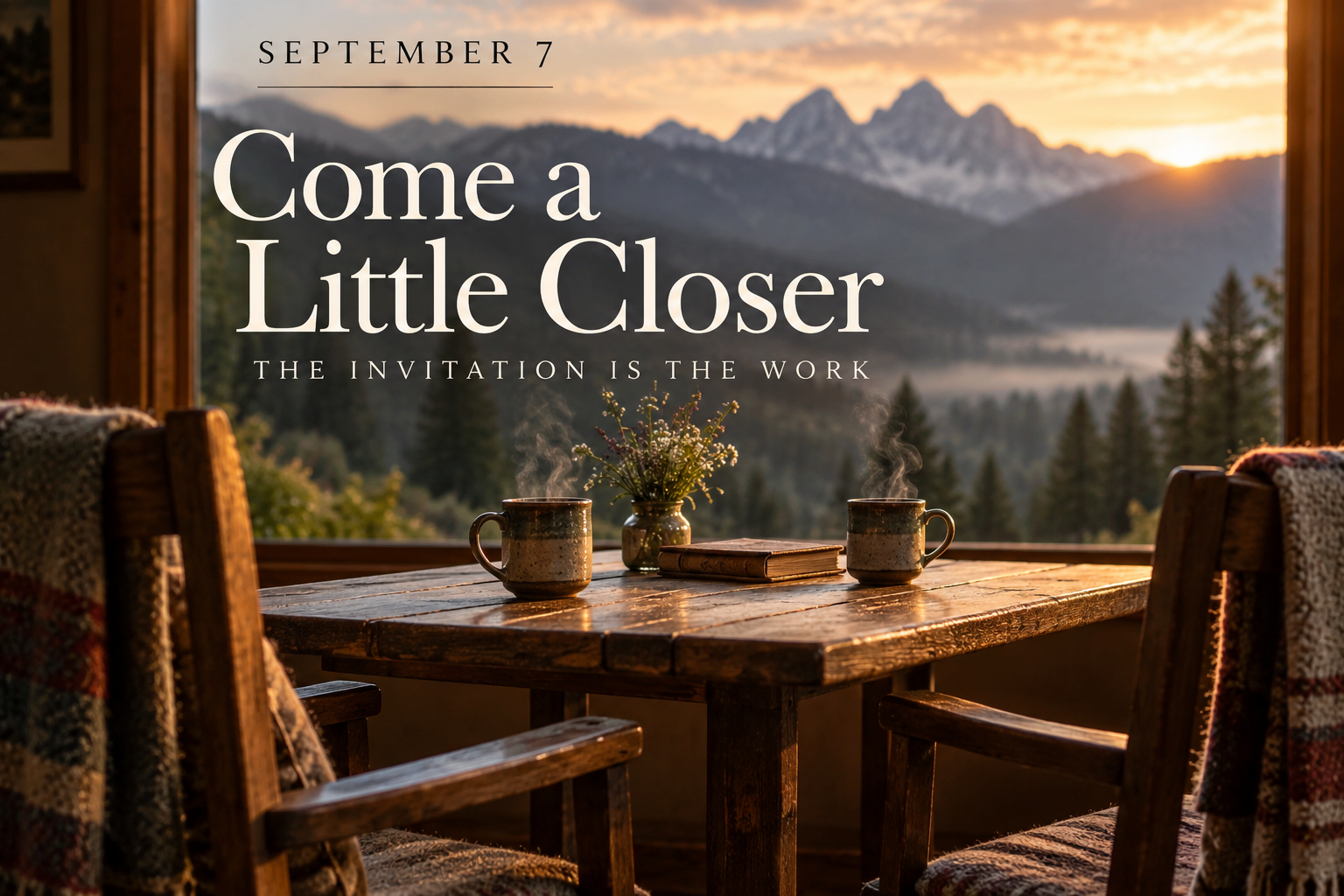
That may be one of the quietest forms of hospitality we can offer another human being. Not merely a chair, but room inside the conversation. Room to hesitate. Room to reconsider. Room to say something badly before finding a better way to say it. Room to stop speaking altogether. We talk so much about connection as though it were something we manufacture through the proper words, but I wonder whether much of what we call intimacy is simply the absence of pressure. Nobody pulling. Nobody insisting. Nobody saying, “Come closer.” Just the unmistakable sense that if you choose to move an inch nearer, there will be room for you.
Stories work that way too. The best ones I know do not drag you through the front door. They leave it open. They put a little light in the window. They allow you to hear something happening inside, and then they trust your curiosity. Perhaps that is why I have become increasingly suspicious of stories that explain themselves too thoroughly. If I tell you exactly what something means, exactly what you should feel, exactly what lesson you should carry away, I have occupied all the available space. There is nowhere left for you. A story needs an empty chair somewhere inside it. Something unfinished. Something the listener must bring with them. Something that belongs to neither of us until we are sitting there together.
Maybe this is what I have been learning all these years without knowing that I was learning it. The work was never simply getting people to listen. The work was making listening feel worthwhile. It was never closing the distance by force. It was becoming trustworthy enough that someone might close a little of it themselves.
This morning there is tea on the table. Beyond the window the mountains are doing what mountains do, which is to remain completely indifferent to our urgency. Two chairs face one another. Nothing remarkable is happening. Nobody is performing. Nobody is trying very hard to be interesting. One person says something, then stops. The other does not hurry to fill the silence.
After a while, almost without noticing, one of us leans forward.


