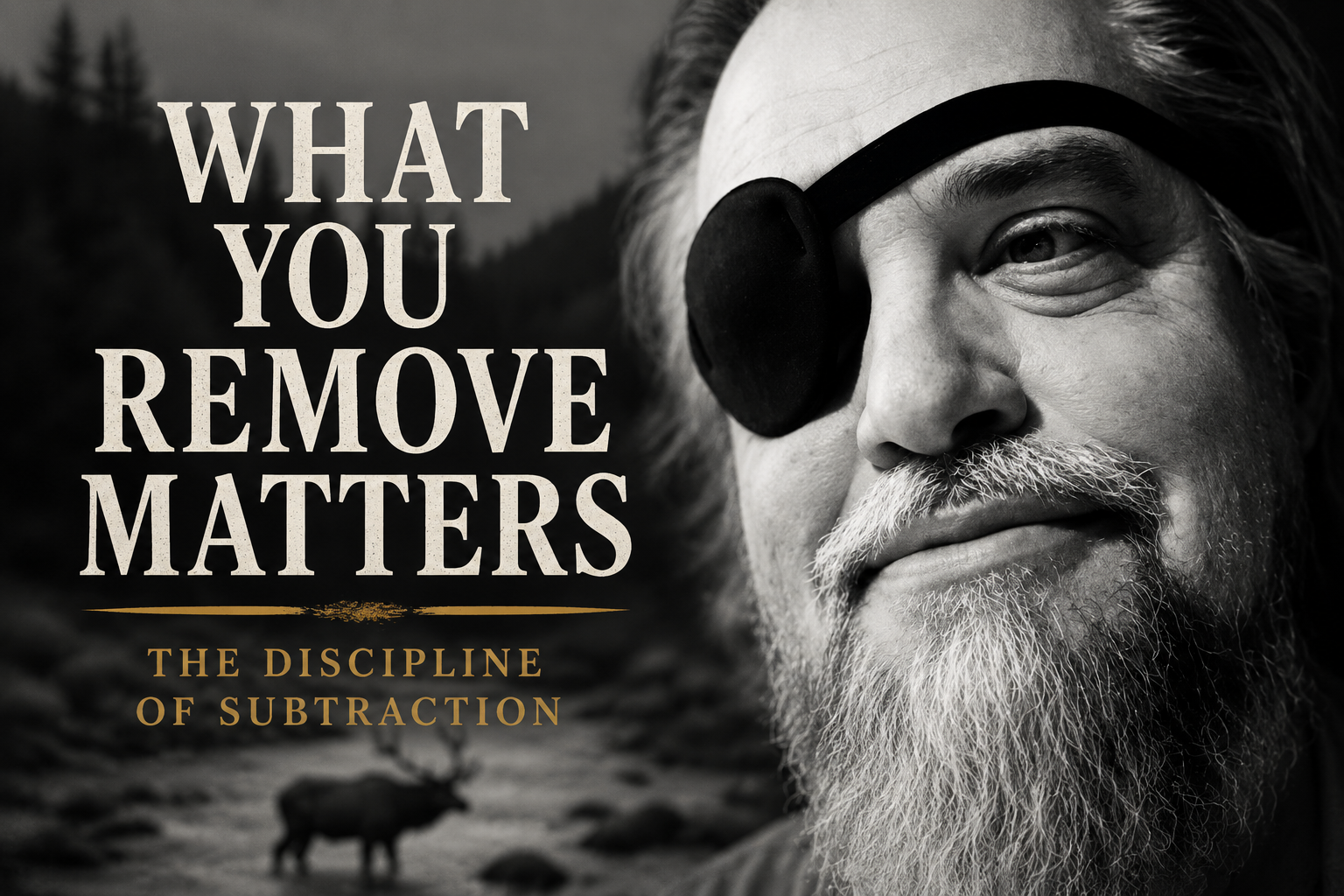

The Discipline of Subtraction
I noticed it while watching the elk at the river this morning. Not in some dramatic way, not with music swelling in the background as if life had arranged itself into a lesson. It was quieter than that. One of them stepped into the current and moved against it for a few moments before changing direction slightly. Barely at all, really. Just enough to stop fighting unnecessary water. Just enough to let strength become useful again.
My beautiful black dog had been watching them long before I had. Head resting on her paws, ears lifting every now and then, content to pay attention without needing to interfere. There is something instructive about animals that way. They rarely add complication where none is needed. Human beings, especially creative human beings, can be remarkably talented at doing the opposite.
We add because adding feels like effort. We add because subtraction can feel like loss.
I have watched so many performers do this. I’ve watched speakers do it. I have watched myself do it. The instinct appears in rehearsals, in scripts, in conversations, in businesses, and eventually in life itself. A story feels weak, so we add another point. A presentation feels thin, so we add more slides. A show feels uncertain, so we add another effect, another joke, another explanation. We begin building little fortresses around the thing itself, convinced that more structure means more strength.
Then I stand in a room full of people and feel it happen.
There is a moment during a performance when the audience tells you the truth, and they do not always tell you with words. Usually, they tell you with silence. A certain kind of stillness settles over a room when something real lands. You can feel people lean toward it, even if they do not physically move. And sometimes, if you are paying attention, you realize the strongest moment in the evening was not created by what you added. It was created by what you finally had the courage to remove.
A line disappears.
An explanation goes away.
A movement becomes smaller.
Space enters.
And suddenly people can step inside.
The strange thing about continuation is that eventually you stop asking, what else do I need? and begin asking, what can I release? Those are different questions entirely.
I think many people assume integration means carrying more things with you. More habits. More systems. More rituals. More practices. More optimization. But carrying the work into every room has shown me something different. Integration often asks for less. Less performance around the performance. Less negotiation with yourself. Less noise between who you are and what you do.
Not because everything unnecessary can be removed all at once. Life does not cooperate that way.
Energy changes. Circumstances interrupt. The room shifts. Some days you are sharp and present and full of momentum. Other days you are drinking tea on the porch, staring at the river, feeling as though your thoughts are arriving several minutes behind the rest of you. Friction remains part of the arrangement.
But even then, subtraction matters.
You can remove the expectation that every day must feel inspired.
You can remove the idea that momentum always feels exciting.
You can remove the belief that difficulty means something has gone wrong.
You can remove the exhausting little performance of pretending you are beginning again each morning.
Because you are not beginning again.
You are continuing.
The river beyond the porch keeps moving without asking permission from the weather. The elk drift in and out of view. My dog finally lifts her head and looks back toward me as if checking whether I intend to sit here all day.
Maybe I will … for a little while longer.
And wherever you happen to be while reading this, whatever work has found its way into your hands, I hope there is some gentleness near you today, some steady thing that stays close and reminds you that not everything valuable arrives by addition.