
I noticed it again the other night, standing just offstage while the audience settled into their seats. The room had that familiar feeling of expectancy mixed with distraction. People arriving from long drives through the mountains. Couples carrying the residue of small arguments. Someone checking a phone one last time before the lights lowered. Someone else already leaning forward, ready to believe in something for an hour. And there I was, not preparing to become someone else exactly, but preparing to remain recognizable.
That distinction matters more to me now than it used to.
There was a time when I believed every new room required a fresh explanation of myself. A sharper introduction. A clearer brand. A revised articulation of what I did and why it mattered. I thought consistency meant repetition at the level of language, as though saying the same things enough times would eventually establish identity. But identity is rarely built through announcement. It settles into the body through continuity. Through returning. Through the accumulation of choices that begin to sound like the same voice, even when the circumstances around it keep changing.
Public creatives often exhaust themselves trying to reintroduce themselves to every shifting room. Different audience, different platform, different energy, different season of life, and suddenly the temptation appears again. Maybe I should change the tone. Maybe I should simplify. Maybe I should become more polished, more visible, more current, more marketable. There is a subtle panic that arrives when conditions change, the feeling that your work must immediately explain itself again in order to survive the transition.
But most people are not actually looking for reinvention from you. They are looking for coherence.
Not rigidity. Not sameness. Coherence.
The kind that allows someone to encounter you in a theater, on a screen, across a dinner table, or in a quiet conversation after midnight, and feel that the same person arrived each time. Maybe older. Maybe more tired. Maybe carrying more grief or more perspective than before. But fundamentally intact.
That integrity becomes visible over time.
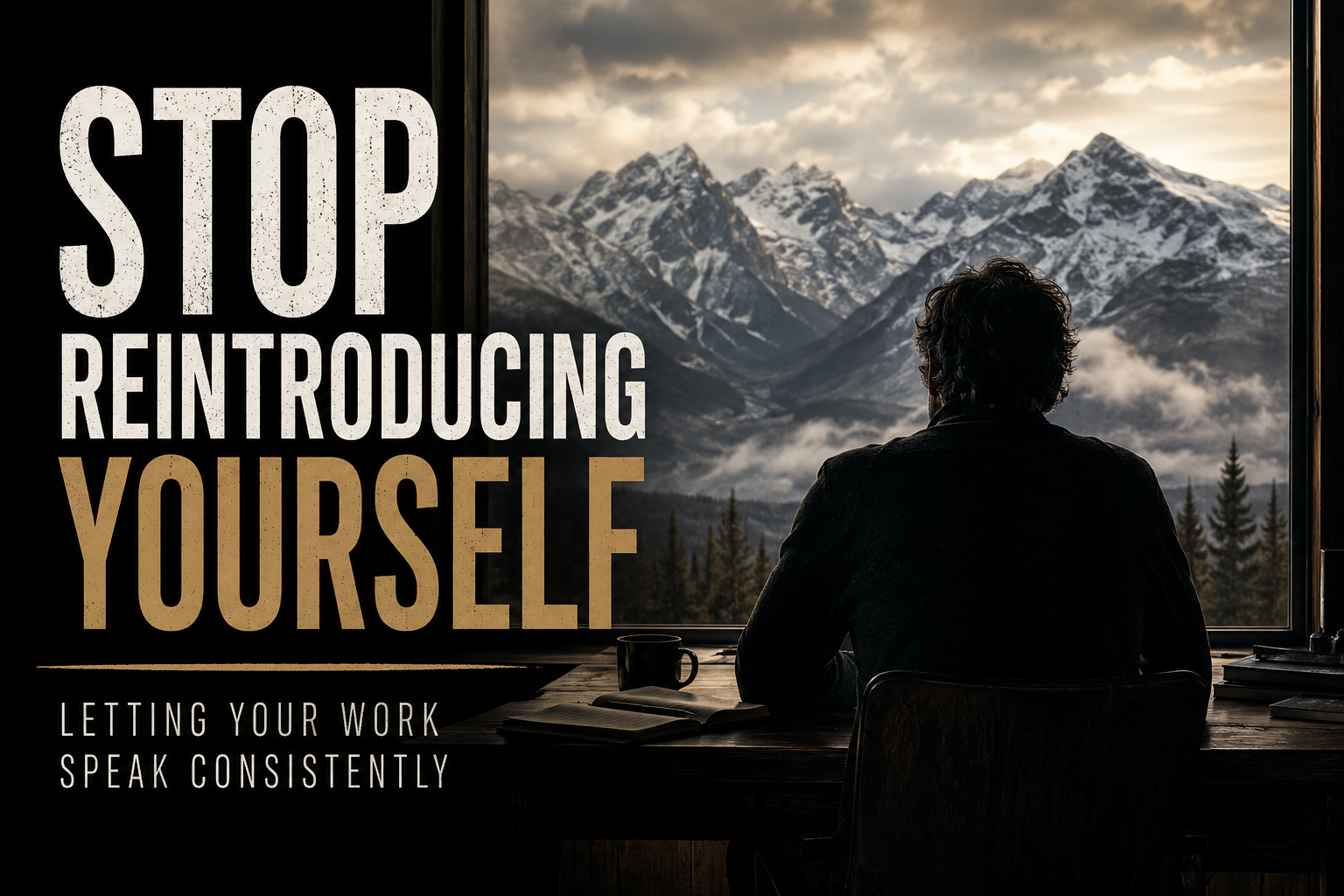
I think about this often while sitting at the table in my office in the early morning, the Rockies still carrying snow in the distance even as the season changes below them. The work waiting here rarely feels glamorous. Some mornings the writing arrives cleanly. Other mornings it feels like walking through mud in heavy boots. The same is true for rehearsals. For conversations. For creating anything worth returning to. Energy shifts. Confidence shifts. Attention shifts. The room changes constantly.
But eventually you realize the goal is not to manufacture a new self for every condition. The goal is to stop abandoning yourself whenever the conditions become less ideal.
That abandonment can happen quietly. You start speaking in a voice that does not belong to you because you think this audience requires it. You loosen standards that once mattered because exhaustion has made negotiation feel easier than steadiness. You begin treating your own identity as something temporary and situational, rather than practiced and lived.
And the strange thing is, audiences feel it immediately.
Not intellectually. Humanly.
People know when someone walks into a room carrying a life that has actually been inhabited. They know when the words coming out of someone’s mouth have survived contact with reality. The performers I trust most are rarely the loudest or newest or most optimized. They are the ones whose presence feels continuous. The ones who stopped treating every appearance like a casting audition for their own existence.
Integration asks something quieter and more difficult. It asks whether you can remain legible to yourself while life keeps moving around you. Whether your values still sound like your values when you are tired. Whether your voice still sounds like your voice when the audience changes shape. Whether the work continues to belong to you after the novelty wears off.
I do not mean perfection. Some days still fracture. Some seasons still scatter things that once felt settled. Integration is not clean architecture. It is maintenance. It is carrying the same flame through different weather and learning how to shield it without turning it into a performance of endurance.
And maybe that is why consistency becomes comforting instead of restrictive after enough years. You stop waking up wondering who you need to become in order to continue. You simply return to the work already in progress.
Outside the window now, the mountains have disappeared behind weather again. They do that often here. But their absence from view never makes me question whether they remain. Some things do not need constant reintroduction in order to be real.
Wherever this finds you tonight, I hope there is steadiness near you. A good chair. A quiet room. Someone kind. And enough trust in your own voice to keep carrying it forward without apology.