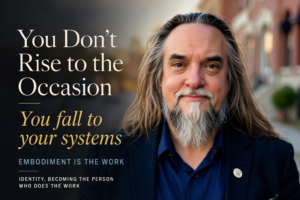

All I did was show up. On the street, in the restaurant, in the theater. I showed up and I did the act and I refined and polished night after night. Thirty years. Again and again and again. There were nights I grew sick of my own voice. Shows where the material was so ingrained that I wondered if I sounded robotic, and adjusted. I found myself wondering if I had already delivered that line, that joke?
That’s how the act gets good, though. That’s how your character steps up.
Repetition Is Where Identity Forms
There is a quiet misunderstanding that lives in the early days of any serious creative life. It whispers that identity arrives in a moment, that one day you simply decide who you are, step onto the stage, and declare it. The lights come up, the voice settles in, and from that point forward, you are the thing you hoped to become.
But that is not how it works.
Identity does not arrive. It accumulates.
It gathers itself slowly, almost reluctantly, in the space where repetition takes root. Not the glamorous repetition we like to talk about, not the highlight reel of performances or the carefully curated posts, but the quieter, less visible returning. The same chair. The same page. The same small rituals that, over time, begin to shape not just what you do, but who you are while doing it.
If you’ve been at this for any length of time, you’ve felt the tension. The part of you that wants to move on too quickly. To evolve before anything has fully settled. To declare mastery before the body has caught up to the idea.
Repetition, in contrast, asks something different of you. It asks you to stay.
To stay with the piece a little longer than feels comfortable. To stay with the structure when it begins to feel familiar. To stay with the audience, not as an abstract, but as a presence you meet again and again until you understand something deeper about how you stand in front of them.
This is where identity begins to form, not in the first attempt, but in the fifth, the fiftieth, the five hundredth. Somewhere along the way, something shifts. The gestures become less forced. The voice finds a natural cadence. The choices you make are no longer borrowed, they are earned.
And perhaps most importantly, you begin to trust yourself.
Not because everything works, it won’t, but because you’ve returned enough times to know that you will.
For public creatives, for speakers, for performers, this is where the real work lives. Not in the search for something new, but in the willingness to deepen what already exists. To revisit the same material, the same themes, the same structures, until they begin to reveal layers you couldn’t see before.
It is tempting to confuse repetition with stagnation. To assume that doing something again means you are not growing. But growth, the kind that lasts, rarely looks dramatic from the outside. It looks like refinement. It looks like subtle shifts in timing, in tone, in presence. It looks like a performance that feels more grounded, not because it is different, but because you are.
There is also a discipline here that cannot be avoided. Repetition removes the illusion of inspiration as the primary driver. It replaces it with something steadier. A kind of practiced attention. You show up whether you feel ready or not. You do the work whether it feels inspired or not. And over time, the work begins to meet you there.
This is the part many people resist. They want identity without repetition. They want presence without practice. They want to feel like the person without becoming the person.
But embodiment doesn’t negotiate in that way.
It asks for consistency. For a certain kind of patience. For the willingness to let time do its work on you.
If you look closely at the performers and speakers who carry real weight in a room, you will see this. Not just talent, but familiarity. Not just confidence, but evidence of having been here before, many times, in many ways, with enough repetition that nothing feels entirely foreign.
That familiarity is what allows them to be present. To listen. To adjust. To respond in real time without losing themselves.
And that, ultimately, is what most of us are after. Not perfection, but presence. Not performance as display, but performance as relationship.
Repetition is what makes that possible.
So if you find yourself in the middle of it, in the returning, in the doing it again when no one is watching, understand that this is not a detour. This is the path.
You are not just refining a skill. You are forming a self.
And if you are willing to stay with it, to let the repetition do its quiet work, you may find that the person you were trying to become has been taking shape all along.
If you feel that shift beginning, even slightly, stay close to it. There is more here than it first appears.