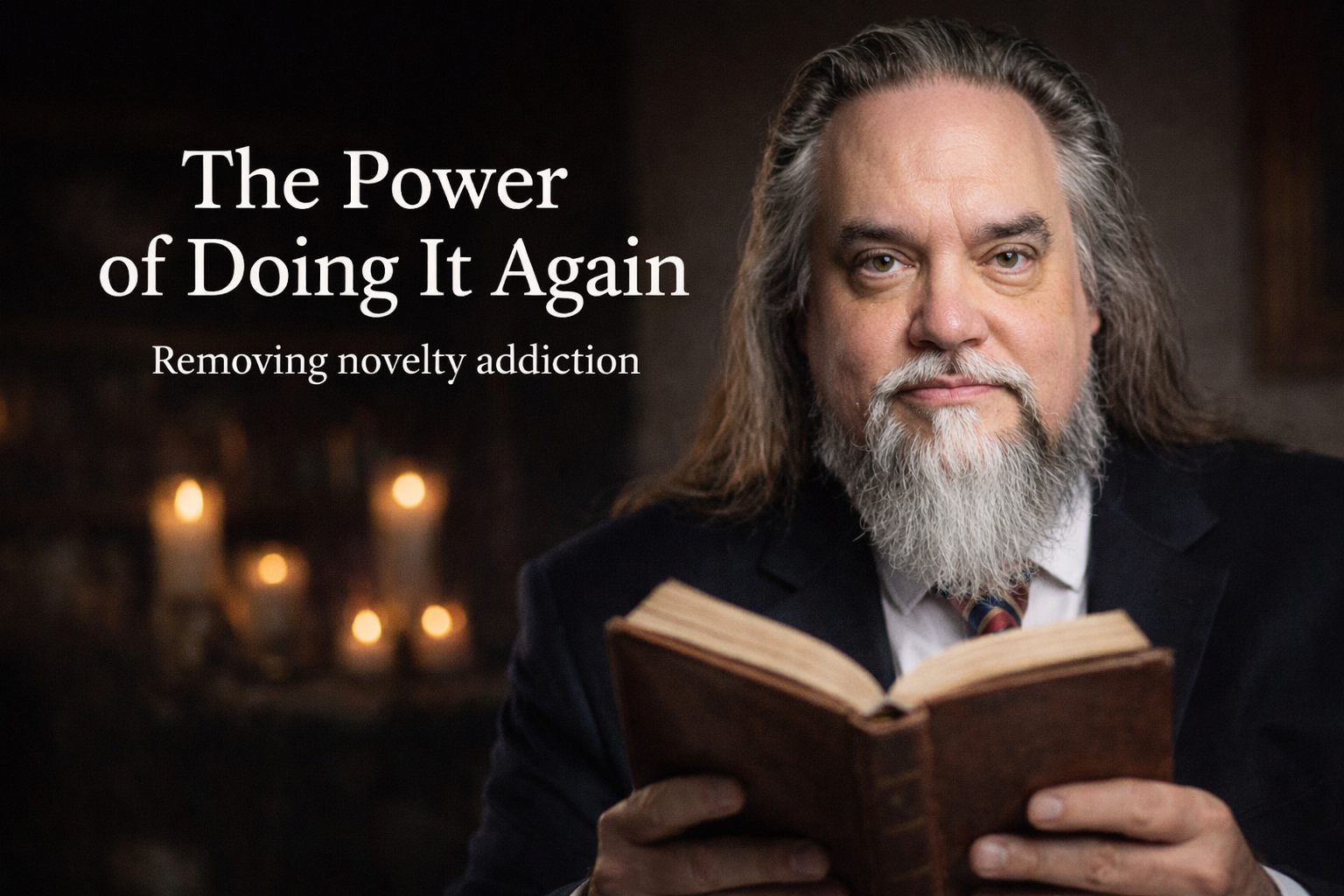

The Power of Doing It Again
Removing novelty addiction
There is a particular kind of restlessness that lives in creative people. It disguises itself as curiosity, sometimes even as ambition, but if you sit with it long enough, you begin to recognize its rhythm. It is the quiet urge to move on too quickly. To reach for the next idea before the current one has fully taken root. To trade depth for the brief, intoxicating lift of something new.
Most people never question this impulse. In fact, it is often rewarded. Newness looks like progress from the outside. A new routine, a new platform, a new direction, a new version of the work. It gives the impression of movement, and movement is easy to mistake for growth.
But the work we are actually talking about here, the kind that changes how you stand in a room, how you speak, how you listen, how you hold attention without forcing it, does not respond well to constant change. It asks something quieter and far less glamorous. It asks you to stay.
Embodiment is not built through novelty. It is built through return.
When you repeat something, not mechanically, but attentively, you begin to notice what was invisible the first time. The second pass reveals tension. The third reveals timing. The fourth reveals where you are still pretending. And somewhere along the way, often later than you would prefer, the work begins to move from something you are doing into something you are becoming.
This is where many people step away.
Not because they are incapable, but because repetition removes the illusion of talent as the primary driver. It exposes the quieter truth that presence is earned through familiarity. Through sitting with the same material, the same gestures, the same ideas, until they stop feeling like choices and start feeling like extensions of you.
There is a moment in rehearsal, and it happens in many forms, where the work stops cooperating. It no longer gives you that early satisfaction. It resists being polished. It reveals your habits. It shows you where you rush, where you soften, where you hide. And if your relationship to the work is built on novelty, that moment feels like a signal to leave.
But it is not a signal to leave. It is the doorway.
Doing it again, especially when it no longer feels exciting, is not punishment. It is refinement. It is where the edges get sanded down, where unnecessary movement falls away, where intention becomes visible. The audience may never see the repetitions themselves, but they will feel the result. They will feel the difference between something performed and something lived.
For those of you who speak, who stand in front of rooms, who try to carry something meaningful across the space between you and another human being, this matters more than you might think. Your words are only part of the exchange. The rest is carried in how settled you are inside them. That kind of steadiness does not come from trying new things every day. It comes from returning to the same thing until it no longer feels separate from you.
There is also a quieter benefit that rarely gets mentioned. Repetition reduces noise. When you are not constantly chasing the next idea, you begin to hear the current one more clearly. You notice subtleties. You make smaller, more precise adjustments. The work becomes less about invention and more about listening.
This is not an argument against growth or evolution. It is an invitation to reconsider how those things actually happen. Growth, at least the kind that holds under pressure, is less about expansion and more about integration. It is not how many new things you can add, but how deeply you can inhabit what is already in front of you.
So if you find yourself reaching for something new, pause for a moment. Not to deny that impulse, but to question it. Ask whether you have truly finished with what you are holding now, or if you are simply uncomfortable staying with it long enough to let it shape you.
There is a kind of power in doing it again. Not louder, not bigger, not different for the sake of difference, but more honest, more grounded, more yours.
If you are willing, stay with it a little longer than is comfortable. There is more there than it first appears. And if you choose to keep going, quietly and without announcement, you may find that the work begins to meet you in a different way.
When that happens, we can continue from there, together, one deliberate return at a time.