
Every performer eventually learns the same quiet truth.
Commitment is not a mood.
It is a decision.
Moods arrive like weather. They move in, move out, change their mind, and rarely ask permission. If your work depends on feeling inspired, you will spend long stretches of your life waiting for clouds to part that never quite do.
Commitment is something else entirely. It is the act of showing up whether the weather cooperates or not.
For those of us who stand in front of other people, storytellers, speakers, performers of any kind, this matters more than we often admit. Audiences experience the finished moment. They see the story land, the room go quiet, the laugh arrive exactly where it should. What they do not see is the slow architecture that made the moment possible.
Structure.
Ritual.
Repetition.
Without those things, most artists do not fail dramatically. They drift.
Drift looks harmless at first. A week where you do not write. A month where you do not rehearse anything new. A season where you promise yourself you will “get back to it soon.”
Soon becomes a year faster than you expect.
Drift is expensive because it does not charge you all at once. It takes small payments over time. A little confidence here. A little momentum there. Before long you are not standing on the path you thought you were walking. You are standing somewhere nearby, wondering how the distance appeared.
The trouble is not lack of talent. Most of the people reading this have more talent than they strictly need.
The trouble is lack of scaffolding.
Talent without structure collapses under its own weight. The ideas pile up. The half-finished pieces accumulate. The intention remains noble, but nothing quite crosses the line into completed work.
Structure solves this quietly.
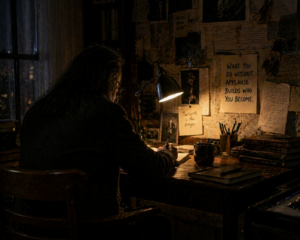
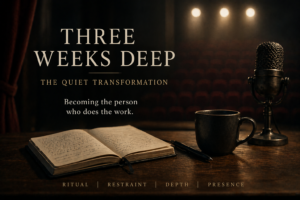
A daily practice. A regular rehearsal. A standing hour where the phone goes away and the notebook opens. Not glamorous. Not Instagrammable. Just dependable.
Over time something interesting happens. What began as discipline becomes identity.
You stop asking yourself whether you feel like doing the work. You simply recognize yourself as someone who does it.
I have watched this happen in magic rooms, rehearsal halls, writing desks, and small theaters across decades. The performers who last are rarely the most explosive talents in the beginning. They are the ones who built structures strong enough to hold a lifetime of work.
They know what days are for.
They know where the work lives.
They know that inspiration is welcome, but it is not required.
If you are a public creative, someone who hopes to show up more meaningfully in front of others, this matters deeply. The audience deserves the version of you that has been practiced, refined, and clarified. Not the version assembled at the last moment because you happened to feel motivated that afternoon.
Commitment protects the audience from your moods.
It also protects you from the quiet erosion of drift.
Years from now you will not remember every rehearsal or every page written. What you will notice is that the body of work exists. The stories are stronger. The voice is clearer. The table you built has room for others to sit down.
And that is the real point of the structure.
Not productivity. Not metrics. Not noise.
Presence.
The kind that only arrives when someone has been tending the same fire for a very long time.
If this way of working speaks to you, if you are someone who prefers depth over spectacle and practice over hype, then you are already part of a quiet company of people doing the long work.
You know where the table is.
You are always welcome to pull up a chair.