
There is a moment, after the last hand has been shaken and the final guest has drifted out into the hallway, when the room remembers what it was before you arrived.
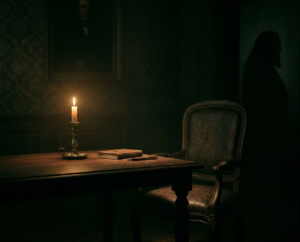
The candles are lower now. The air has settled. The chair across the table is empty again.
And this is the part no one talks about.
Because we spend so much of our lives training for the applause.
We rehearse for it. We build toward it. We edit ruthlessly in its name. We cut the stories that do not land quickly enough, we tighten the pauses that might otherwise breathe, we polish the phrases that seem to catch the light just right when spoken aloud to a room full of strangers.
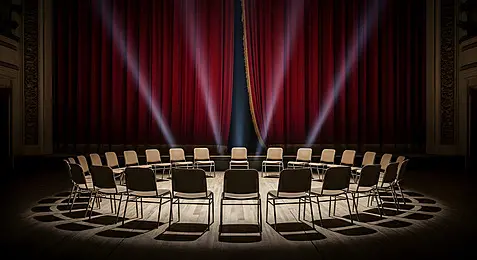
Then the lights come up, the hands meet, and for a moment, it feels like confirmation.
You did it correctly.
You were seen.
You were enough.
Now, in the era of digital rooms and endless stages, the applause has become quieter, but far more constant. It arrives as a number, a graph, a small red notification bubble. It refreshes itself while you sleep. It tells you, in tidy increments, whether or not you mattered today.
Five hundred views.
Twelve new subscribers.
A watch time increase of 1.3 percent.
We begin, slowly and without noticing, to live for this version of applause. To measure the value of our voice by how efficiently it travels. To decide which parts of ourselves deserve to remain based on which ones are easiest to like.
And yet, every night, after the séance concludes and the table is cleared, there is still the same quiet.
No analytics dashboard waits for me in the darkened parlor. No algorithm lingers beside the teacups. There is only the echo of conversation and the soft, unremarkable act of putting things back where they belong.
This is where the real work lives.
Not in the crescendo, but in the return.
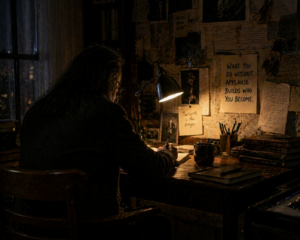
After the applause, you still have to be a person. You still have to speak kindly to the barista in the morning. You still have to decide whether you are going to write today, even if no one is watching. You still have to sit across the kitchen table from someone you love and offer them your full attention, without the benefit of stage lighting or a closing line.
Metrics cannot tell you whether the story mattered.
They can tell you whether it traveled.
They can tell you how long someone stayed before scrolling.
They cannot tell you if a sentence followed someone home.
They cannot tell you if the work helped someone forgive their father, or start their novel, or finally raise their hand in the meeting where they have been silent for years.
They cannot tell you if someone felt less alone.
And if you are not careful, you will begin to neglect the parts of your practice that do not perform well in public. The slow reading. The private journaling. The long walks where no insights arrive. The rehearsal that exists solely to make you steadier, not louder.
But these are the things that carry you back to the table tomorrow night.
These are the things that keep your voice recognizable to the people who matter when the room is full, and when it is not.
You are not building an act.
You are building a life that can survive the standing ovation.
A life that does not collapse when the video underperforms.
A life that does not become uncertain when the subscriber count stalls somewhere in the high fifty thousands and refuses, for a time, to budge toward six.
A life that knows what it is for, even when the applause does not arrive on schedule.
Because eventually, always, the hands grow quiet.
The house lights come up.
And you will still need somewhere to sit.
Still need something honest to say to the person across from you.
Still need the willingness to begin again, in a room that does not yet know your name.
The applause is lovely.
But it is not the point.