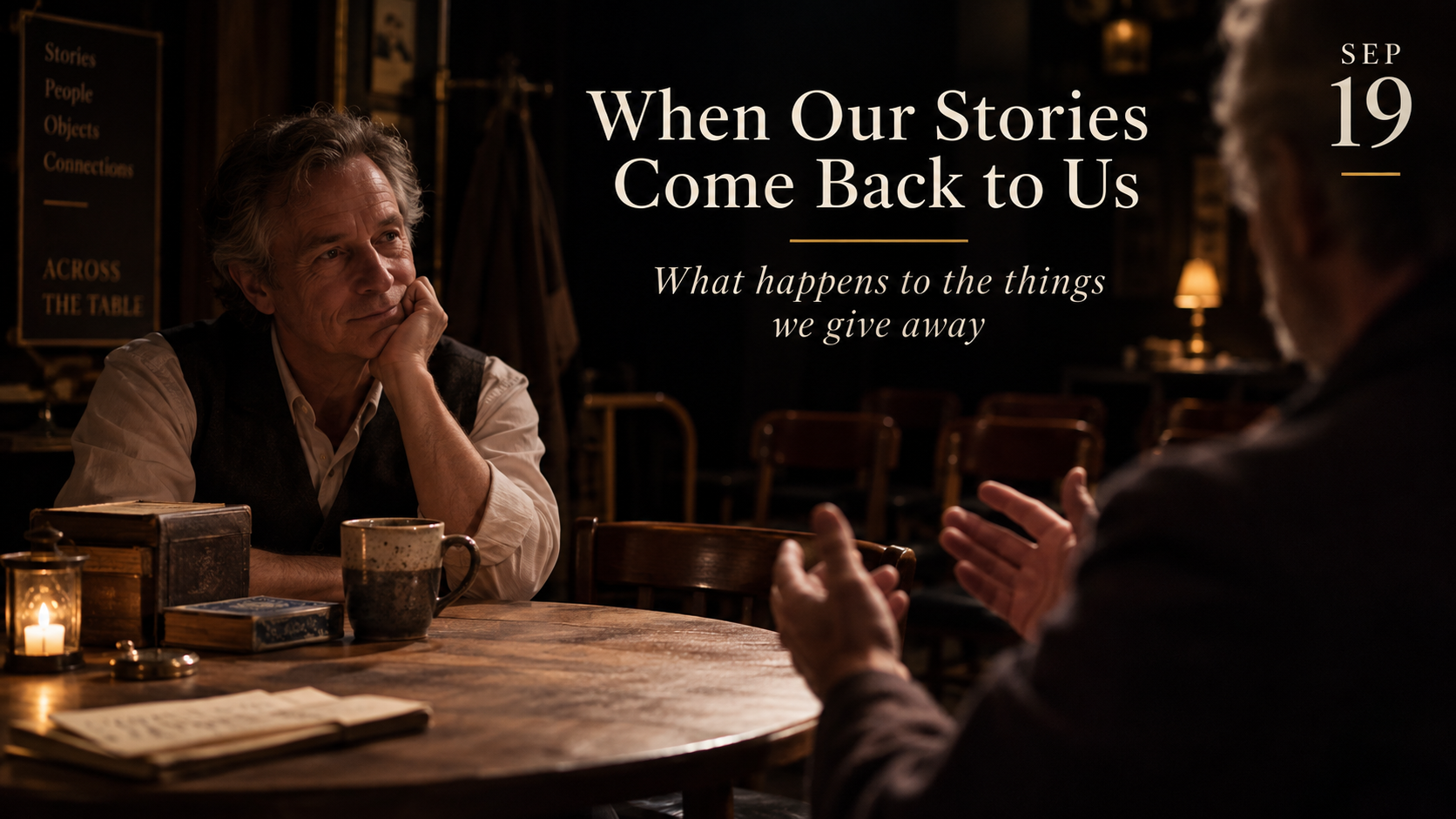

What happens to the things we give away
A man waited for me after a performance once and began telling me one of my own stories. The room was nearly empty by then. The particular noise an audience makes while leaving had faded down the corridor, and I was doing what I usually do after a show, putting things back where they belonged. Cards returned to their case. A chair pushed beneath the table. Small objects that had seemed mysterious only a few minutes earlier became ordinary things again once they were placed in drawers and boxes. There is something I have always liked about that part of performing. The theatre returns itself to the world. Whatever happened there is over, and the room seems to know it before I do. This man, however, had stayed behind. He told me he had seen me years earlier, in another place, during another period of my life. I recognized the venue when he mentioned it. I could picture the room. I could even remember where I had stood and, strangely enough, the jacket I was probably wearing. Memory can be ridiculous that way. It will preserve the color of a jacket while throwing away entire conversations.
Then he began telling me something I had apparently told him that night, and I recognized the story almost immediately. At least I thought I did. The beginning was familiar. I knew the people involved and the circumstances surrounding it. I knew why I had originally told it. But as he continued, the story began drifting away from the version I carried in my own head. A detail had changed. Another had disappeared. Something I considered almost incidental had somehow become important. Then he repeated a sentence I had supposedly said, a sentence that had stayed with him for years, and I had no memory of saying it. My first instinct was embarrassingly predictable. I wanted to correct him. Not dramatically. I wasn’t going to seize him by the shoulders and demand the return of my intellectual property, but somewhere inside me the storyteller had begun making notes. Well, that’s not exactly how it happened. That detail came later. And I’m fairly certain I didn’t say it quite like that.
This is one of the occupational hazards of spending a lifetime telling stories. You become particular about them. We choose words carefully. We move details around. We learn that something that actually happened on Tuesday sometimes belongs on Thursday if the story is going to make any sense. We discover where the unnecessary parts are hiding and remove them. We find the pause before the important sentence. We decide where the story begins, which is almost never where the event actually began, and where it ends, which is rarely where life stopped happening. After enough years, a story acquires a shape, and once we have shaped something carefully, we become strangely possessive of it. Listening to this man, however, I began to realize that the story he was telling me was no longer entirely mine. It had been once. I had lived whatever original experience caused it. I had carried it around for some time before deciding it was worth telling. I had shaped it and spoken it aloud. But then something happened that storytellers do not always consider carefully enough. I gave it away.
That may be what telling a story actually is. We usually talk about storytelling as an act of expression. I have something inside me, a memory, an idea, an experience, and I find a way to communicate it to you. That description is perfectly reasonable, but it stops too early. Because if the story actually reaches you, if you truly receive it, then it enters a life that I cannot see. It encounters everything already living there: your childhood, your disappointments, the people you have loved, the people you have lost, the places you have lived, the thing your father once said that you have never forgotten, the afternoon when somebody left, the teacher who believed in you, the friend who betrayed you, the person you still miss when a particular song plays unexpectedly in a grocery store. I didn’t put any of those things into my story. You did. Somewhere between my mouth and your imagination, then, the story becomes something neither of us could have made alone.
I think I understood this intellectually long before I understood it emotionally. Performers have evidence of it every night. I work in a room with thirteen people at a time. Thirteen chairs, thirteen sets of eyes, thirteen histories sitting around the same table. I can control an astonishing number of things in that room. I can decide how much light there is. I can choose what sits on the table and what remains hidden. I know when I am going to speak and when I am going to allow silence to do the work instead. I can direct attention toward an object, a person, a sound, a candle. Years of performing have taught me how carefully an experience can be constructed, and still thirteen different performances leave the room. Ask those thirteen people afterward what happened and you will hear thirteen versions. One person remembers an impossible moment. Another remembers something funny. Someone else remembers being frightened. Another remembers the expression on the face of the person sitting across from them. Someone may barely remember the effect I spent weeks rehearsing but vividly remember a sentence I improvised because someone asked an unexpected question. For a long time, I think I considered that an imperfection in communication. Now I suspect it may be the whole point.
We are not recording devices. We do not receive experiences intact and store them somewhere inside ourselves for later retrieval. We participate in them. We complete them. That distinction has become increasingly important to me as I have grown older, perhaps because I have spent so much of my life making things for other people. Performances certainly, but also books, essays, conversations, little pieces of writing sent out into the world without any reliable way of knowing where they eventually land. Writing makes this even stranger because, onstage, I can at least see you. I can watch someone lean forward. I can feel when a room becomes quiet. I can sense laughter arriving before it happens. There is a kind of invisible current between performer and audience, and after enough years you learn to feel its changes. Writing offers almost none of that.
I sit at my table, often with tea nearby and the mountains outside the window, and arrange words for people who are not there. I finish something, read it once more, make whatever small changes still bother me, and eventually press a button. I know where it goes technically, a blog, a newsletter, a book, a screen somewhere, but I have almost no idea where it goes humanly. Someone may read it before breakfast. Someone may find it months later while sitting alone at night. Someone may read three paragraphs and leave. Someone else may carry one sentence for years. The maddening, beautiful part is that I don’t get to choose which sentence. The line I polished for twenty minutes may vanish immediately. The sentence I nearly deleted may be the one somebody writes down. There is humility in recognizing that, and perhaps even a little relief.
There is an exhausting kind of vanity hidden inside the desire to be understood exactly. We want people to understand not merely what we said, but what we meant. We want them to recognize which parts were important. We want them to notice the craftsmanship. We want the thing that moved us while making the work to be precisely the thing that moves them while receiving it. I have certainly felt that desire, especially after putting a great deal of myself into something. But the older I get, the more I wonder whether that is actually invitation at all. Perhaps it is closer to instruction. An invitation leaves room for the other person, and I have been thinking about that distinction throughout this month, about what it actually means to invite another human being into a story, a conversation, a performance, or a life. It is tempting to imagine invitation simply as opening the door and saying, Come in. Sit down. Let me show you something. But perhaps genuine invitation requires something more difficult. Perhaps we have to surrender some control over what happens once they enter.
If I invite you across the table and then insist upon telling you exactly what everything means, exactly what you should notice, exactly what you should feel, I haven’t really invited you into anything. I have given you a guided tour. There are times for guided tours, certainly, but they are not the same thing as hospitality. Hospitality says there is room here for you, and that must include room for your interpretation. It must include the possibility that you will notice something I overlooked, care deeply about something I considered incidental, or recognize yourself in a corner of the story where I never imagined anyone would look. You may even misunderstand something I intended and still discover something useful there. That possibility can be uncomfortable for anyone who makes things carefully, but perhaps the alternative is worse. A story that can mean only what its author permits it to mean is not much of a story. It is an instruction manual.
This extends far beyond performance or writing. We do it constantly in ordinary conversation. We tell someone about something that happened to us and become frustrated when they understand it differently. We explain why we made a decision and want them to approve not merely the decision but our reasoning. We tell someone we love them and quietly attach instructions about how that love should be received. Human beings are forever handing things to one another and then trying to control what happens after they leave our hands. Stories have been teaching me the futility of that for most of my life. Once you tell one, something changes. It crosses the table, and what happens on the other side belongs partly to the person sitting there.
I think again about that man after the performance, telling me my own story. There came a moment when I could have corrected him. I remember it distinctly because I could feel the correction forming in my mouth. It would have been easy and probably harmless. I could have smiled and said, “Actually, that’s not quite how it happened.” Maybe he would have appreciated knowing. But I didn’t. I listened, and gradually something remarkable became apparent. The version he was telling me had mattered to him. Whatever I had originally intended was almost irrelevant now. The story had traveled through years of his life without me. It had accompanied him into rooms I had never entered. It had been remembered and reconsidered. Perhaps he had told it to someone else. Perhaps that person had told it again. I suddenly became curious about where it had been, not whether it was accurate, but where it had been.
There is something wonderfully strange about realizing that pieces of our lives may be traveling through the world without us. A sentence spoken backstage twenty years ago may still exist somewhere in another person’s vocabulary. A kindness we barely remember may have become part of someone’s understanding of kindness. A story told over tea may be retold at another table to people whose names we will never know. We spend so much of our lives wondering what we will leave behind that perhaps we should occasionally wonder what has already left. I don’t mean legacy. That word feels too grand for what I mean. Legacy sounds like statues and collected works and buildings with someone’s name engraved above the door. I mean smaller things, human things, the phrase, the gesture, the story that crossed a table one evening and found another place to live.
The man eventually finished telling me my story. We talked for another few minutes, and then he left. I returned to putting the room back together. The cards went into their box, the chairs were straightened, the table became a table again, and soon there was no evidence that anything had happened there at all. But I found myself thinking about that story, not the one I originally told, but the one he carried back to me. I liked his version. Not because it was better or because I had suddenly decided the details didn’t matter, but because it had lived. He had taken something I once gave away and carried it long enough for it to gather some of his life around it. By the time he returned it to me, I could still recognize it, but I could also see that it had been somewhere without me.
That may be one of the great privileges of making anything and offering it to another person. We begin something, but we do not necessarily finish it. The finishing happens elsewhere, inside lives we cannot enter and imaginations we cannot control. Perhaps our stories are never entirely complete when we finish telling them. They continue in rooms we will never see, inside conversations we will never hear, carried by people whose lives we may never fully know. They gather things along the way. They lose details. They change shape. Sometimes, if we are very fortunate, one of them finds its way back across the table and allows us to see what became of it. When that happens, I am learning not to correct the story too quickly. I want to hear where it has been. After all, the storyteller may get the first word, but the rest belongs to everyone who carries it forward.