The theater is dark, and it waits.
There is always a chair.
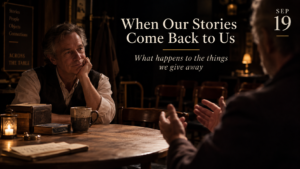
At the séance table, it sits waiting, velvet-backed, polished wood, sometimes draped in shadow. At the magic table it is the seat just across from me, the place of invitation. The chair is never truly empty; it hums with expectation. It is the seat of the absent guest, the unseen hand, the audience member not yet chosen.
I always take time to sit in the empty theater and allow the quiet to fill the space. I recall the past, and try to anticipate the future. The humans that will fill those empty seats.
As a magician, I’ve learned that the empty chair carries as much weight as the one occupied. It is a reminder that performance is a dialogue, not a monologue. Without someone across the table, the magic has nowhere to land. Without that gaze, that breath, that willing suspension of disbelief, the trick is just mechanics. It is the presence of another (seen or unseen) that turns practice into wonder.
The Séance Table
When I lead a séance, the empty chair becomes a character in the room. We speak of spirits, of those who walked this earth before us, of stories half-remembered and never finished. That chair holds their memory. It is the invitation for the audience to lean forward, to wonder who might join us. It is filled by silence, by imagination, by the ache of absence we all carry in our own ways.
Some guests enter with skepticism, some with hope, and some with grief too heavy to name aloud. The empty chair absorbs all of it. It is where we project our questions, where we place the possibility of “what if.” In the flicker of candlelight, the chair is no longer furniture; it is possibility itself.
The Magic Table
In my magic shows, the chair is more tangible, but no less mysterious. Someone will sit there, chosen at random, or perhaps guided by the rhythm of the moment. In that act, the chair transforms. The stranger becomes a partner, the trick becomes a shared secret, and the table becomes a stage for two.
Yet before anyone sits, the empty chair whispers anticipation. The audience wonders: who will be called? What will happen? Will it be me? The weight of possibility presses on everyone present, not just the seat itself.
Across the Table
Every performance I give, be it séance, storytelling, or magic, is really about what happens in the mind and heart of the observers. The empty chair reminds me that my work is never solitary. The audience completes the circle.
In life, too, the empty chair follows me. It might be the chair at the kitchen table where someone used to sit. It might be the chair in a theater that remains unclaimed, reminding that every gathering could have been one soul larger. It is absence and presence, weight and invitation.
I sit across the table each night, knowing the empty chair is part of the story I tell. It carries the gravity of what is missing, the promise of what may arrive, and the sacred mystery of who or what might join us if we only make room.
Because sometimes, it is not the card trick or the spoken story that lingers. Sometimes, it is the silence of the empty chair; the possibility that it might not stay empty for long.
Or it might remain vacant forever.
h