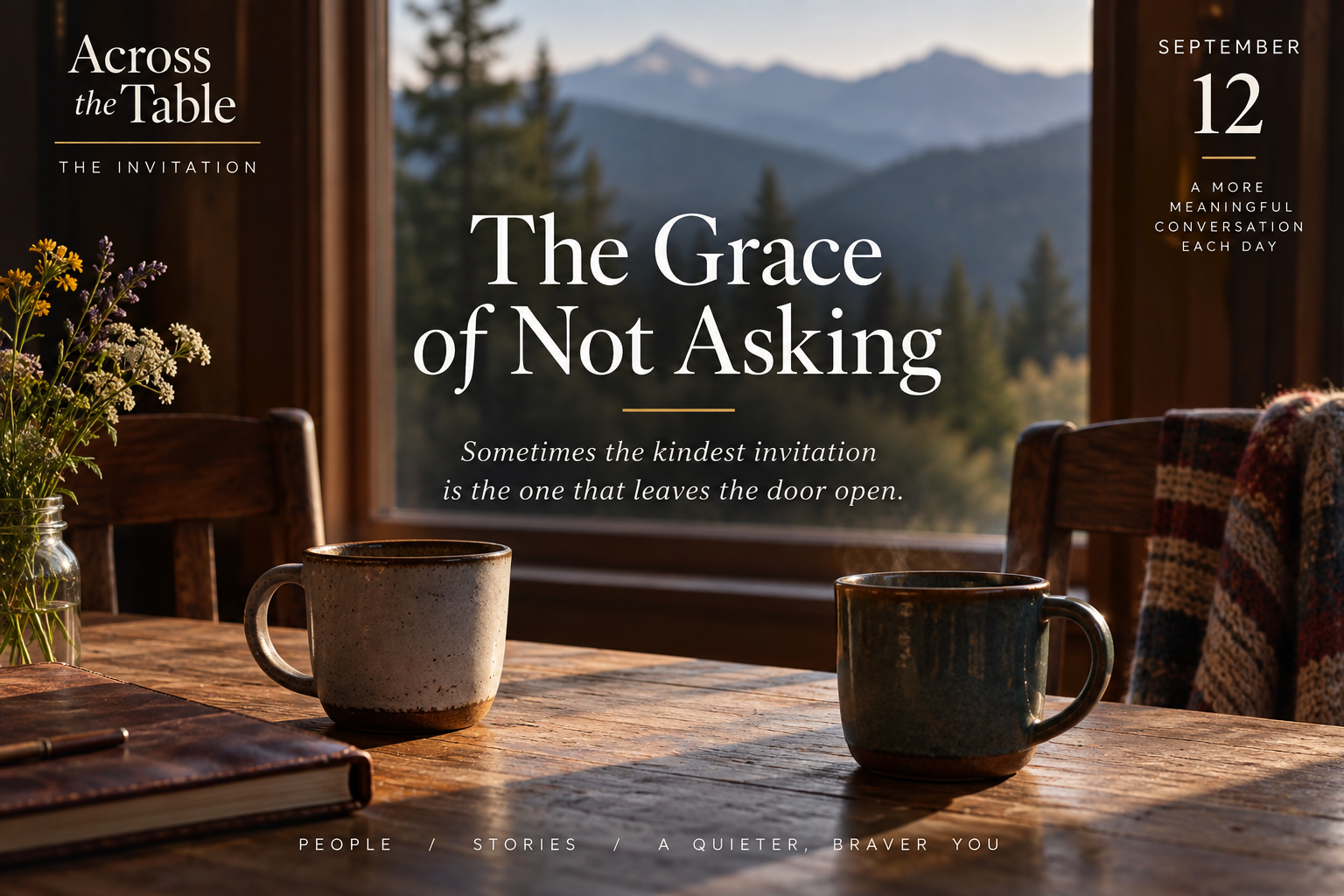

Sometimes the kindest invitation is the one that leaves the door open.
There was a moment in the conversation when I knew there was more. I cannot tell you precisely what gave it away. Perhaps it was the way the sentence ended before it was finished, or the small change in the face that accompanied it. Perhaps it was simply that old instinct I have developed after so many years of sitting across from people and standing in front of them, listening not only to what they say but to what happens around the words. We were at the table. Tea sat between us, mine already cooling because I had forgotten about it, as I often do when the conversation becomes more interesting than the cup. Beyond the window, the mountains were doing what mountains do, remaining entirely indifferent to whatever small human drama was unfolding in their presence. The person across from me had been telling me something about their life, nothing especially dramatic at first, when they reached the edge of a sentence and stopped. Their hand stayed around the cup. Their eyes moved toward the window. There was a pause, not quite long enough to become uncomfortable, but long enough for me to recognize that something had been left behind.
I knew the question I could ask. That is the part I remember. It was right there, ready and waiting, and I was reasonably certain that if I asked it gently enough, if I softened my voice and gave the question enough room, the rest of the story might come. I have spent much of my life learning how to do exactly that. Storytellers become students of the unfinished sentence. We notice when someone changes a word halfway through saying it. We hear the slight hesitation before a name. We recognize when a person takes the long way around something they could have said plainly. Onstage, those instincts are useful. In writing, they are invaluable. In conversation, they can make you appear to be a very good listener. But sitting there that afternoon, I became aware that being capable of opening a door did not necessarily mean I had been invited to walk through it. So I did something that felt strangely difficult. I left the question alone.
There is a kind of vanity hidden inside curiosity that I have not always recognized. Curiosity sounds generous. We associate it with attention, interest, openness. We like people who ask thoughtful questions because thoughtful questions tell us that someone is actually listening. I have always been curious about people, particularly about the stories beneath the stories they tell publicly. Give me the polished version and I will almost immediately wonder what happened before it became polished. Tell me what you decided and I will wonder what frightened you before you decided it. Show me the scar and some part of me will wonder about the wound. That curiosity has served me well as a storyteller, and perhaps as a human being too. But curiosity can quietly become appetite. We can convince ourselves that because we care about someone, we deserve to understand them completely. We can begin asking questions not because the other person needs somewhere safe to speak, but because we are uncomfortable with what we do not know.
Perhaps intimacy is not permission.
That possibility has become more important to me as I have grown older. We speak about intimacy as though it were measured by access. The closer we become to another person, the more we expect to know. Their history, their wounds, their fears, the names they still think about, the things they regret, the things they have never forgiven themselves for, the private corners of their lives where even people who love them may not be welcome. There is some truth in this, of course. Closeness does involve revelation. To be known requires allowing ourselves to be seen. But I am beginning to think that genuine intimacy is not the elimination of every locked room. Sometimes intimacy is knowing that the locked room exists and not rattling the handle.
There is an important difference between invitation and extraction, although from the outside they can look remarkably similar. Both may involve a gentle question. Both may involve silence afterward. Both may involve leaning forward and paying attention. The difference may lie almost entirely in who the question is serving. An invitation says, You may tell me if you want to. Extraction says, however softly, I need you to tell me so I can feel closer to you, understand you, help you, reassure myself about you, or satisfy the curiosity your silence has created in me. We are capable of disguising extraction beautifully. We can call it concern. We can call it honesty. We can tell ourselves that we are creating a safe space. And perhaps we are. But a safe space with an entrance requirement is not quite as safe as we imagine.
A lifetime onstage teaches you to follow tension. If something changes in the room, you notice it. If an audience suddenly becomes very still, you understand that something has happened, even if you cannot yet name it. A storyteller learns to feel those shifts almost physically. There are nights at the Stanley when I can sense thirteen people leaning toward me without seeing a single one of them move. Something in the room contracts. Attention gathers. The silence changes texture. As a performer, my job is to follow that energy, to understand where it is going and, when necessary, lead it somewhere. You learn to look for the thing beneath the thing because that is often where the story lives. The obvious event is rarely the whole event. What matters is what it cost, what it changed, what someone wanted and could not say.
Those instincts do not disappear when the performance ends. I carry them down the corridor, into the car, home to the table. That can be useful, but it can also be dangerous because the person sitting across from me is not an audience member in a story I am responsible for completing. Their silence is not dramatic tension. Their unfinished sentence is not a loose thread in a script. Another human being is not material. This should be obvious, and yet storytellers must occasionally remind ourselves of it because we have spent so much of our lives turning experience into narrative. We look for beginnings, endings, revelations, patterns. Real people are under no obligation to provide any of them.
Sometimes a person stops talking because they want you to ask. I know this too. There are moments when silence is an invitation, when someone has walked almost all the way to the edge of disclosure and needs only the smallest gesture from us to know it is safe to continue. There is no rule that tells us precisely which silence is which. Human beings would be considerably easier if there were. We have to pay attention. We have to risk getting it wrong. But perhaps there is a difference between making room and demanding entry. We can say, in a hundred ways that do not require words, I am here if you want to keep going. And then we can allow the decision to remain theirs.
That last part may be the hardest. Allowing the decision to remain theirs means accepting that we may never know. It means living beside an unanswered question without treating it as a problem to solve. It means allowing someone we love to retain a private interior life that does not include us. There is something humbling about this. We like to believe closeness grants us a map of another person. Perhaps it grants us only the privilege of walking beside them while they decide which parts of the landscape they want to show us.
I have come to think that one of the deepest forms of listening is allowing another person to remain partially unknown. Not ignored. Not neglected. Unknown. There is a difference. We can pay exquisite attention to someone without demanding complete access to them. We can love them without possessing their explanations. We can recognize the sadness behind a joke and choose not to expose it. We can notice the fear beneath an answer and resist naming it before they do. We can understand that a person may still be learning the language for whatever is happening inside them, and that our desire for clarity does not obligate them to find those words faster.
There is grace in being given that kind of room. I think most of us know the relief of discovering that someone is not going to make us explain ourselves. They see that something is there. We know they see it. And somehow, mercifully, they do not reach for it. They stay. They continue drinking their tea. They allow the conversation to wander somewhere else without making the silence feel like a failure. In that moment we learn something important about them. We learn that their care is not conditional upon our disclosure. We learn that we can remain in their company without surrendering every guarded thing we carry.
Perhaps that is one of the quieter ways trust grows. We usually imagine trust being built through confession. I tell you something difficult, you receive it gently, and now I know I can tell you more. But trust may also be built through what we refuse to take. You notice the opening and do not exploit it. You recognize vulnerability and do not turn it into an opportunity. You let me discover, over time, that you are capable not only of holding what I give you, but of leaving untouched what I have not.
I do not remember exactly where that conversation went after the unfinished sentence. I suspect we talked about something ordinary. We may have laughed. At some point I probably remembered the tea and drank it cold, which is the fate of a surprising amount of tea in my life. The mountains remained outside the window, unchanged and unconcerned. The thing that had almost been said remained unsaid. Maybe it was told to me later. Maybe it never was. I have learned that this matters less than I once thought it did.
What I remember is the door.
I knew it was there. The person across from me knew I had seen it. And for once, I did not mistake seeing a door for being invited through it. I simply stayed where I was, across the table, close enough to enter if it was ever opened and far enough away that opening it remained entirely their choice. The tea grew cold between us. The mountains kept their ancient counsel beyond the glass. And the unopened door remained what perhaps every human boundary ought to remain, not a challenge, not a mystery demanding solution, but a door belonging to the person on the other side.