
I bought into the big lie. The one that looks for the ‘new and shiny’. Whispered into my brain that the audience will get tired of the old material. Then a wise mentor told me that the ‘old’ material matures like wine, and that a professional seeks new audiences, rather than new tricks.
Thirty plus years in, and I can verify that the concept is true; I’ve made and given away thousands of little boots and the long-term clients still ask to see it again, to make sure I’m still including it. Evolution happens over eons, art happens at a glacier pace.
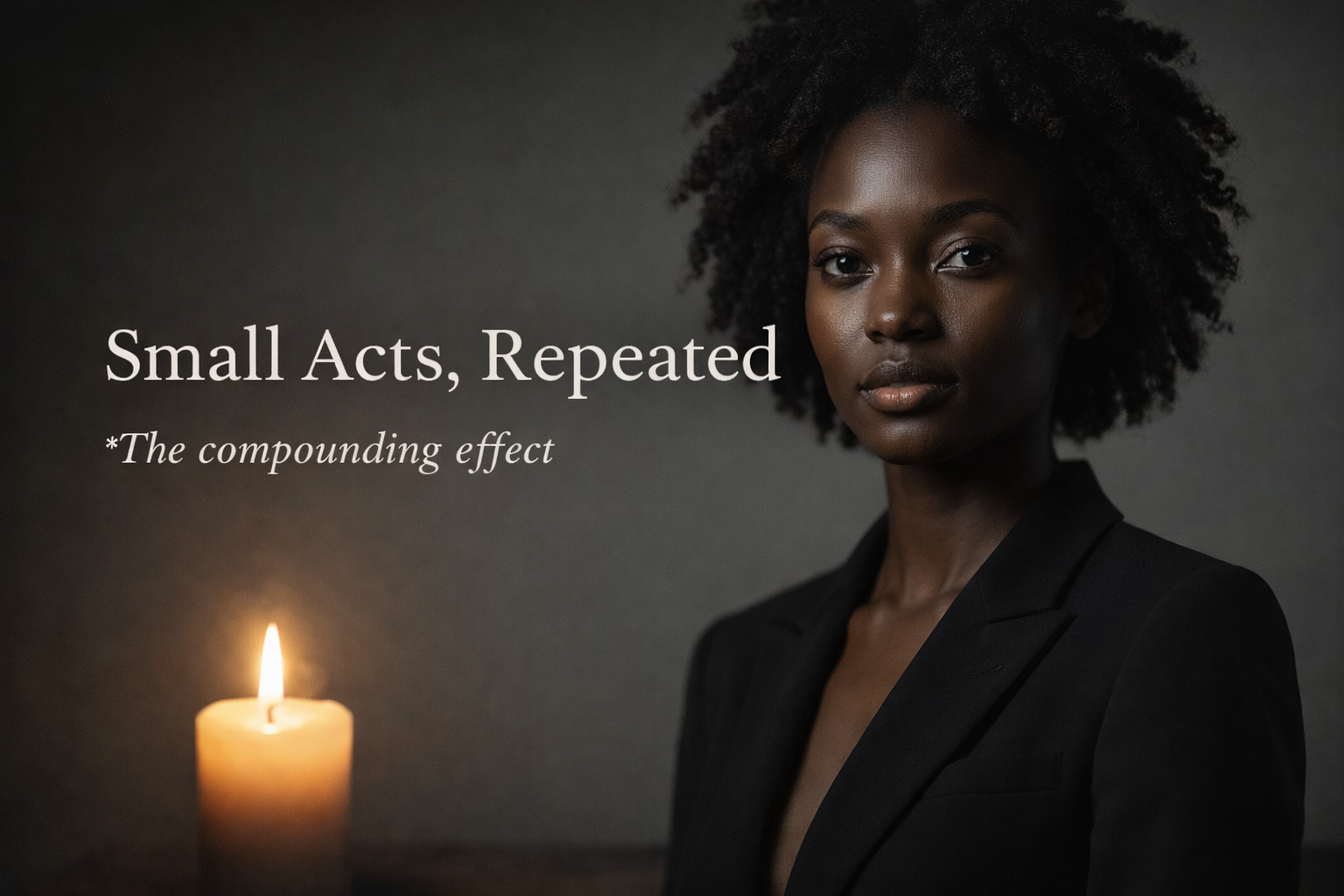
Small Acts, Repeated
The compounding effect
There is a quiet misunderstanding among public creatives, one that reveals itself not in what people say, but in how they work. It’s the belief that transformation arrives in visible moments, the breakthrough speech, the perfect performance, the night when everything finally clicks. Those moments exist, of course, but they are not the source. They are the echo.
What actually builds the voice, the presence, the authority to stand in front of others and mean something, is far less dramatic. It is made of small acts, repeated. Not occasionally. Not when inspiration visits. Repeated, even when the room is quiet and the work feels almost too simple to matter.
This is where embodiment begins to take root.
If you’ve spent any time on a stage, you already know the strange truth of it. The audience never sees the work directly. They see the result of it, the ease, the timing, the breath that seems to arrive exactly when it should. But underneath that moment is a long accumulation of choices. You chose to sit down when you didn’t feel like it. You chose to write another paragraph that no one would read that day. You chose to rehearse a transition that already “worked,” simply because you knew it could be more honest, more precise.
None of those choices feel significant on their own. That’s the trick.
We tend to measure our efforts against outcomes that are too large to be influenced by a single action. A single rehearsal will not make you masterful. A single piece of writing will not define your voice. A single conversation will not reshape how you show up in the world. And so we dismiss the small act, not because it lacks value, but because its value is delayed.
But compounding does not ask for your belief. It only asks for your participation.
Over time, these small acts begin to organize something deeper than skill. They shape identity. You are no longer someone who occasionally prepares. You become someone who prepares as a matter of course. You are no longer someone who waits to feel ready. You become someone who begins, and allows readiness to follow.
This shift is subtle, but it changes everything.
Because once the identity begins to form, the work no longer feels like something you must force. It becomes something you return to. The table is there. The chair is there. The tools are familiar. There is a rhythm to it, almost domestic in its simplicity. Sit down. Light the candle. Open the page. Begin again.
And again.
This is not glamorous work. It does not photograph well. It rarely produces immediate feedback. There are long stretches where it feels as though nothing is happening at all. But something is happening. The repetitions are layering. The voice is settling. The body is learning how to carry the work without strain.
When the moment does come, when you step into a room and feel the attention of others settle toward you, it will feel almost effortless. Not because it is easy, but because you have already done the work so many times in smaller, quieter ways. The performance is simply the visible expression of something that has already been built.
This is why embodiment cannot be rushed. It is not a switch you flip. It is something you inhabit, gradually, through the accumulation of small, repeated acts that align your intention with your behavior.
So the question is not whether today’s effort will change everything. It won’t. The question is whether you are willing to place another piece on the scale, knowing that it is the steady addition of weight that eventually tips the balance.
If you can make peace with that, if you can learn to respect the quiet work as much as the visible moment, you will find yourself building something far more durable than momentum. You will be building a way of being.
And if you choose to continue, to keep returning to the table in this way, you may find that we are already sitting across from one another, doing the work together, one small act at a time.