
The quiet ways a life continues beyond us
The audience had mostly gone, and I was doing what I always do when a room stops being a theatre and becomes a room again. There is something wonderfully ordinary about those few minutes. Cards go back into their box. A chair gets pushed beneath the table. Something that looked mysterious under carefully considered light becomes a perfectly ordinary object when you pick it up and put it in a drawer. The candle, which had done such good work pretending to be ancient and important, was reduced to a little flame at the end of the evening, and I pinched it out. Someone was still standing near the door. I assumed he had a question about something that had happened in the show. People sometimes linger because they want an explanation, or because they want to tell you their theory, or because leaving too quickly after an intimate performance feels somehow impolite. But he wasn’t interested in anything that had happened that night. He had seen me years before, somewhere else, in another room I could barely remember. He told me this with the pleasant certainty of someone who had been carrying a memory much longer than I had.
I waited for him to remind me what I had performed. Instead, he reminded me of something I had said. Apparently, during the show, someone had been nervous about participating. I had stopped whatever I was doing and told the person there was nothing here they had to prove, and nothing they could do wrong. Or something like that. I don’t remember the exact sentence. That was the strange part. The man standing there remembered it better than I did. He remembered the person relaxing. He remembered the room changing slightly afterward. He remembered me continuing with the performance as though nothing important had happened. For him, apparently, something had. I stood there holding a deck of cards I had probably handled tens of thousands of times, trying to summon a moment from years ago that had vanished completely from my own memory and somehow remained intact in his.
Performers develop peculiar ideas about memory. We spend an unreasonable amount of time trying to manufacture it. We decide where someone should look, when the music should stop, how long a silence can be held before it becomes uncomfortable, which object should remain visible on the table, what the final image of the evening should be. We rehearse sentences because we want them to land in a particular way. We build an experience with the slightly absurd confidence that if we arrange everything correctly, people will remember what we intended them to remember. Then someone finds you years later and tells you that what stayed with them was the way you moved a chair for somebody. Memory is wonderfully disobedient that way. It wanders off with whatever it pleases.
I have been thinking about that more lately because I have begun noticing how much of what I call myself was given to me by other people. A phrase slips out of my mouth and I suddenly hear the person who first said it. My hands do something at a table and I remember another pair of hands showing me how. Some small ritual I have practiced for decades turns out not to have originated with me at all. We are strange collections of borrowed things. We inherit gestures, language, standards, jokes, prejudices, tenderness, recipes, manners, fears, ways of standing in a doorway. We absorb them so thoroughly that eventually we stop recognizing them as inheritance. They simply become ours. There is something comforting in discovering this. The people who have passed through our lives do not always leave when they leave. Some small part of them keeps moving around in us.
But once you notice that, another thought becomes unavoidable. If their fingerprints are on me, mine must be somewhere too.
I don’t mean legacy, at least not in the way we usually use that word. Legacy has become too ambitious for what interests me here. It makes me think of buildings with names carved into stone, careers summarized in paragraphs, books sitting on shelves after their authors are gone, awards collecting dust in rooms no one visits. Even the modern version of legacy seems strangely concerned with measurement. How many people watched? How many followed? How much work was produced? How far did the name travel? I understand the desire behind all of that. I make things and send them into the world too. I hope they matter. But I suspect most of what we leave behind will never appear on a résumé, a bookshelf, a plaque, or a screen. Most of it will disappear into other people so completely that nobody will remember where it came from.
Someone may use a phrase you once used with them. A young performer may treat an audience member differently because they once watched you do it. Someone may pour tea in a particular way because you always poured it that way when they sat at your table. Someone may ask better questions because you once asked them a good one. There may be a person who learned that silence did not have to be filled because you were willing to sit quietly beside them. Another may have discovered that they were interesting because, for twenty minutes, you behaved as though they were. Years later, they may give that same attention to somebody else without thinking of you at all. By then the thing has become theirs, which is perhaps the finest fate anything we give another person can have.
There is an uncomfortable side to this, of course. Human residue is not always beautiful. Impatience leaves fingerprints too. So does contempt. A sentence spoken carelessly can become astonishingly durable once it enters another person’s life. There are grown men and women still arguing internally with something said to them when they were fourteen. They have built careers partly to answer a teacher who told them they weren’t particularly talented. They apologize before speaking because someone once made them feel that their presence required an apology. They distrust affection because somebody taught them, deliberately or otherwise, that affection came with conditions. We can spend five seconds saying something another person spends thirty years trying not to believe.
The reverse is also true, and perhaps that is why I cannot find this thought entirely frightening. There are people walking around with courage that began as someone else’s confidence in them. Someone said, “I think you can do this,” before there was much evidence available. Someone made room at the table. Someone took the young artist seriously before the artist knew how to take himself seriously. Someone laughed at the joke, read the terrible first draft, watched the clumsy first performance, stayed after everyone else had gone home, or said, “Try it again.” It may have been an ordinary Tuesday to the person who said it. To the person who heard it, the world tilted half a degree. Half a degree is not much at first. Given enough distance, it can take you somewhere entirely different.
I don’t think the answer is to become terrified of our own influence. That sounds exhausting, and more than a little self-important. If I entered every conversation wondering what immortal fragment of Hannibal I was about to place into another human soul, I suspect people would quite reasonably stop inviting me to tea. There is something ridiculous about trying to curate every encounter for posterity. It turns kindness into strategy and presence into another performance. We would become actors in our own lives, constantly watching ourselves from the imaginary audience, trying to make sure we were leaving behind the proper impression. I have spent enough of my life on stages to know that not everything needs one.
Perhaps the better question is not, “What will they remember about me?” Perhaps it is simply, “What is it like to be with me?”
That question feels different.
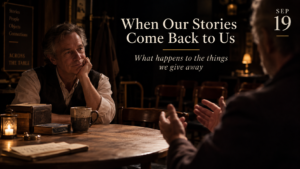
I think about it at the table sometimes. There is tea between us, mountains beyond the window, and no particular reason for the conversation other than the conversation itself. Nobody is buying anything. Nobody is an audience. There is no applause waiting at the end. The conversation wanders because good conversations are allowed to wander. We talk about something important, then something ridiculous, then something we didn’t expect to talk about at all. A silence appears and neither of us rushes to repair it. Somewhere inside such an ordinary hour, things are being exchanged that neither of us can see. Perhaps a phrase. Perhaps permission. Perhaps reassurance. Perhaps nothing more lasting than the feeling of having been listened to without someone waiting impatiently for their turn to speak.
What will this person carry away from being with me?
Even writing the question makes me wary of it. I don’t want to sit across from another human being calculating their takeaway. That would destroy precisely the thing I am trying to understand. The people who have left the deepest marks on me were rarely trying to leave marks. They were simply themselves in my presence. They showed me what patience looked like by being patient. They demonstrated generosity without announcing generosity as the subject of the afternoon. They taught me how to behave around frightened people, difficult people, grieving people, children, strangers, audiences, waiters, friends, because I happened to be nearby when they did it. Their influence arrived sideways.
Maybe that is how most influence arrives.
We are shaping one another while believing we are merely having tea. We are teaching while believing we are only talking. We are giving permission while telling a story. We are showing someone how they deserve to be treated while doing nothing more remarkable than treating them that way. We are leaving traces while driving through the mountains, sitting backstage, sharing dinner, laughing at something completely stupid, walking someone to the door, or saying goodnight. Most of the consequential exchanges of a human life probably occur without either participant recognizing them as consequential.
That makes the ordinary seem less ordinary to me.
Not sacred exactly. I am suspicious of making everything sacred. Sometimes tea is just tea, and sometimes a stupid joke deserves the dignity of remaining a stupid joke. But there is a tenderness in realizing how porous we are. We pass through one another. We carry things away. The person who taught you something may never know you learned it. The person you encouraged may never tell you it mattered. Someone you disappointed may eventually forgive you without your knowing. Someone may repeat one of your stories years after your name has fallen out of it entirely. The story survives. The source disappears. There is something beautiful about that disappearance.
After the last show, the room at the Stanley becomes quiet very quickly. The audience moves into the corridor and then into elevators, stairwells, hotel rooms, cars, whatever comes next in their evening. I remain behind for a few minutes putting things back where they belong. The chairs are empty again. The table is only a table. Whatever seemed impossible a few minutes earlier has already become memory, and memory has begun its private work of rearranging the evening.
I have no idea what anyone takes through the door.
Perhaps they remember the mystery. Perhaps they remember a story. Perhaps they remember the person beside them squeezing their hand in the dark. Perhaps they remember nothing at all until ten years from now, when something small returns for reasons they cannot explain. Perhaps one sentence follows them home.
I straighten a chair. I gather the cards. I extinguish the candle.
Somewhere, someone may remember tonight.
Probably not the part I expect.
And perhaps that is enough.