
The people who become part of us
I caught myself doing something with my hands the other day that I am fairly certain did not begin with me. I was making tea, nothing ceremonial about it, just one of those small morning acts the body performs while the mind is somewhere else, and there was a particular way I held the cup while reaching for something across the table. I stopped for a moment because I recognized the gesture. I could not immediately remember where I had seen it, which made the recognition stranger. It was familiar without being identifiable, like hearing a few notes of a song through a wall. Eventually a person came to mind, someone I had known years ago, and I laughed a little at the discovery. I had apparently stolen something from him without knowing it. Not an idea or a possession, not even anything worth mentioning, just a movement of the hand. He had left it behind in me.
I wonder how much of us is like that. I sit at this table looking toward the mountains and imagine myself as a reasonably complete and independent human being, assembled through experience and choice into whatever peculiar creature I have become. Yet the longer I live, the less convinced I am that any of us can claim complete authorship of ourselves. There are phrases I use that belonged to other mouths first. There are ways I approach an audience that came from watching performers long before I knew what kind of performer I would become. There are courtesies I learned because someone once extended them to me, and suspicions I learned because someone once gave me reason to be suspicious. There are books on my shelves that I would never have read if someone had not pressed them into my hands. There are jokes I tell because someone who is no longer around would have laughed at them. I have become, without intending to, a small museum of other people.
Perhaps we all have.
For the last couple of days I have been thinking about the people who stay and the people who leave, as though those are the two categories available to us. It is an understandable distinction. We look around our lives and notice who is still here. There are people who have walked beside us for decades, people who have somehow survived all the changing versions of us, the ambitions and disappointments, the marriages and divorces, the successes, the foolishness, the years when we were particularly difficult to love. Then there are the others, the people whose roads eventually turned away from ours. Some left deliberately. Some drifted. Some died. Some simply disappeared into that strange country called the past where so many people we once knew now live.
But presence and absence turn out to be inadequate measurements. Someone can leave your life and remain remarkably present within it. Someone you have not spoken to in twenty years can still influence the way you enter a room. A person who has been dead for decades can still determine how you hold a fork, tie a necktie, tell a joke, respond to bad news, or behave when somebody weaker than you needs help. And someone can remain physically beside you while the person you originally knew gradually disappears. We change one another, then we change ourselves, then time changes all of us again. The borders become difficult to draw.
I have spent enough of my life backstage to know that performers are particularly susceptible to this kind of inheritance. We watch one another. We borrow without realizing we are borrowing. A gesture, a pause, a way of turning toward an audience, a little ritual before walking into the light. Somewhere along the way it becomes ours, although that is not quite the right word. I suspect there are things I do onstage that began in rooms I can no longer remember, watching performers whose names I may have forgotten. My hands know things my memory does not. That strikes me as a beautiful kind of immortality, considerably more believable than the grander versions we invent for ourselves. Perhaps very little of us survives intact, but a gesture might. A kindness might. A sentence might.
Of course, not everything we carry is beautiful.
People leave wounds behind too. We inherit cautions and defenses. We learn what not to say because someone once punished honesty. We learn to anticipate anger because somebody taught us that rooms can change without warning. We become suspicious of generosity because a gift once arrived with an invoice hidden inside it. We distrust compliments, brace ourselves when voices rise, apologize when no apology is necessary, and sometimes mistake vigilance for wisdom because vigilance once kept us safe. Some people teach us to open doors. Others teach us to check the locks. Both lessons can remain long after the teacher is gone.
There is a peculiar moment in growing older when you begin discovering that some of the things you have always called your personality are actually history. You begin asking where a particular fear came from, why a certain situation produces such an immediate response, why you always assume the worst in one circumstance and the best in another. Sometimes there is a person standing somewhere behind the answer. Not necessarily a villain. That is important. Most of the people who shape us were simply human beings trying to make their way through their own confusion while standing close enough to us that some of it rubbed off. We inherited things they did not know they were giving us, just as surely as we have handed things to others without realizing it.
Perhaps maturity involves occasionally opening the luggage.
Not to throw everything away, and certainly not to spend the rest of our lives blaming the people who helped pack it, but simply to look. Is this still mine to carry? Is this caution protecting me or merely making the journey heavier? Is this belief actually true, or did someone frightened hand it to me years ago and I have been guarding it ever since? There are inheritances worth protecting and inheritances worth ending. We are allowed to be grateful for a person without preserving every lesson they taught us. We are allowed to love someone and still decide that their fear does not need another generation.
Storytelling complicates all of this because a storyteller carries people forward professionally. I have stood on stages and spoken about people who had no idea they were entering the room with me. I have borrowed their voices, remembered the peculiar way they pronounced something, described the shirt they wore or the way they looked at me across a table. Sometimes they were heroic. Sometimes ridiculous. Usually they were both, which is considerably closer to the truth of being human. Their kindness, foolishness, cruelty, humor, tenderness, and contradictions became part of the material through which I learned to understand my own life.
There is responsibility in that. A true story is never entirely ours simply because we happened to be present for it. Other people occupy our memories, and when we tell those memories publicly we are carrying something that once belonged, at least partly, to them. I have become more aware of that as I have grown older. A younger storyteller may be fascinated by what makes a story effective. An older one begins wondering what makes telling it honorable. Those are not always the same question. Memory gives us custody, not necessarily ownership.
Still, I am grateful for the people who wander through my stories. Some of them probably have no idea that I remember them. That may be one of the strangest truths of a human life. We rarely know where our influence ends. A person may remember something you said thirty years after you have forgotten saying it. Someone may still be carrying a kindness that cost you almost nothing. A joke told at exactly the right moment may survive in another person longer than accomplishments you considered important at the time.
I think about people who believed in me before there was much evidence available to support their position. People who sat through bad versions of things I was trying to make and somehow saw the better thing hidden inside them. People who laughed when I desperately needed the laugh. People who told me the truth when flattery would have been easier. People who showed me, without announcing that they were teaching anything, how a grown man behaves when he loses, how an artist continues when applause becomes scarce, how a friend sits quietly beside another human being when there is nothing useful left to say.
Most of them probably do not know what they gave me.
That seems important.
We spend so much time imagining that influence is something dramatic. We associate it with speeches, accomplishments, audiences, books, awards, legacies, things with our names attached to them. Yet I suspect most human influence happens anonymously. Someone watches how you treat the waiter. A child notices whether you keep your promise. A younger performer sees what you do when another performer succeeds. A friend remembers that you called when everyone else assumed someone else would. None of these moments announces itself as consequential. There is no music underneath it. No one says, “Remember this. You are going to carry it for the next forty years.” Life simply places something in our hands and moves on.
Perhaps that is why I have become increasingly interested in tables.
Stages are wonderful places, and I have spent much of my life on them, but a stage makes influence visible. One person stands beneath the light while others watch. A table is different. Across a table, influence travels both directions. We exchange stories, habits, language, fears, jokes, recipes, opinions, silences. We borrow from one another without keeping accounts. Years later, we discover pieces of those conversations embedded in us like small stones carried home unknowingly in the soles of our shoes.
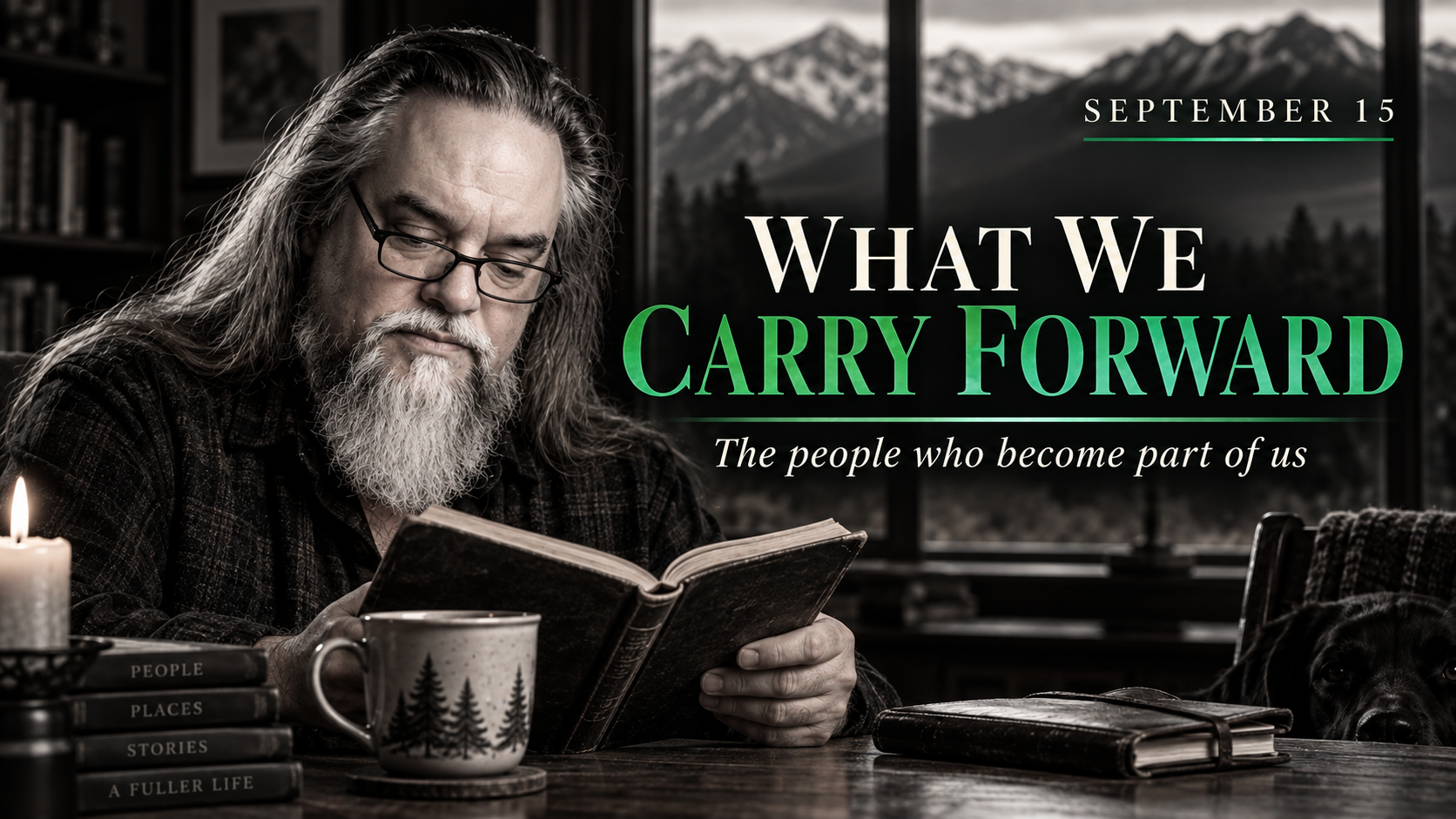
This morning the mountains are where they always are, although the light makes them look slightly different from yesterday. My tea is beside me. The black dog is nearby, occupying his usual portion of the world with considerably less philosophical concern than I seem capable of managing. There is only one person sitting at the table, but I am not certain anymore that this means the room is empty.
A lifetime has pulled up chairs around me.
Some people occupied them for decades. Some stayed for an afternoon. Some appeared only long enough to tell me something I needed to hear and then continued on toward lives I know nothing about. Others left before I understood what they had given me. A few remain close enough that I can still tell them. Many do not. Yet here they are anyway, in the language I use, the stories I tell, the things I believe, the things I have finally stopped believing, the way my hands move when I make tea.
Perhaps this is what we carry forward.
Not people exactly. We cannot keep one another, however much we sometimes wish we could. Time refuses that arrangement. But we keep traces. A phrase. A gesture. A kindness. A warning. A story. A way of standing when the room becomes difficult. A particular kind of laughter. The knowledge that someone once believed in us when we had temporarily misplaced the ability to believe in ourselves.
The measure of a relationship may not finally be how long someone stayed. Some people remain for fifty years and leave surprisingly little behind. Others cross our lives briefly and alter the landscape forever.
Maybe what matters is simpler than duration.
Maybe it is what became part of us because they were there.