
Not Every Ending Is a Failure
I don’t remember what we were talking about when the conversation ended. That is the strange part. If I had known it was going to be the last one, I suppose I would have paid better attention. I would like to imagine that I would have found some extraordinary thing to say, something worthy of being carried away, but I know myself well enough to doubt it. More likely, I would have ruined the moment by trying to make it important. Instead, there were two cups on the table with a little tea left in each of them. A coat hung over the back of the chair across from me. The conversation had wandered into that pleasant territory where neither person was trying very hard anymore. Then the chair moved backward against the floor. The coat was lifted and put on. There was the usual business at the door, the small exchange of words people use when they expect there will be another time. We should do this again. Let’s not wait so long. Get home safely. Nothing memorable. Nothing that asked to be remembered.
Then the door closed.
The room did not react. That seems worth mentioning. The cups remained where we had left them. The chair stayed slightly away from the table. Whatever light had been coming through the window continued coming through the window. Outside, the mountains remained entirely indifferent to the significance I would eventually assign to that moment. There was no shift in the weather, no sudden silence, no instinct that told me to open the door and call the person back. I probably gathered the cups and carried them to the kitchen. Perhaps I pushed the chair in. Perhaps I went on with whatever I was doing before the visit began. Only much later did I understand that the ordinary goodbye had become a final one.
We rarely recognize endings while they are happening.
I have been thinking about that lately, perhaps because I have reached an age when there are enough people behind me to make the thought unavoidable. There are people I once saw almost every day whom I have not seen in decades. People whose telephone numbers I knew without looking them up. People whose kitchens I could navigate in the dark. People who knew the particular stories I told too often and the particular jokes I would make before I made them. There were cities where I knew which door to knock on without calling first. There were dressing rooms and bars and rehearsal spaces where the same faces appeared so reliably that I mistook their presence for permanence. Then something changed. Someone moved. Someone married. Someone took another job. Someone became interested in a different life. Sometimes there was an argument, but surprisingly often there wasn’t. Life simply kept moving, and eventually we stopped appearing in one another’s days.
We have an odd way of measuring relationships. Duration impresses us. We speak with genuine admiration about friendships that have survived forty years, marriages that have reached fifty, partnerships that began when two people were young and somehow continued through all the versions of themselves that followed. That kind of endurance deserves respect. Staying is not easy. Remaining interested in another human being through decades of change may be one of the more remarkable things we do. But I wonder whether we have made a small mistake by allowing length to become evidence of value. We assume that what lasted longest mattered most, as though relationships were measured in years rather than depth.
My own life has provided considerable evidence against that idea. I have had conversations lasting twenty minutes that changed something in me permanently. I have known people for a season who altered the direction of my work. There have been audience members who stayed after a performance and said something I can still remember years later, while there are people I knew for long stretches of my life whose voices I can barely summon now. Time is a remarkably unreliable accountant when it comes to meaning. Some people occupy enormous quantities of our lives and leave surprisingly little behind. Others pass through almost unnoticed and somehow rearrange the furniture.
Perhaps theatre taught me this before I had language for it.
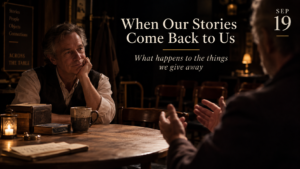
Every night at the Stanley, thirteen strangers come into a room and sit around a table with me. Before that evening, most of them have never met one another. They arrive carrying whatever they have carried through the rest of their day. Curiosity. Skepticism. Excitement. Grief, sometimes. A private hope they may never mention. For a little while, we make something together. I perform, certainly, but anyone who has spent enough time in a theatre knows that a performance is never made entirely by the person standing in front of the room. The audience makes it too. Their attention changes it. Their silence changes it. The way they breathe, laugh, hesitate, lean forward, or glance at the person beside them changes what the evening becomes. For an hour or so, a tiny temporary community exists around that table.
And then it ends.
The lights come up. Chairs move. Coats are collected. People thank me and walk into the corridor. Occasionally someone stays for another minute because there is something they want to say. Then they leave too. Tomorrow there will be thirteen different people sitting in those chairs, and the particular collection of human beings who existed in that room tonight will almost certainly never exist together again.
I have never considered that a failure.
In fact, the temporary nature of it may be part of what gives the evening its weight. We pay attention because it will end. Theatre has always understood something life allows us to forget: the curtain is coming down whether we are ready for it or not. Perhaps that is why people sometimes become unusually present in a theatre. Somewhere beneath the entertainment, we understand that this particular thing is happening once. Even if I perform the same material tomorrow, it will not be the same evening. Those people will not be there. That silence will not happen in precisely that way. Whatever passed between us belonged to that room, at that hour, with those particular people.
Maybe some relationships are like that.
I can look back across a lifetime of performing and find people everywhere. Fellow performers whose habits quietly became part of mine. Someone who taught me a way of thinking about an audience. Someone who showed me how to wait an extra second before speaking. Someone whose generosity embarrassed me into becoming more generous myself. There are jokes in my vocabulary that probably belonged to someone else first. Pieces of music that still summon particular rooms. Expressions I use without remembering exactly when I borrowed them. Ways of working that I once thought were mine until I trace them backward and discover another person standing there.
We carry people strangely.
Not always as memories. Sometimes as mannerisms. Sometimes as standards. Sometimes as warnings. Sometimes as a kindness we received at precisely the moment we needed it and have spent the rest of our lives trying, consciously or otherwise, to give to someone else. A person can disappear completely from our daily lives while continuing to influence how we move through them. Perhaps that is one of the quieter mysteries of being human. We are considerably less self-contained than we imagine. We are crowded with people who are no longer in the room.
Of course, there is another kind of leaving, and it is harder to speak about with this much grace.
Sometimes people do not simply drift away. Sometimes they choose a life that no longer includes us. Sometimes a friendship ends because someone no longer wants the friendship. Sometimes love ends while one person is still very much inside it. Sometimes the empty chair across the table does not feel poetic or instructive. It simply hurts.
There is no philosophy clever enough to make that painless. I distrust any wisdom that arrives too quickly after heartbreak. Some things need to hurt before they are allowed to teach us anything. But pain has its own peculiar logic, and one of the things it often persuades us to do is rewrite the past. If someone could leave us, perhaps they never really loved us. If the friendship ended, perhaps it was never a friendship. If someone chose another life, perhaps everything they said while sitting across from us was somehow false.
I understand the temptation. It gives the ending a clean explanation. Unfortunately, human beings are rarely clean.
Something can be true and still end.
Someone can love us and later become unable to stay. A friendship can be genuine and still belong to a particular season. Two people can mean what they say to each other and eventually discover that what they mean has changed. None of this makes leaving painless, nor does it excuse cruelty, betrayal, or carelessness. Some endings deserve anger. Some departures reveal truths we would rather not know. But I am increasingly reluctant to let the final page rewrite every page that came before it.
There is an empty chair across from me now.
I am learning not to rush to fill it.
There is a kind of dignity in allowing an empty chair to remain empty for a while. We are so uncomfortable with absence that we often want to repair it immediately. Replace the person. Explain the departure. Turn the relationship into a lesson. Decide who was right. Decide who was wrong. Find the moral before the cups have even gone cold. But perhaps absence deserves the same attention presence did. Perhaps there is something to be learned by sitting with the fact that someone was here, and now they are not, without immediately demanding that the difference become useful.
Stewardship, I am beginning to think, includes endings.
We are responsible for how we welcome people into our lives. We are responsible for how we sit across from them, how carefully we listen, how honestly we speak, how gently we hold what they entrust to us. But perhaps we are sometimes responsible for how we release them as well. There may be tremendous love in refusing to turn a departure into an accusation. There may be grace in allowing a chapter to remain beautiful even though it did not become the whole book.
Outside my window, the mountains are darkening. They do this slowly enough that I rarely notice the precise moment daylight becomes evening. One minute I can see the details of the trees, and sometime later there are only shapes against the remaining light. There is a cup of tea beside me. One cup tonight, not two. Across the table is an empty chair.
It does not seem tragic.
It simply looks empty.
And perhaps that is enough.
There are people I wish had stayed longer. There are conversations I would gladly have again. There are doors I might have stood beside for another minute had I understood what their closing would eventually mean. I suppose most of us accumulate these wishes if we live long enough. But I do not want regret to become the curator of my memories. I would rather remember that someone sat there. Someone drank the tea. Someone laughed. Someone told me something they had not intended to tell me. Someone listened when I needed listening. Someone changed me, perhaps only slightly, and then stood up, lifted a coat from the chair, and walked into whatever came next.
Gratitude and grief can occupy the same room. I think I once believed one was supposed to defeat the other. Perhaps maturity is discovering that neither has to leave. I can miss someone and still be grateful they were here. I can wish something had lasted and still refuse to call it a failure because it did not. I can leave the chair empty without pretending nobody ever sat there.
Some people stay.
Some people leave.
And some leave something behind that continues quietly in us, not because they remained, but because for a little while they were here.
The mountains have almost disappeared now. Soon the window will hold mostly my own reflection. The tea is getting cold. Eventually I will carry the cup into the kitchen and turn off the lights. Tomorrow there will be other conversations, other chairs occupied, other people entering and leaving rooms without any of us knowing which moments will matter years from now.
Perhaps knowing that is enough to make me pay a little more attention while they are here.
Not everything meaningful is permanent.
I am beginning to think it never had to be.