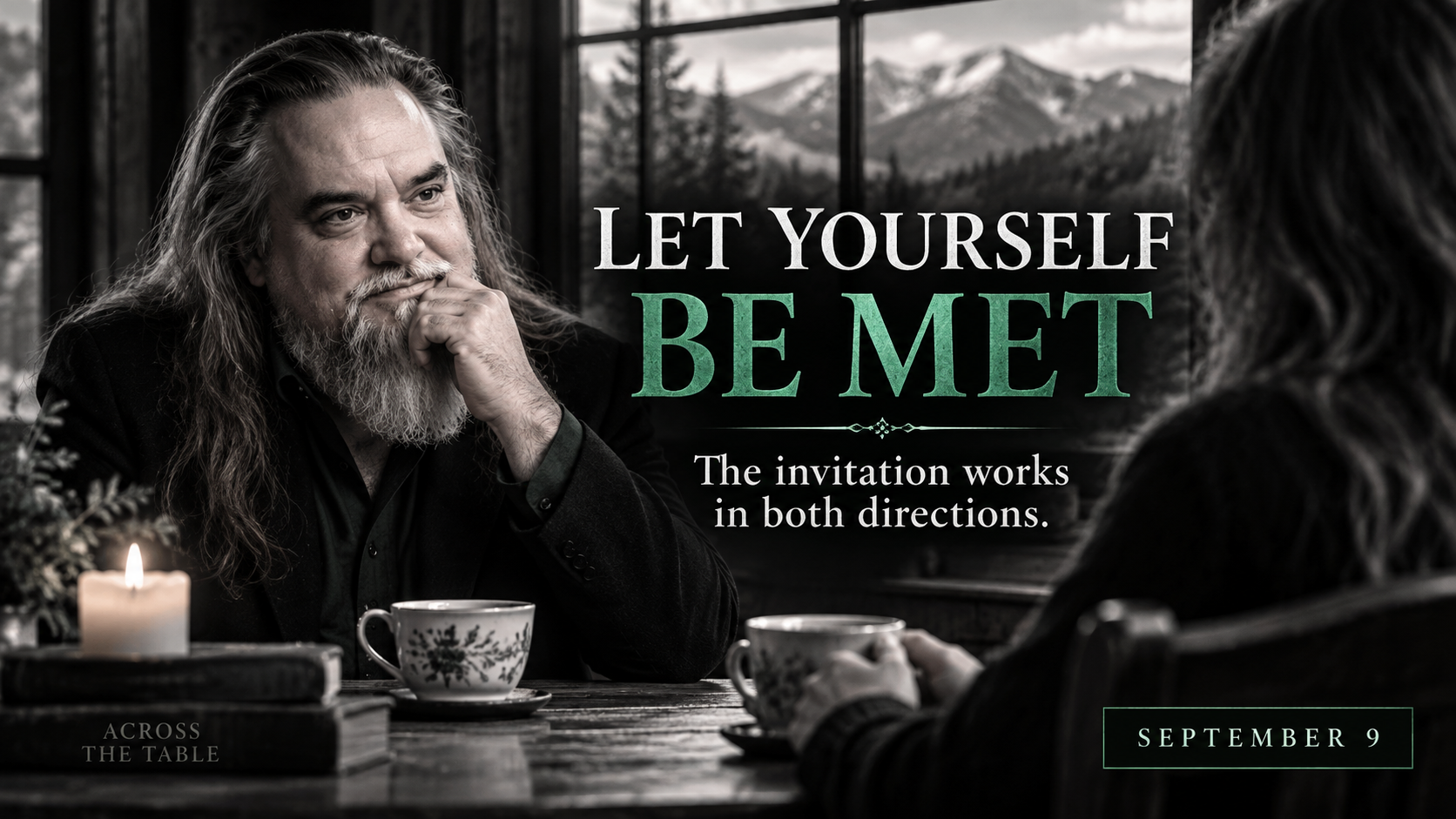

There comes a point when listening is no longer enough. We have to allow ourselves to be heard.
There was tea between us, which is often how these things begin in my life. Not ceremonially. No carefully arranged pot or meaningful choice of cups. Just tea that had been hot when the conversation started and had been forgotten somewhere along the way. I had been listening for quite a while. I do not remember everything we talked about, and perhaps that is part of what made the moment memorable. The conversation had wandered beyond whatever reason we originally had for sitting down together. We had crossed that invisible boundary where people stop exchanging information and begin telling one another things. I had asked questions. I had listened. I had done what I know how to do. And then, somewhere in the middle of it, the person across from me stopped, looked at me for a moment, and said, “And what about you?”
My hand was around the cup. I remember that. I also remember looking toward the window, though there was nothing outside that suddenly required my attention. There was a little joke waiting nearby. I could feel it. I have spent enough years in front of audiences to know when a room needs rescuing, and I have become rather good at rescue. A line appears. A small laugh. A change of rhythm. Something that allows everyone to breathe again and moves us safely into whatever comes next. It is a useful instinct onstage. That afternoon, sitting across from someone who knew me well enough not to be distracted by the scenery, I realized I was about to use the same instinct for an entirely different purpose. I was not trying to rescue the conversation. I was trying to rescue myself from it.
Storytellers live inside a peculiar contradiction. We can spend our lives revealing ourselves to strangers while remaining remarkably difficult to know. I have stood in front of rooms and told stories that were personal, embarrassing, tender, painful, occasionally foolish, and entirely true. There is vulnerability in that, certainly. But there is also control. I chose those stories. I chose the words. I knew where the difficult moment was coming. I knew what would follow it. I knew when the laugh would release the pressure and when the silence should be allowed to stay. Even the most intimate story told from a stage has edges. There is a beginning and an ending, and somewhere inside those boundaries the storyteller remains the person holding the reins.
Across the table, things are less orderly.
There is a difference, I have come to think, between revealing yourself and allowing yourself to be discovered. Revealing is something a performer can become very good at. We open the door ourselves. We decide how far. We decide which room you may enter. We may even show you something precious inside and trust you with it. None of that is false. But being discovered is different. Someone notices the closed door at the end of the hallway and asks about it. Someone hears the sentence you did not finish. Someone recognizes that the joke arrived half a second too quickly. Someone asks, gently and without accusation, the question you have become very skilled at asking everyone except yourself.
And then there is nowhere to perform.
You are simply the person sitting in the chair.
I think I have hidden inside generosity more often than I realized. That is an uncomfortable sentence to write because generosity is supposed to be among the good things. Listening matters to me. I believe deeply in making room for another person. I have spent much of this month thinking about what happens when we stay long enough, listen carefully enough, and become trustworthy enough that another human being feels safe placing something true on the table between us. I do not want to diminish that. But even a virtue can occasionally become a hiding place. If I am listening to you, asking about you, making room for you, then there is a very good chance nobody is asking about me.
It is possible to become indispensable as a witness to other people’s lives while keeping your own life carefully behind glass. You become the person people call. The person who asks the good question. The person who remembers what was said six months ago. The person who does not rush to fill the silence. People trust you because you have earned their trust, and there is something beautiful about that. But there can also be a quiet imbalance hidden inside it. Everyone leaves feeling known, and you leave having successfully remained unknown.
Perhaps performers are particularly susceptible to this. We learn early that attention is something we can direct. A magician understands misdirection. An actor understands focus. A storyteller understands that if I place something compelling enough over here, you may never notice what I am protecting over there. These are not necessarily deceptions. Sometimes they are simply habits of survival that became habits of craft and eventually became habits of personality. After enough years, you may not even notice you are doing it.
Age has not convinced me that everyone should know everything about us. Quite the opposite. I have become more protective of certain things as I have grown older. Privacy is not dishonesty. Mystery is not necessarily fear. There are pieces of a life that do not improve by being made public. Some experiences need time before they become stories, and some should never become stories at all. Not everyone who asks a question has earned the answer. There is wisdom in knowing the difference.
But that leaves a more difficult question.
When someone has earned the answer, do we give it to them?
That afternoon, the person across from me had earned it.
So I left the joke where it was.
I wish I could tell you that what followed was some grand confession, that I finally opened the locked room and everything changed. It was nothing like that. I simply answered the question. Not completely. Not eloquently. Probably not even particularly well. I said something true that I would ordinarily have polished before letting another person hear it. And then came the part I found much harder.
They were quiet.
They did not rescue me.
There is a strange intimacy in being allowed to finish speaking and then having someone remain there. No advice. No quick reassurance. No clever reframing. Just another person sitting across from you who has heard what you said and has not gone anywhere. I realized how often I had offered that gift to others and how rarely I had allowed myself to receive it.
Perhaps this is what being met feels like. Not being understood perfectly. Not being solved. Certainly not being exposed. Simply discovering that someone can see a little farther into you than you usually permit and finding that the world does not collapse because of it.
Eventually I reached for my tea.
It was cold.
Neither of us had noticed how much time had passed.
We were still sitting there, two people across a table, and for once I was not responsible for where the conversation went next. I did not need to make the moment interesting. I did not need to find the ending. There was no audience waiting for the final line.
There were simply two chairs.
And I understood, perhaps later than I should have, that the chair across the table was never meant to face only one direction.


