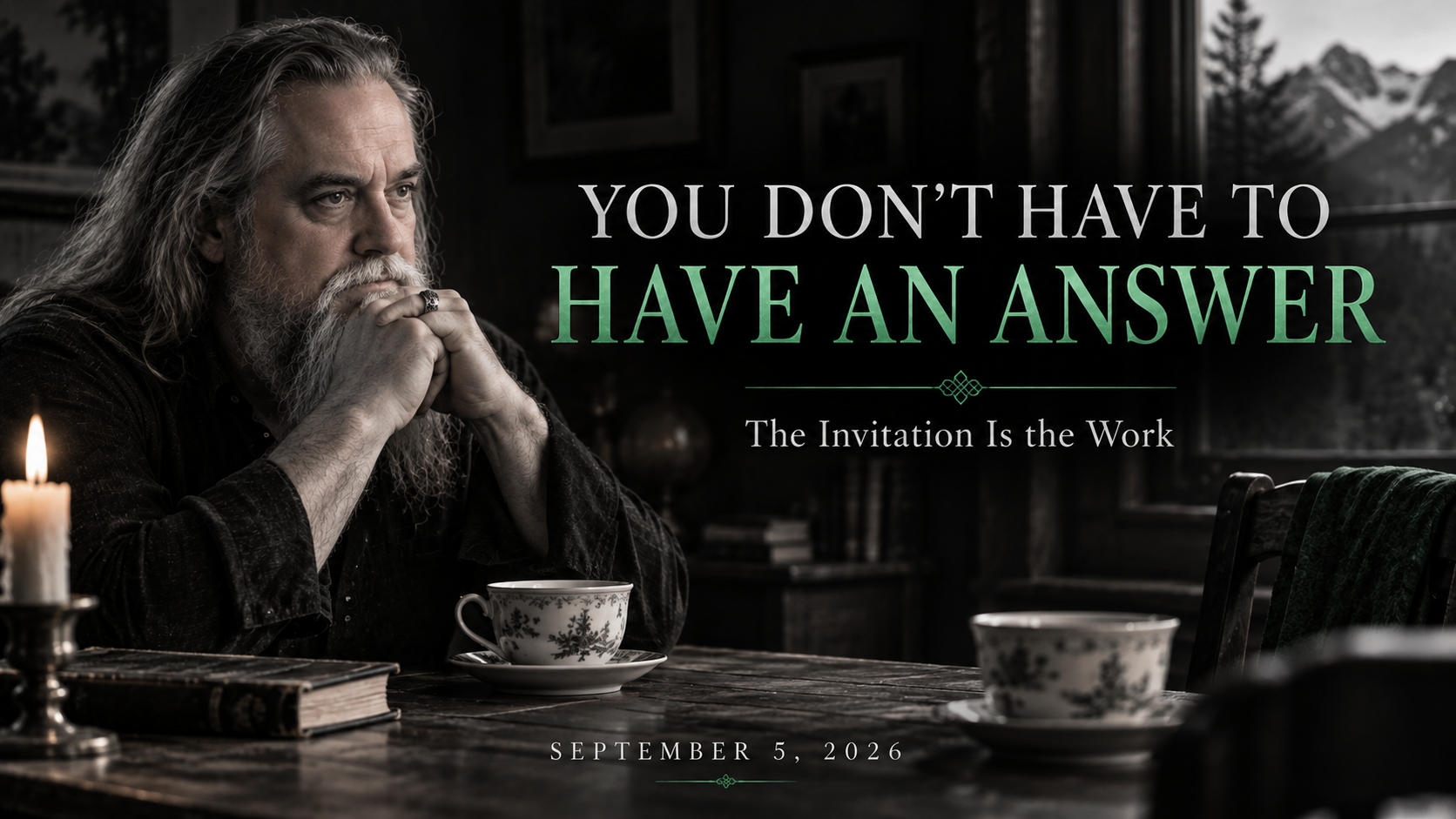

Sometimes the kindest thing we can offer another person is our willingness to remain beside a question.
I remember sitting across from someone once when the conversation changed without either of us announcing that it had changed. That happens sometimes. You begin with ordinary things, the safe inventory of a life, work and weather and where someone is headed next, and then something shifts. The room seems to get smaller. The person across from you stops looking around quite so much. Their voice loses whatever little performance it had been carrying. I remember there was tea between us, although by then neither of us was drinking it. I had both hands around the cup anyway, not because I was cold but because it gave my hands somewhere to be. There are moments when you become strangely conscious of your own body, of where your hands are resting, of whether you are looking too directly at someone or not directly enough. I remember looking down at the table when the question came. It was not complicated. In fact, like many of the questions that stay with us, it was almost painfully simple. “What am I supposed to do now?” I knew immediately that I did not have an answer.
I wish I could tell you that I possessed enough wisdom in that moment to understand what was being asked of me. I didn’t. My first instinct was the same instinct I have had most of my life. I wanted to say something. I wanted to be useful. I wanted to reach into whatever collection of stories, experiences, mistakes, observations, and borrowed wisdom I have accumulated over sixty-one years and find the right thing to place on the table. Surely there was a story for this. Surely I had lived long enough to offer some perspective. I make my living with words, after all. I have stood in front of audiences for most of my adult life and learned how to feel a room, how to hold silence just long enough, how to move a story toward the place where it needs to arrive. A performer becomes accustomed to the idea that eventually something must happen. The story must turn. The tension must resolve. The audience has trusted you with their attention, and part of the bargain is that you will take them somewhere. Sitting across that table, I could feel the old machinery beginning to turn. Find the words. Find the story. Make this mean something.
But the words that came to me all seemed too small for the question.
That may be one of the things age has changed in me. I am less impressed than I once was by a quick answer. I have given enough of them to know how often they are really an attempt to relieve the discomfort of the person giving them. Someone tells us that their marriage is ending, that they are frightened, that someone they love is dying, that they have made a mistake they cannot undo, that they no longer recognize the life they have built, and almost immediately we begin reaching for language. We tell them everything happens for a reason. We assure them that time heals. We remind them of their strength. We tell them what we would do. We offer the story of someone else who survived something similar. None of these responses are necessarily cruel. Most are born from tenderness. We want to build a little bridge across the terrible space that has opened in front of someone we care about. But sometimes, if we are not careful, we build the bridge because we cannot bear to look into the space. We answer because the unanswered question makes us uncomfortable.
I have begun to wonder how many conversations I have hurried past because I mistook accompanying someone for helping them. They are not the same thing. Helping usually imagines a destination. There is a problem, and together we are going to move toward its solution. Accompanying someone asks for something quieter. It means agreeing to walk beside them without insisting that we know where the road leads. There is a humility in that which does not come naturally to those of us who make things from stories. Stories train us to look for shape. We notice beginnings and endings. We recognize patterns. We find the moment that explains the moment that came before it. Given enough time, a storyteller can make almost anything look inevitable. Life itself is considerably less cooperative. Some things do not resolve. Some losses do not reveal their purpose. Some people leave without explaining themselves. Some apologies arrive too late, and some never arrive at all. There are doors that close without teaching us why they had to close.
I know more about that now than I did when I was thirty. What is strange is that knowing more has not necessarily produced more answers. In some ways, it has done the opposite. At sixty-one, there are things I understand less confidently than I once did. There are people from my past whose choices I can explain in half a dozen different ways, and I no longer know which explanation is true. There are decisions I made that seemed unquestionably right at the time and whose cost I did not understand until years later. There are relationships that ended without the clean final scene a writer would have given them. There are people I miss whom I would not know how to speak to if they walked through the door this afternoon. There are old wounds I have stopped trying to turn into wisdom because perhaps they were simply wounds. There are questions I thought age would answer for me, questions about love and belonging and purpose and why some people stay while others leave, and I have discovered that years do not necessarily solve them. Sometimes the years merely teach us how to carry them differently.
The theatre can spoil you in this regard. Onstage, I know where we are going. Even when an audience does not. I know what waits behind the next turn. I know why an object has been placed on the table. I know which detail will matter later. In the séance room at the Stanley, there are thirteen chairs, and when people take their places around that table they enter something that has been carefully considered. However mysterious the evening may feel to them, I have a responsibility for its architecture. I know the road. I have walked it before. Perhaps that is part of what makes the work satisfying. For a little while, within the boundaries of a performance, the world can possess shape. Outside that room, after the candles are extinguished and the audience has gone back into the hotel corridors and I am left with the chairs and whatever quiet remains behind them, life returns to its more familiar habit of refusing to explain itself.
Maybe that is why the conversations after a performance have sometimes stayed with me longer than the performance itself. Someone lingers. Everyone else leaves. The performer in me is finished for the evening, but the person standing there has not quite finished. You can usually tell. They say something complimentary about the show, perhaps, but they do not move toward the door. There is another sentence waiting. Sometimes it takes a while to arrive. I have learned not to hurry it as much as I once might have. Eventually they tell you about a father, a wife, a child, a death, a fear, some private absence they carried into the room with them. And suddenly you understand that whatever happened during the show brushed against something you could not possibly have known was there. In those moments, being the storyteller is of surprisingly little use. The temptation is to become one anyway, to offer some beautiful observation that will justify the trust they have just placed in you. But perhaps trust does not always require a response. Perhaps sometimes it requires restraint.
There is an intimacy in allowing another person’s question to remain unanswered. It says, in a way that reassurance sometimes cannot, that I am not frightened by the fact that you do not know. I will not force a meaning onto this because your uncertainty makes me uncomfortable. I will not hurry your grief toward gratitude. I will not turn your fear into a lesson before you have had the chance to admit that you are afraid. I will not demand that this chapter become useful simply because stories have taught me to expect chapters to serve the whole. We can sit here for a while. The tea can get cold. The silence can grow longer than either of us expected. Nothing has to be repaired before one of us is allowed to leave the table.
I think I once imagined maturity as a gradual accumulation of answers. You live long enough, pay attention, make enough mistakes, survive enough losses, and eventually you become the person younger people come to because you know things. There is some truth in that. Experience matters. There are storms I recognize now because I have been caught in them before. But maturity, if I understand any part of it, may have more to do with becoming less frightened of what cannot be answered. There is a kind of peace in no longer requiring every part of your life to explain itself. Not everything becomes a lesson. Not every broken thing reveals a hidden gift. Not every goodbye eventually makes sense. Sometimes a thing happened, and it hurt, and years later it still occupies a small room somewhere inside you. Wisdom may not be finding the key to that room. It may simply be learning that you can live a good life without locking it.
That afternoon at the table, I eventually looked up. The person across from me was waiting, although I don’t think they were waiting for wisdom. That was something I had imagined because wisdom would have given me a role to play. I could have been the older man, the storyteller, the person who had seen enough of life to offer direction. Instead I said the only thing that felt honest.
“I don’t know.”
And then I stayed.
The tea was cold by then. Neither of us reached for it. The question remained exactly where it had been placed between us, unanswered and perhaps unanswerable. Nothing opened. Nothing resolved. There was no sentence I could carry away and polish into certainty. There were only two people sitting across a table, one of them hurting, the other unable to make the hurt smaller.
For a while, that was enough.


