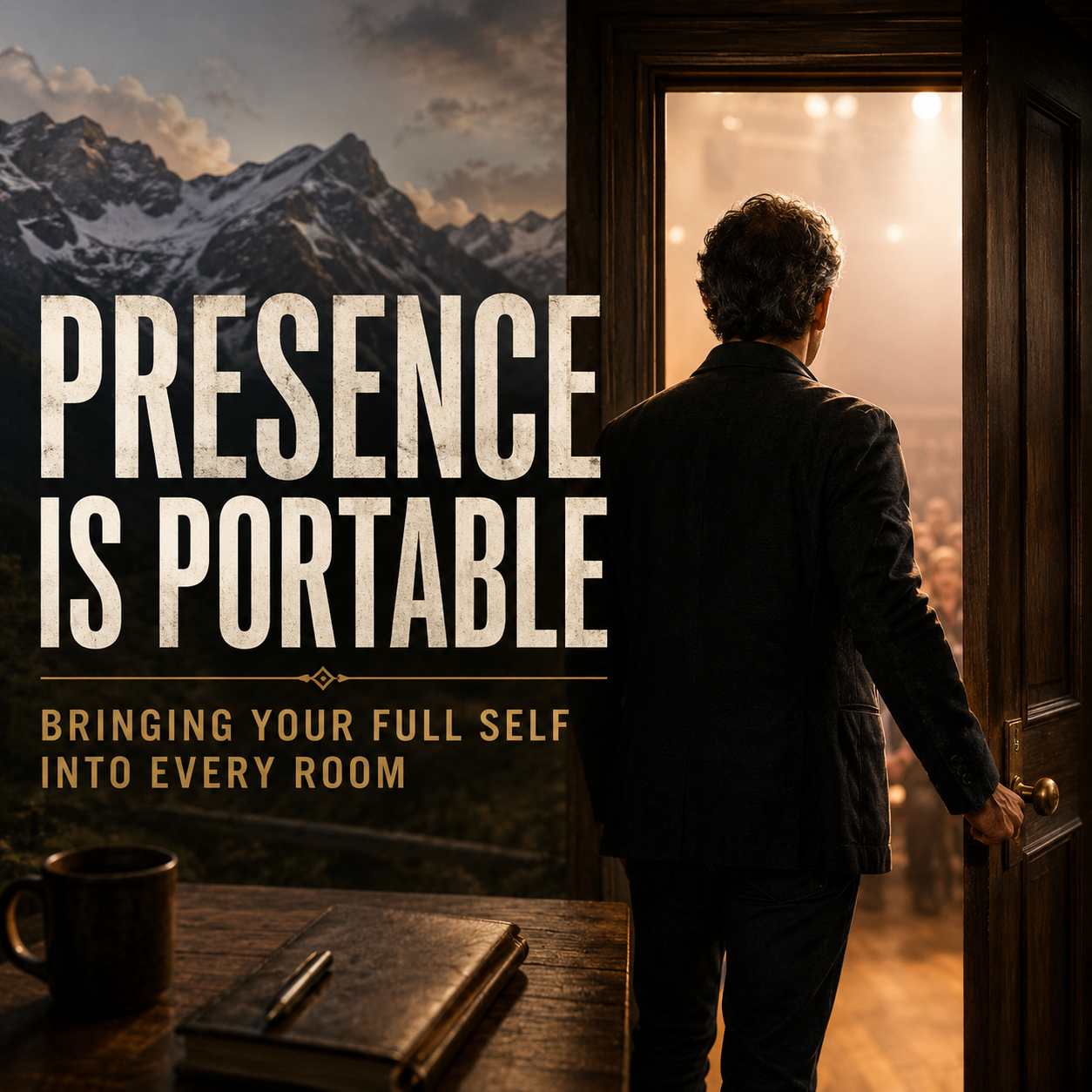

The room changed three times before noon.
A delayed phone call. A pile of unfinished notes beside my coffee. The low hum of construction somewhere beyond the office walls. By the time the light finally settled across the table, the mountains beyond the window had disappeared behind weather that couldn’t decide what it wanted to become. Snow one minute. Rain the next. Then brightness again, as if none of it had happened.
There was a time when I would have treated that kind of morning as a disruption to the work. I would have waited for the atmosphere to improve. Waited for quiet. Waited for certainty. Waited for the version of myself who felt composed enough, rested enough, inspired enough to begin properly.
But eventually you live long enough inside your own vocation to realize something uncomfortable. The conditions rarely stabilize for very long. The room changes. Your energy changes. The audience changes. Sometimes your own mind changes halfway through the sentence. If your presence depends entirely on ideal circumstances, then you will spend much of your life absent from it.
This becomes especially clear in performance. People imagine that presence is something theatrical, something summoned by lights or applause or the invisible agreement between audience and performer. But the older I get, the more I think presence is much quieter than that. It is not intensity. It is not charisma. It is not force.
It is continuity.
I have stood behind the séance table on evenings when I felt sharp as a blade, every word arriving exactly where it should. I have also stood there exhausted from travel, distracted by life outside the theater, carrying grief or uncertainty I could not neatly resolve before curtain. The audience rarely knows the difference in the way performers fear they will. Not because the inner world disappears, but because presence was never about pretending not to feel it.
It was about arriving fully anyway.
That distinction matters.
A great many thoughtful people spend years trying to compartmentalize themselves into functionality. One version for the stage. One for the meeting. One for the family dinner. One for the difficult season. One for the days when confidence arrives naturally. Another for the days when it does not. And while some adaptation is necessary, fragmentation has a cost. You begin rehearsing your own life instead of inhabiting it.
Integration asks something harder. It asks whether the self sitting quietly at the kitchen table can remain recognizable inside the crowded room. Whether your values survive inconvenience. Whether your voice remains your voice when the environment stops cooperating with you.
And truthfully, this is where the real work begins to reveal itself.
Because presence becomes most visible precisely when maintaining it is inconvenient.
Not during the polished keynote. During the awkward conversation afterward. Not during the triumphant season. During the Tuesday afternoon when motivation has quietly left town and the responsibilities remain. Not when everyone agrees with you. When the room subtly asks you to become smaller, flatter, easier to digest.
Most people do not lose themselves all at once. They abandon themselves incrementally, through tiny negotiations repeated over time.
Just this once.
Just for this room.
Just until things calm down.
But the nervous system remembers every compromise. So does the spirit.
I think this is why integrated people feel calming to be around. Even when they are imperfect. Even when they are tired. There is less performance happening beneath the performance. Less scrambling. Less invisible negotiation between who they are and who they think the room requires them to become.
You can feel when someone has brought their whole self with them.
Not their loudest self. Their whole self.
And perhaps that is the quieter invitation hidden underneath all of this. Not mastery. Not polish. Simply the willingness to remain present long enough for your life and your work to stop arguing with each other.
The weather has shifted again while I’ve been writing this. The mountains are visible now, blue at the edges, carrying that strange Colorado stillness that makes even distance feel intimate. In a few hours, another audience will gather somewhere. Conversations will begin. Coffee cups will cool beside unfinished thoughts. Someone will wonder whether they still have the energy to keep carrying the work forward into rooms that do not always make it easy.
Still, I suspect something steadier than certainty is already traveling with them.
And I hope the room receives them gently when they arrive.