
The interruption used to feel personal.
A delayed flight. A bad night of sleep before a performance. A week where the writing rhythm breaks apart because life arrives with its own demands and does not ask permission first. Even now, with years behind me and enough evidence to know better, there are moments when I still feel the old instinct rise up, the belief that the real work exists somewhere just beyond inconvenience. That if I could only secure the right conditions long enough, everything would finally move cleanly.
But the older I get, the more suspicious I become of clean things.
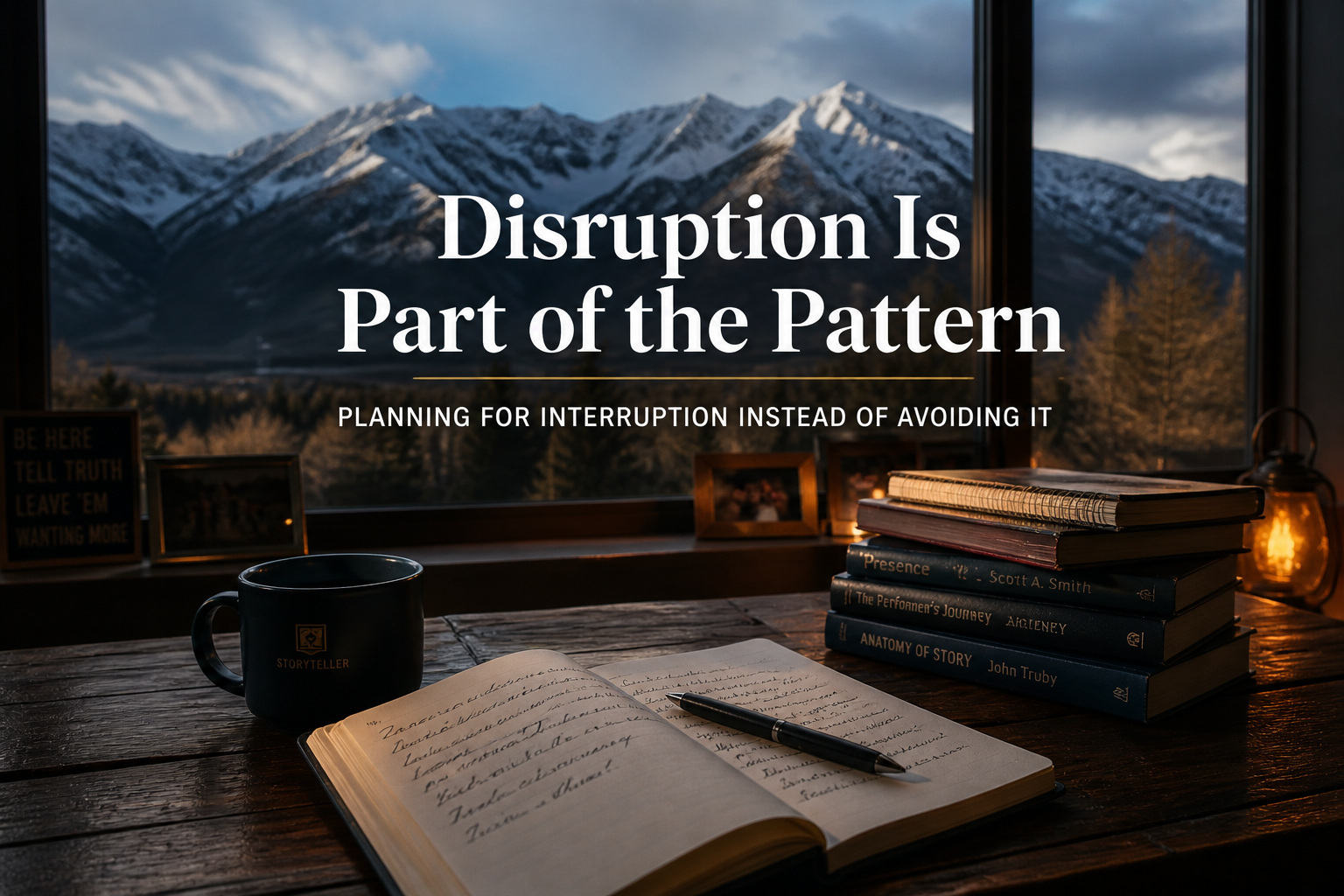
The mountains outside the office window were hidden most of this morning behind weather that rolled in without warning. For a while, the entire range disappeared into a flat gray wall, and it struck me how quickly the mind assumes absence simply because visibility changes. The mountains were still there. The shape of the land had not vanished. Only my access to it had shifted for a few hours.
Work is often like that.
People talk about discipline as though it is the removal of interruption, but I have started to think the opposite may be true. Real discipline is learning how to remain in relationship with the work even while the conditions move around you. Especially then. Otherwise what we are building is not practice, but dependency. Dependency on mood. Dependency on energy. Dependency on silence, confidence, clarity, affirmation, momentum. And the problem with dependency is that life eventually collects its debt.
Some of the most meaningful performances I have ever given arrived on nights that should not have worked at all. Exhaustion sitting heavy behind the eyes. Technical problems minutes before the audience entered. Personal grief quietly unfolding offstage while people gathered expecting mystery, presence, steadiness. I remember standing behind the curtain once, listening to a room fill with voices while feeling utterly unlike the version of myself I thought belonged out there. But the strange thing about long practice is that eventually the work stops asking whether you feel ideal. It asks only whether you will enter honestly.
And honesty rarely looks polished.
I think many thoughtful people reach a point where beginning is no longer the central challenge. They know how to start. They have notebooks filled with beginnings. What becomes harder, and infinitely more important, is continuation. How do you continue when the rhythm breaks? How do you continue when your body changes, your attention fractures, your certainty dims a little? How do you continue when the room itself shifts shape around you?
Not by pretending disruption will someday disappear.
The seasons here make that impossible anyway. Spring in Colorado arrives like an argument between realities. Snow in the morning, sunlight in the afternoon, wind rattling the windows by evening. You learn quickly not to build your identity around stability. You learn to carry the necessary things with you instead. A decent coat. Patience. A willingness to adapt without dramatizing every change in weather.
Creative work asks for much the same.
There is a quieter form of maturity that emerges when you stop treating interruption as evidence that something has gone wrong. The phone rings. The schedule changes. Someone needs you. Your energy dips. The day fractures into smaller pieces than you hoped for. Fine. The pattern was never supposed to be uninterrupted. A living practice has to account for reality or it remains fragile by design.
This does not mean becoming casual about the work. Quite the opposite. It means building forms sturdy enough to survive contact with an actual life. Smaller rituals that can travel. Standards that hold even when motivation does not. A way of returning without shame after inevitable lapses. The return matters more than the fantasy of never leaving.
And perhaps that is what integration really begins to mean after a while. Not balance. Not perfection. Not some immaculate morning routine untouched by the world. Just a deepening ability to remain connected to yourself across changing conditions. To recognize that disruption is not outside the pattern. It is part of the pattern.
The light has shifted again now. The mountains have reappeared in full, snow still resting high along the ridges as though nothing happened at all. Somewhere tonight there will be another audience gathering in dim light around a table, carrying their own interruptions with them, their own unfinished thoughts, private griefs, exhausted hopes. And together, for a little while, we will practice staying present anyway.
May there be kindness near you tonight, and enough steadiness to continue from wherever you are.