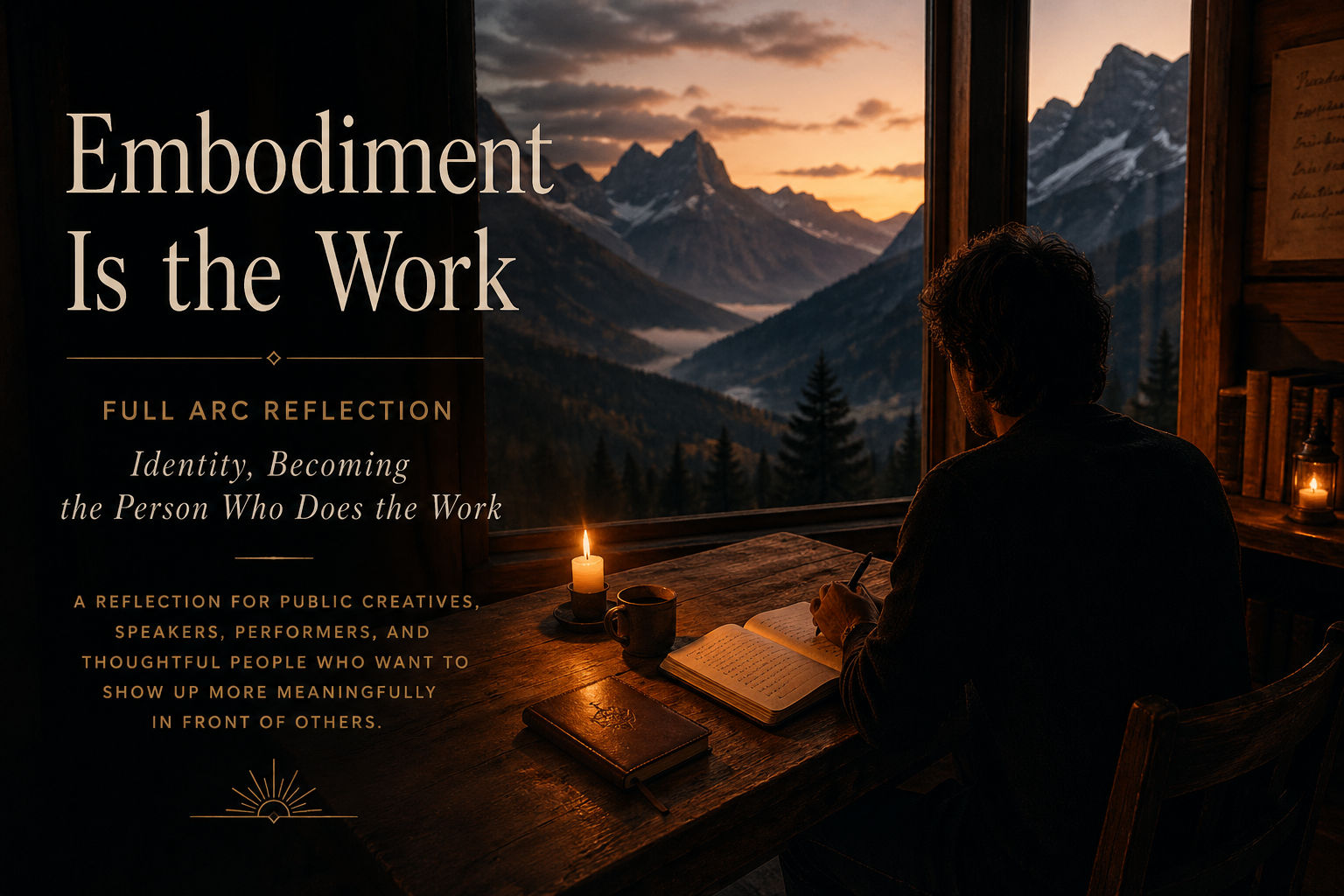

Embodiment Is the Work
Full arc reflection
In this moment, somewhere past the early enthusiasm and before any real sense of mastery, when the work stops feeling like something you visit and begins to feel like something you live inside. It is quieter than you expect. No ceremony marks it. No one announces your arrival. But you notice, if you are paying attention, that your days have begun to organize themselves around a different center of gravity.
This is what I mean when I say embodiment is the work.
For public creatives, for speakers, performers, and anyone who stands in front of others with the hope of offering something meaningful, the temptation is always to focus on the visible moment. The talk. The show. The post. The outcome. We polish the surface because that is what can be seen, measured, applauded. But the longer you stay in this life, the more you realize that what happens in front of an audience is only a small expression of a much larger, quieter practice.
Identity is not declared in those moments. It is revealed.
Over the past stretch of work, you have likely felt this shift begin. Repetition has worn down the novelty. Structure has replaced improvisation in places where you once relied on instinct alone. What felt rigid at first has started to feel like a kind of support, a scaffolding that allows you to go deeper rather than merely wider. And somewhere along the way, the question changed from “What should I create today?” to “Who am I becoming through this?”
That is not a small change. It is the entire game.
To become the person who does the work is to remove negotiation from the process. Not entirely, of course, we are still human, still subject to weather both internal and external. But the baseline rises. The standard becomes quieter and more consistent. You begin to show up not because you feel inspired, but because it is simply what you do. The ritual carries you when motivation does not.
This is where many people step away. Not because the work is too difficult, but because it is no longer dramatic. There are fewer spikes of excitement, fewer moments that feel like breakthroughs. Instead, there is a steady accumulation. Small acts, repeated. A sentence written. A rehearsal completed. A room entered with presence rather than performance.
It can look unremarkable from the outside. It rarely is.
Because what is happening beneath that surface is a slow integration. The voice you use on stage begins to sound like the voice you use across the table. The discipline you apply in your craft begins to shape how you move through ordinary life. There is less separation between the artist and the person. Less strain in holding those identities apart.
And with that integration comes a kind of authority that does not need to announce itself.
Not loud authority. Not the kind that demands attention. Something quieter. More durable. The kind that comes from knowing, in a lived way, that you can rely on yourself. That you have built something internal that does not depend entirely on external response.
This is what audiences feel, even if they cannot name it. Not perfection. Not polish. But coherence.
So as you look back across this arc, it is worth asking a different set of questions than the ones you might be used to. Not how much you produced, or how well it performed, but how consistently you returned. How often you chose the work over distraction. Whether your standards held when no one was watching.
And perhaps most importantly, whether the person doing the work now feels more recognizable to you than the one who began.
If so, then something meaningful has taken root.
There is still more to do. There always is. But it will not be built through grand gestures or sudden reinvention. It will be carried forward in the same way it has been built, through attention, through repetition, through a quiet willingness to continue.
Pull up a chair. The work is still here.