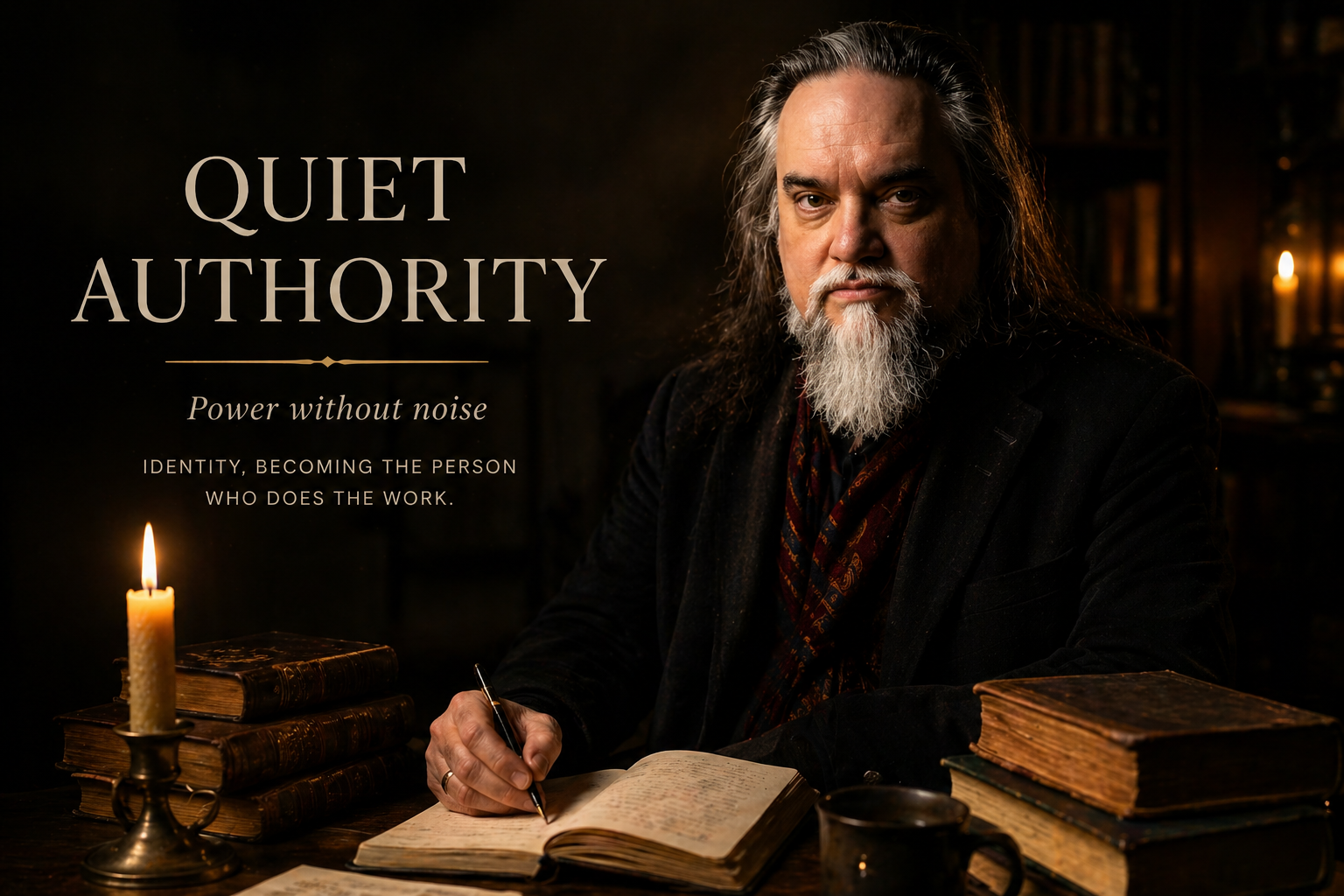

Quiet Authority
Power without noise
There is a particular kind of presence that does not announce itself. You feel it before you understand it. It enters the room without asking permission and settles, not in dominance, but in certainty. No raised voice, no sharp gestures, no urgency to prove. Just a steady, grounded sense that something here knows what it’s doing.
Most people miss it.
We have trained ourselves to look for volume as a signal of value. The loudest voice, the fastest speaker, the one with the sharpest edges and the most polished certainty, tends to get the attention. And attention, for many, has become the substitute for authority. But they are not the same thing. Attention is a flicker. Authority is a flame that doesn’t rush.
If you work in public, if you stand in front of people in any meaningful way, this distinction matters more than you might think.
Quiet authority is not about withholding. It is not about being passive or vague. It is a form of precision. It comes from knowing what belongs and what does not. It is the discipline of saying less because you have already done the work to understand more.
I have seen performers try to manufacture this. They slow their speech, lower their voice, adopt the posture. But it doesn’t hold. The room senses the difference immediately. Quiet authority cannot be worn like a costume. It is built, slowly, in private, through repetition that no one applauds.
It is built when you rehearse a piece for the twentieth time, not because you have to, but because you know it can still be cleaner. It is built when you remove a line you like because it muddies the moment. It is built when you choose to listen longer than is comfortable, allowing the space to breathe before you step in.
What you are doing in those moments is not just refining a performance. You are becoming someone who does not need to reach for control, because you have already cultivated it.
This is where identity begins to shift.
We often think identity is declared. That at some point we decide who we are, and then we try to live up to it. But in practice, identity is revealed through what we repeat under no pressure. The way you prepare when no one is watching. The way you handle silence when the moment stretches. The way you respond when something doesn’t go as planned.
Quiet authority grows in those places.
It is also deeply tied to restraint. Not the kind that feels tight or restrictive, but the kind that comes from trust. Trust in your material, in your timing, in your ability to carry the moment without overloading it. You stop trying to fill every gap. You stop trying to win every second. You allow the work to stand on its own legs.
There is a kind of generosity in that.
When you do not crowd the moment, the audience has room to arrive. They can meet you halfway. They can think, feel, and participate. And in that shared space, something more meaningful happens than any perfectly executed line could achieve on its own.
This is power without noise.
It does not spike. It does not demand. It accumulates.
And it requires patience, which is why so few people commit to it. The results are not immediate. You will not always be the most memorable person in the room, at least not in the way people are used to measuring memory. But over time, something else happens. People begin to trust you. They lean in without being asked. They remember how it felt to be in your presence, even if they cannot quote a single line.
For those of us who care about depth, that is the work.
Not to be louder, but to be clearer. Not to be seen more, but to be felt more accurately. Not to control the room, but to hold it.
If you are building toward that, continue. Stay with the repetitions that no one sees. Refine what can be refined. Remove what does not serve. Let the work shape you into someone who no longer needs to announce their authority, because it is already there, quietly doing its job.
There is more of this ahead, if you are willing to keep going.