
I’ll continue to stress this: there’s a big difference in making art because you love to make it, and making art because it’s nine o’clock and the show must start. Committing to ‘showing up’, whether that means performing or setting aside your time to purposefully exercise your gift, is where art is conceived and born. You must show up before you can show out,
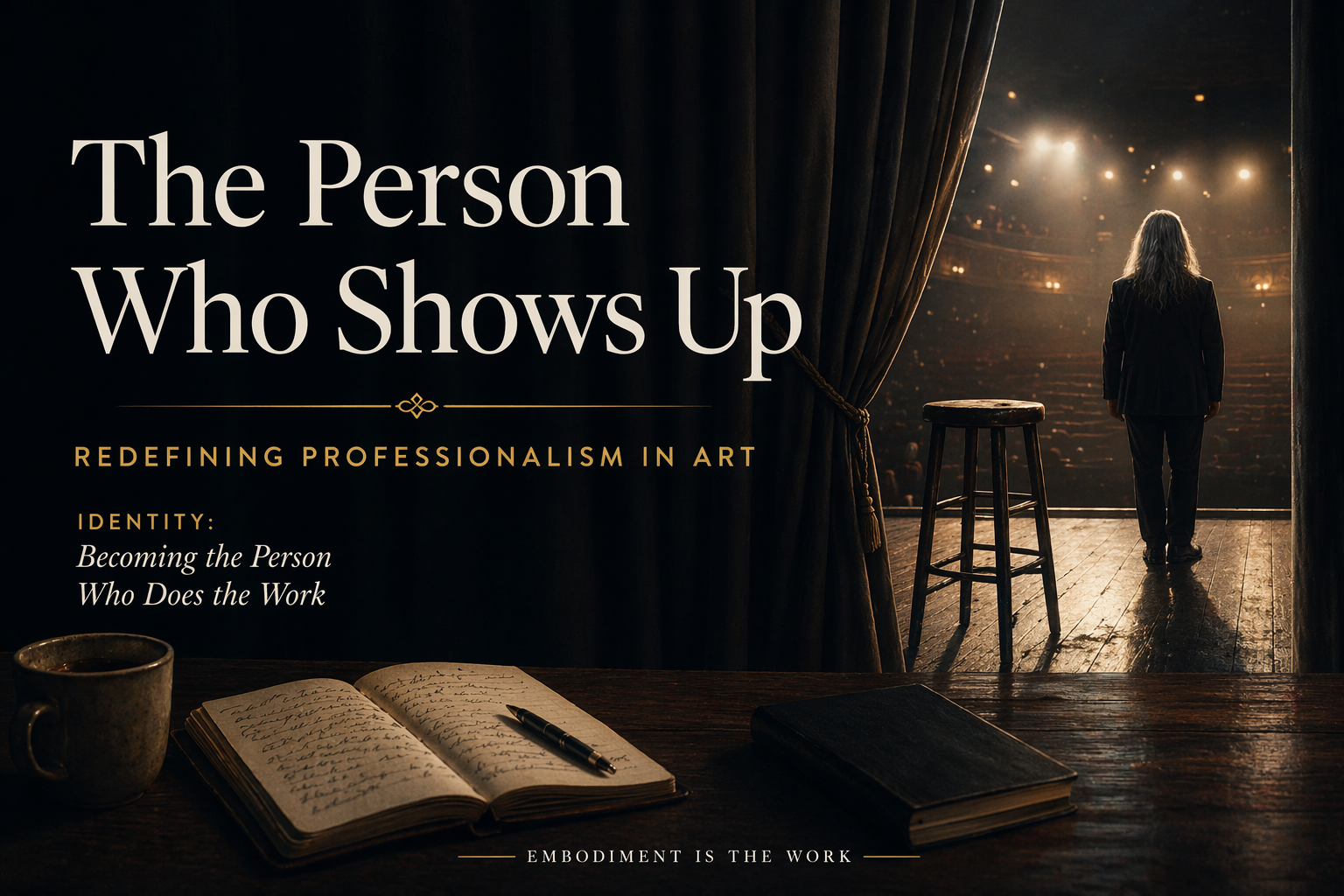
The Person Who Shows Up
Redefining professionalism in art
There is a quiet shift that happens when you stop asking whether you feel like doing the work and begin asking whether you are the kind of person who shows up to do it.
It does not announce itself. There is no ceremony, no visible crossing of a threshold. In fact, from the outside, it looks almost identical. The same desk, the same stage, the same blank page waiting patiently. But something fundamental has changed beneath the surface. The work is no longer something you visit. It is something you inhabit.
We have inherited a strange idea of professionalism in the arts. It is often dressed up in outcomes, in applause, in the language of opportunity and momentum. It speaks in terms of gigs booked, audiences grown, recognition earned. And while none of that is inherently wrong, it is incomplete. It places professionalism somewhere downstream, as if it arrives after the work has already proven itself.
But in practice, professionalism begins much earlier, in far quieter places. It begins in the decision to keep a promise that no one else is tracking. It begins in the return to the table when yesterday’s work did not feel particularly inspired. It begins in the willingness to be seen in the middle of the process, not just at its polished conclusion.
The professional, in this sense, is not the one who is most celebrated. It is the one who is most consistent in their relationship to the work.
For public creatives, speakers, performers, and those who carry something worth sharing, this distinction matters more than it first appears. Because your audience, whether they know it or not, is responding less to the peak moments and more to the pattern. They are reading your rhythm. They are sensing whether you are visiting your craft or living inside it.
And that rhythm is built long before the performance.
It is built in the small negotiations with yourself. The moment you decide whether to write when the paragraph feels slow. Whether to rehearse when the room is empty. Whether to refine a line no one will consciously notice, but everyone will feel. These are not dramatic decisions. They rarely make for good stories. But they accumulate, and over time, they form a kind of gravity around your work.
This is where identity quietly takes root.
Not in declarations, but in repetitions. Not in what you claim, but in what you return to. You do not become the person who shows up by announcing it. You become that person by showing up, again and again, until the question no longer feels negotiable.
There is a certain relief in this, if you let it land.
Because it removes the burden of constant reinvention. It frees you from the exhausting need to feel ready before you begin. It replaces the fragile motivation of the moment with something steadier, something more reliable. A posture. A stance. A quiet agreement with yourself about who you are and how you operate.
This is the deeper meaning of embodiment in the work.
You are not performing discipline. You are living it. You are not waiting for inspiration to grant permission. You are building a structure that allows inspiration to find you already in motion. And over time, the distance between who you say you are and what you actually do begins to close.
That closing of the gap is what people feel.
They may not have the language for it, but they recognize it immediately. There is a coherence in your presence. A steadiness that does not need to be announced. It is not loud, but it is unmistakable. And it is built, quietly, in all the moments no one applauds.
So if professionalism is to mean anything in this work, let it mean this.
You are the person who shows up.
Not occasionally. Not when conditions are favorable. But as a matter of identity. As a way of being in the world. As someone who has decided, perhaps without ceremony, that this is what you do.
And if that feels like a high bar, consider that it is also a simple one.
You do not need to become someone else overnight. You only need to return, today, and take your place again. The work will meet you there, as it always does, indifferent to your mood but deeply responsive to your presence.
If you are willing, we can keep exploring what that kind of presence requires, and what it quietly builds over time.