
I walked around my little town early this morning and watched the sunrise. Sent up gratitude and apologies. Trying to be a better man.
Seven Days In, Now It’s Real
There is a particular honesty that arrives around the seventh day.
Not the excitement of beginning, which is often loud and full of promises we have not yet had to keep. Not the distant, imagined satisfaction of completion. But something quieter, more revealing. A small, steady moment where the work has had just enough time to press back against you, to ask if you meant what you said when you began.
Seven days is not impressive. It will not earn applause. No one is watching closely enough to reward you for a week of consistency. And yet, for those of us who stand in front of others, who ask audiences to trust us, to follow us, to feel something real, this is often the first true threshold.
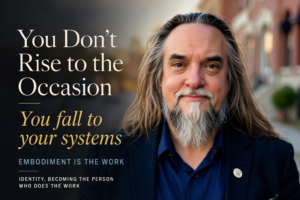
Because this is where embodiment begins.
Up until now, you could still be performing the idea of the work. You could still be flirting with it, trying it on, keeping one foot slightly outside the circle. But seven days in, the body knows. Your rhythms are being interrupted. Your habits are being negotiated with. Your identity, whether you intended it or not, is being quietly rewritten through repetition.
This is the moment most people soften their standards.
Not dramatically. Not in a way they would even admit out loud. It shows up in small negotiations. A skipped rehearsal justified as rest. A piece left unfinished because “it’s good enough.” A decision to drift just slightly, just for today.
And the trouble is, these choices feel reasonable. They always do.
But what you are actually negotiating is not the task. You are negotiating the terms of your relationship with yourself.
For public creatives, for speakers and performers especially, this matters more than we often acknowledge. Because the work is not just what you produce. It is what you carry into the room. It is the difference between someone who is presenting something and someone who has become it.
An audience can feel the distinction, even if they cannot name it.
Seven days in, the question is no longer “Can you do this?” It is “Will you continue to become the person who does this?”
There is a subtle shift that happens when you stop treating your work as an activity and begin treating it as a practice. Activities can be skipped. Practices have a place in your life. They are expected. They are returned to. They begin to shape the structure of your days rather than being squeezed into the leftover space.
This is where embodiment quietly takes hold.
It is not glamorous. It rarely feels dramatic. Most days, it feels like sitting down when you would rather not. Like speaking the line again, even when you already know it. Like refining something that no one else will ever see, simply because you can feel the difference.
And yet, this is where depth is built.
Not in bursts of inspiration, but in the steady, almost invisible layering of attention. In the willingness to stay when the novelty has worn off. In the discipline to continue when there is no external validation to sustain you.
If you are seven days in, you have already crossed something meaningful.
You have proven that you can begin. Now you are being asked something more interesting. Can you remain? Can you let this work move from something you do into something you are?
There is no need to answer that question loudly. In fact, it is better if you don’t. The answer will be built quietly, over the next seven days, and the seven after that, in the choices no one sees.
Stay close to the work. Stay close to yourself inside it.
And if you find yourself wanting a steadier table to return to, a place where this kind of depth is not only practiced but understood, you already know where to sit.