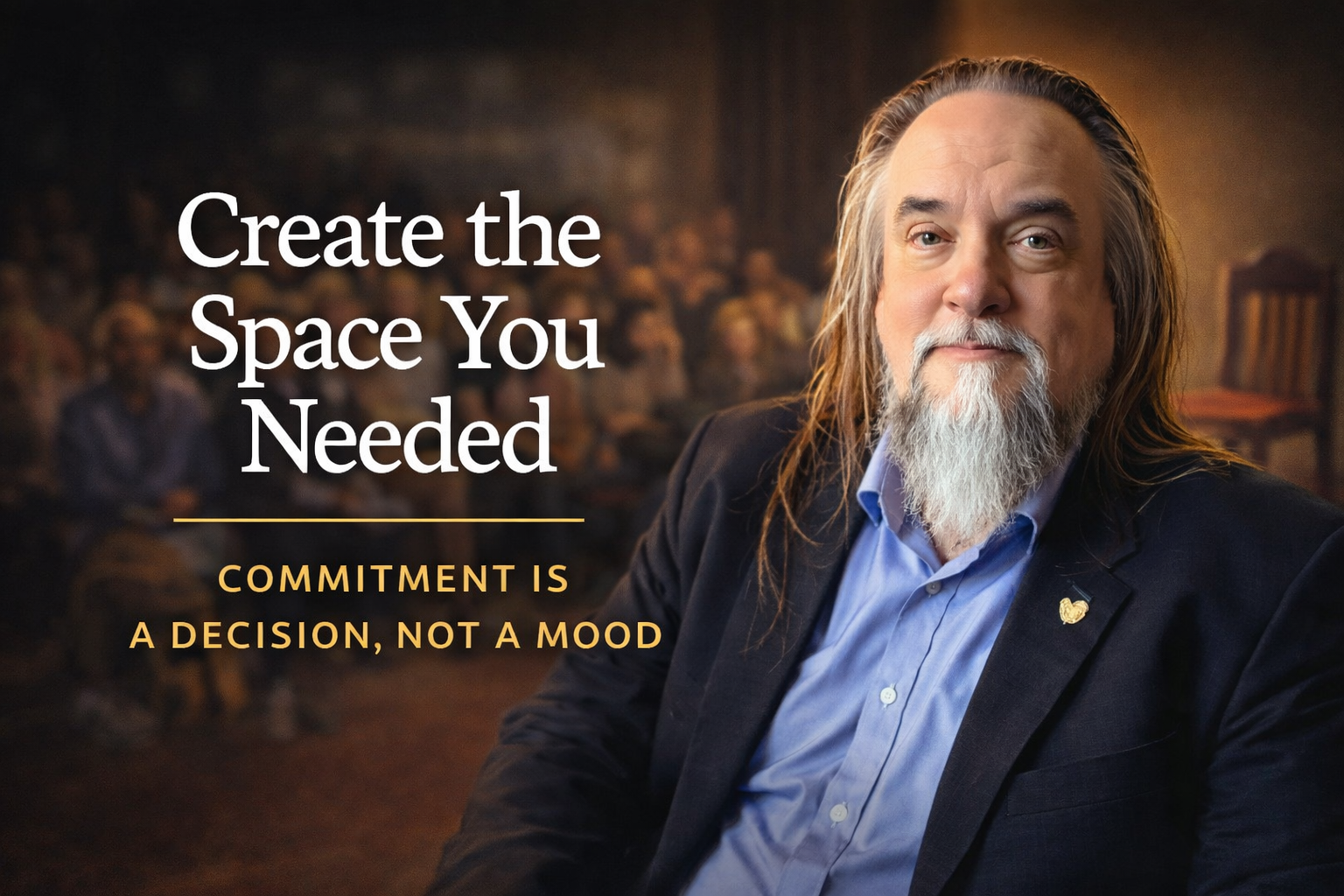

Create the Space You Need
There is a moment, if you stay in the work long enough, when you begin to recognize a quiet absence. Not a dramatic lack, not the kind that announces itself with frustration or anger, but something subtler. A missing room. A missing tone. A missing kind of attention. You feel it when you watch others perform, when you sit through talks that almost land but don’t quite hold, when you scroll past content that is technically competent but spiritually thin. And if you’re honest, you realize that what you’re noticing is not just what’s missing out there. It’s what you needed once and could not find.
Most people respond to that absence by waiting. They wait for a better teacher, a clearer system, a more generous room. They assume that somewhere, someone has already built the space they require, and they keep searching for the door. But commitment, real commitment, asks something different of you. It asks you to stop waiting for the space and begin building it.
This is where the work turns from consumption to practice.
As a performer, I’ve learned that the room is never neutral. The way a space is held, the pace of it, the quality of attention within it, all of that is shaped by someone’s decision. Even silence, when it is used well, is a kind of architecture. And so when you step forward to speak, to write, to perform, you are not simply delivering material. You are shaping a room that others will step into, whether you intend to or not.
The question, then, is not whether you are creating a space. It is what kind of space you are creating.
If you needed more patience when you were learning, then build your work in a way that allows people to stay a little longer than is fashionable. If you needed clarity instead of cleverness, then resist the temptation to decorate your ideas and instead make them usable. If you needed permission to be thoughtful in a world that rewards speed, then slow your delivery down until it becomes unmistakable that depth is not an accident, but a choice.
This is not about becoming a savior for your audience. It is about becoming responsible for the room you hold.
And responsibility, in this context, is a form of restraint. It means you do not chase every trend simply because it is loud. It means you do not dilute your voice in order to be more widely palatable. It means you are willing to let some people pass by your work because you are building something that requires a different kind of attention.
There is a quiet courage in that. Not the kind that looks impressive from the outside, but the kind that accumulates over time. The courage to decide that what you needed was not trivial, and that it is worth offering to others, even if it takes longer to be recognized.
In my own work, I’ve come to see that the most meaningful rooms are not the largest. They are the ones where people feel seen in a way they did not expect, where the pace allows for reflection, where the performance or the conversation leaves them with something they can carry, not just something they can applaud. Those rooms do not happen by accident. They are built, piece by piece, through choices that often go unnoticed.
And this is where commitment reveals itself again. Not as a surge of motivation, but as a steady agreement with yourself. You decide the kind of space you are building, and then you keep building it, even on the days when it would be easier to imitate what is already popular.
Over time, something shifts. The space you once needed begins to exist, because you made it. And others, often quietly, begin to find their way into it. Not because you called loudly, but because what you built resonates with something they have also been missing.
If you are paying attention, you will notice them. They are the ones who linger. The ones who return. The ones who do not just consume your work, but engage with it.
Those are your people. And that is your room.
If this way of working feels familiar to something you’ve been circling for a while, then perhaps it is time to stop circling and begin building. There is space at the table for that kind of work, and I suspect you already know what it looks like.


