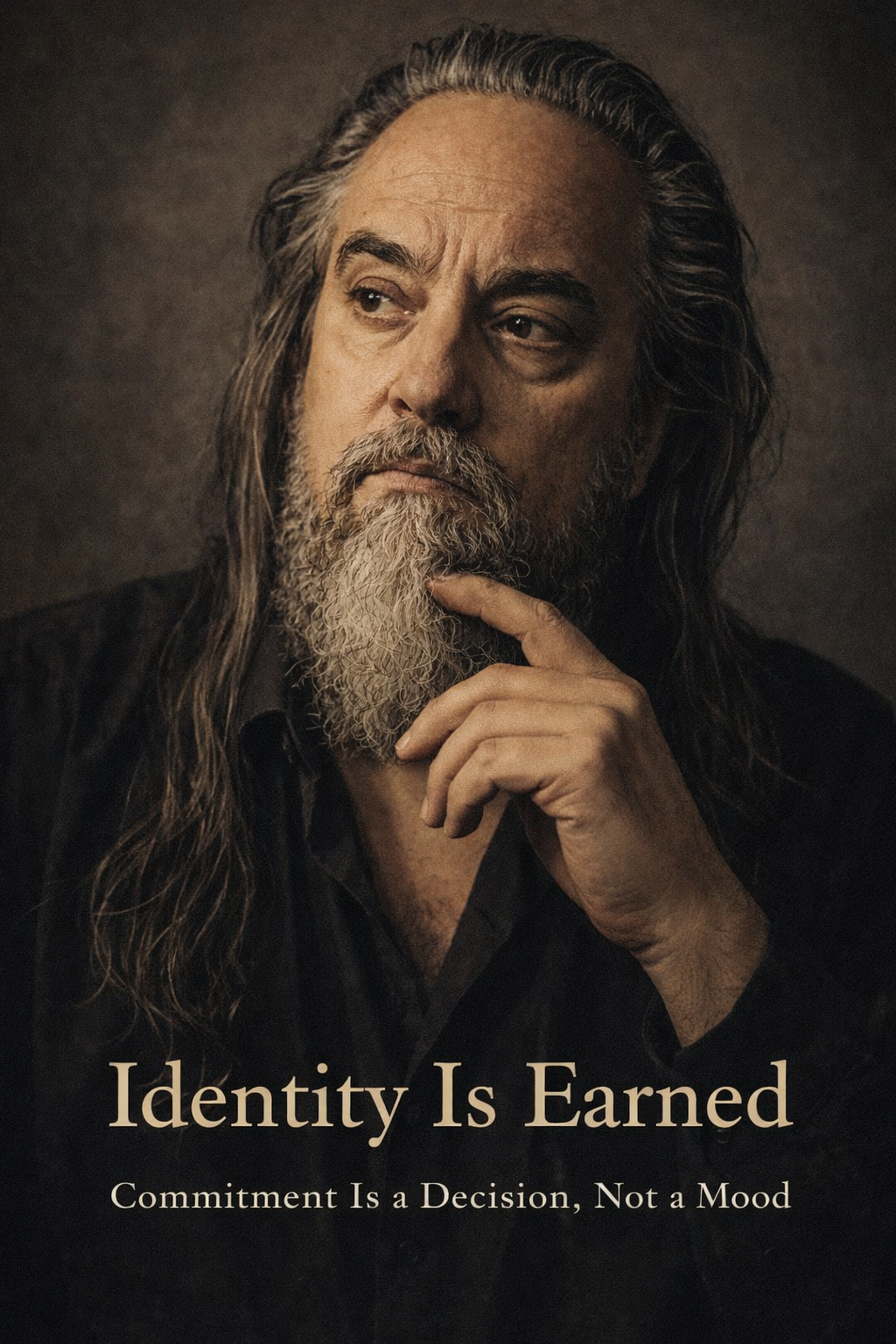

Identity Is Earned
There’s a quiet misunderstanding that shows up in creative circles, and it tends to linger longer than it should. We speak about identity as if it’s something waiting to be uncovered, as though, with enough reflection, we’ll eventually arrive at a clean and settled answer to the question of who we are as artists. It sounds thoughtful, even responsible, but more often than not it keeps us in a kind of holding pattern, circling the work instead of stepping fully into it.
Because identity, at least the kind that holds weight in front of other people, isn’t something you discover. It’s something you build, and more than that, something you earn. Not in a single defining moment, but in a long series of decisions that rarely feel important at the time. It’s in the choice to sit down when you said you would, to keep working on the piece after the initial excitement has worn off, to prepare with care even when no one would notice if you didn’t. None of that feels like identity while you’re doing it. It feels ordinary. Some days, it feels like a bit of a grind.
And yet, that’s exactly where it begins.
Over time, those small decisions start to accumulate. They leave a kind of residue behind, something that lingers in the way you work and, eventually, in the way you show up in front of others. People may not be able to explain it, but they can feel it almost immediately. There is a difference between someone who is trying to sound like themselves and someone who actually does. That difference is paid for, quietly, over time, in the moments where you chose to stay instead of drift, to return instead of wait for inspiration, to favor clarity over cleverness.
This is where identity takes shape, not as a declaration, but as a pattern.
We often try to name who we are before we’ve lived it long enough to be true. We say we’re this kind of speaker, or that kind of performer, as if the statement itself will carry weight. But the room is listening for something else entirely. It’s listening for evidence. And evidence doesn’t arrive all at once. It’s built slowly, through repetition, through restraint, through the willingness to do the same meaningful things often enough that they begin to belong to you.
This is why commitment matters so much, and why it has to be understood as a decision rather than a mood. The feeling of commitment comes and goes. It’s influenced by energy, by circumstance, by how the day happens to be unfolding. The decision, on the other hand, is something steadier. It’s the quiet agreement you make with yourself to return, again and again, whether or not it feels convenient or inspired in the moment.
When that decision is kept over time, something shifts in a very practical way. You begin to trust yourself. Not in a loud or performative sense, but in the simple knowledge that you will do what you said you would do. You know you’ll show up prepared. You know you’re not depending on a good mood to carry you through. And that kind of trust changes how you carry yourself. It softens the need to impress, quiets the urge to push too hard, and allows you to speak more plainly, which often lands with far more power.
Identity, then, is not what you announce. It’s what you can sustain. It’s what remains after the mood passes, after the novelty fades, after the audience has gone home. It is the sum of your repeated decisions, visible to others whether you call attention to them or not. And it’s available to anyone willing to pay for it, not with talent or ambition, but with consistency.
That part rarely gets celebrated. There’s nothing particularly flashy about returning to the same work, the same table, the same practice long after it stops feeling new. But that is where the work deepens. That is where your voice stops shifting to match the room and begins, almost quietly, to shape it instead.
If you’re feeling undefined in your work, it may not be a lack of clarity. It may simply be that the decision hasn’t been kept long enough yet. Stay with it. Let it build. And if you’d like a place to do that kind of work, in a way that’s steady and grounded, you don’t have to do it alone. We can sit with it together, as always, across the table.


