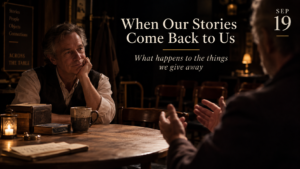
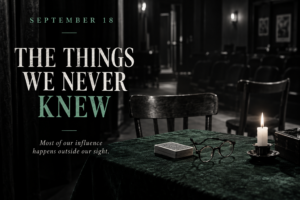
“For a storyteller
Every table is a stage
Every chair an invitation” ~ hannibal
The Table is Sacred.
It is more than a piece of furniture, more than wood and nails, more than the arrangement of flat surface and four legs. The table is where things happen. It is where bread is broken, where secrets are whispered, where love letters are read, where contracts are signed, and where spirits are summoned.
For centuries, the table has been a place of gathering — kings and peasants alike have leaned elbows on wood and looked across at someone else, hoping to be seen, hoping to be heard, hoping to connect.
It should not surprise you then, that when I imagined my life as a performer, storyteller, magician, and apparitionist, the table became central to my work. But here is a detail that matters: I do not sit beside my audience. I do not tower above them. I do not place them behind a barrier of velvet rope or stage lights.
I sit across the table.
Today, I want to tell you why.
The Geometry of Trust
Imagine two chairs pulled up to the same table. Not side by side, not angled toward a stage, but face to face. Across from one another. This is geometry with consequence.
Across the table, there is nowhere to hide. You can look into my eyes, and I can look into yours. Every flicker of an eyebrow, every nervous shuffle of cards in my hands, every catch of your breath when I pause in silence, it’s all visible. This is not a mere trick; this is intimacy.
When you sit across from someone, you cannot pretend to be disinterested. The plateau demands your attention. It is a contract: “I will meet your gaze if you will meet mine.”
In a séance, this geometry becomes even more potent. The spirits we pretend to summon are given weight by the sincerity of that gaze. When I tell you a story of a departed voice, or when the candle flickers at the precise moment of invocation, the meaning is magnified because we are across from one another.
Across the table, we are co-conspirators. We agree to believe together.
A Childhood of Tables
When I was young, the table was where I first learned the weight of silence. My family gathered at the dinner table, and not always in harmony. There were nights when the only sound was the scrape of fork against plate. Other nights, laughter bubbled up like champagne, spilling into stories that grew larger in the telling.
I learned early that tables hold both silence and song.
I also learned that stories told across the table are not the same as stories told from a stage; or a TV screen, or a pulpit. At the table, you could be interrupted. You could be challenged. Someone could call your bluff. So you learned to listen as much as you learned to speak.
This listening, this rhythmic back and forth, is the seed of every séance I lead, every magic trick I perform, every story I tell.
The table taught me that performance is not a monologue. It is dialogue. A sacred sharing.
The Magician’s Dilemma
Many magicians stand above their audiences. They perform on raised platforms, hiding behind the shield of distance. This has its advantages: grandeur, scale, the illusion of command. But I have always felt that something essential is lost in that arrangement.
Magic, when stripped bare, is about astonishment. It is about creating a moment that ruptures reality just long enough for wonder to slip through. But astonishment does not thrive at a distance. It thrives in closeness, where you can swear you saw everything and yet still cannot explain it.
Across the table, the miracle feels personal. The card was shuffled by your own hands, not mine. The coin was placed in your palm, and yet it vanished. The ghostly rapping sound was heard under your chair, not in some darkened corner of the room.
I do not want my audience to feel like spectators. I want them to feel like participants. Friends, even. Sitting across the table is the simplest, oldest way to ensure that.
The Séance as Supper
My nightly séance at the Stanley Hotel is, in essence, a dinner without food. We gather around a table. The lights are dimmed. Candles flicker like the afterglow of a half-forgotten feast. Instead of wine, I pour stories. Instead of a meal, I serve mysteries.
This arrangement is no accident. The séance borrows its form from supper because supper is the most familiar ritual of gathering.
Think of it: when families reunite, they do not meet in a field or an amphitheater. They meet at a table. When lovers long separated finally find each other, they share a moment across a table. When treaties are signed, when friendships are rekindled, when birthdays are celebrated, the table is the anchor.
By placing my audience at the table, I invite them not just to witness, but to belong.
The First Chair
But why the first chair? Why across the table, rather than beside or behind?
Because across the table is where confession happens.
Think of the last time you sat across from someone and revealed something true. A fear. A dream. A heartbreak. The across-the-table posture is the one we choose when we are willing to risk vulnerability. It is the shape of confession and the shape of counsel.
In my work, I am constantly asking for confession. When I invite someone to choose a card, I am also inviting them to admit curiosity. When I ask someone to hold my hand in the darkened séance, I am asking them to confess belief — or at least the desire for belief.
To ask for confession, I must first model it. Sitting across the table, I offer my own vulnerability: here I am, without curtain or stagecraft to shield me. Just my voice, my hands, my stories.
I take the first chair because I want to make it safe for you to take yours.
The Ghosts We Share
Across the table, something remarkable happens: the ghosts become ours.
When a candle sputters at the precise moment I invoke a name, you and I lock eyes across the table. The unspoken question hangs in the air: Did you see that too?
It no longer matters whether the candle was rigged or whether the draft came from the hallway. What matters is that we experienced it together. You lean in, I lean in, and suddenly we are not strangers. We are companions in mystery.
The séance does not work without this shared ownership. I am not the priest dispensing miracles from on high. I am the dinner guest, sitting across from you, breaking mystery instead of bread.
The Table as Stage, the Table as Altar
Some performers resist the table because it feels small, confined, ordinary. They prefer prosceniums, curtains, spotlights. But I believe the table is both stage and altar.
As a stage, it focuses attention. The cards, the candles, the objects of mystery all rest in plain sight. There is no scenery to distract, no trapdoor to suspect. The table is honest.
As an altar, it sanctifies the act. The very placement of hands upon wood, the shared leaning forward, the circle of light in a surrounding dark, all of it creates a ritual space.
The table says: “Something important will happen here.”
And so it does.
Why I Chose This Path
There are easier ways to be a performer. There are flashier ways to be a magician. There are safer ways to be a storyteller.
But I chose the table, and I chose the first chair across from you, because I am less interested in spectacle than I am in connection.
The world has enough noise. It has enough flashing lights and booming sound effects. What it starves for is presence; two human beings seeing each other clearly, without distraction, without armor.
When you sit across from me at the séance, or at a magic show, or even in the pages of a story, my hope is that you feel seen. My hope is that you leave the table not only astonished, but also reminded that intimacy is still possible in a noisy world.
Across the Table
This is why I named my first book Across the Table. It is not simply a clever phrase. It is a philosophy.
To be across the table is to commit to closeness. To commit to honesty. To commit to the possibility of wonder shared between equals.
When you sit across the table from me, you are not an audience member. You are my partner in mystery, my co-author in story, my companion in the oldest ritual we know.
The table is set. The candle is lit. The first chair is waiting.
Please … take a seat.
h